

Realtor fees are one of the biggest costs in any Colorado real estate transaction, yet most buyers and sellers accept the first number they hear without question. On a $600,000 home, the difference between a 5% and a 6% commission is $6,000 straight out of your pocket. Commissions remain relatively steady for many buyers, but negotiation options and discount models are expanding fast, which means the sellers and buyers who do their homework stand to keep significantly more money at closing. This guide walks you through exactly how to prepare, negotiate, and verify fee agreements in Colorado's evolving real estate market.
Table of Contents
- Understanding realtor fees in Colorado
- What to prepare before negotiations
- Step-by-step guide to negotiating realtor fees
- Common pitfalls and smart verification
- The reality of negotiating Colorado realtor fees: More options but more work
- Next steps: Tools and partners for saving on realtor fees
- Frequently asked questions
Key Takeaways
| Point | Details |
|---|---|
| Know the averages | Most Colorado realtor fees land between 5% and 6%, typically paid by the seller. |
| Preparation matters | Bring solid market data and compare multiple agents to boost negotiating leverage. |
| Options are growing | Discount brokers and fee rebates provide more ways to save than ever before. |
| Everything negotiable | From percentage to flat fees, terms can often be tailored—always get them in writing. |
Understanding realtor fees in Colorado
Before you can negotiate anything, you need to know what you're negotiating. In Colorado, the traditional realtor fee runs between 5% and 6% of the home's sale price, typically split between the listing agent and the buyer's agent. On a $550,000 property, that means $27,500 to $33,000 in commissions alone. These aren't fixed by law; they're negotiable business agreements.

For a long time, the seller paid both sides. The listing agent and buyer's agent divided a shared commission, and buyers rarely thought about it. That model is shifting. The Colorado realtor fee breakdown is no longer one-size-fits-all. Sellers still often cover the buyer's agent fee to attract the widest pool of offers, but buyers are increasingly negotiating their own agent compensation separately.
Key factors that influence realtor fees in Colorado include:
- Home price: Higher-priced homes often allow more room to negotiate a lower percentage because the total dollar amount is still substantial for the agent.
- Market conditions: In a hot seller's market, agents may hold firmer on rates. In a slower market, they may be more flexible.
- Agent experience and services offered: Full-service agents with strong track records command higher fees than newer agents or limited-service brokers.
- Transaction complexity: Investment properties, land sales, and unique rural properties often carry different fee structures than a standard residential sale.
| Transaction type | Typical total commission | Notes |
|---|---|---|
| Standard residential sale | 5% to 6% | Split between two agents |
| Discount brokerage listing | 1% to 3% | Reduced listing side only |
| Flat-fee MLS listing | $300 to $1,500 fixed | Seller handles buyer agent fee separately |
| Dual agency | 4% to 5% | One agent represents both sides |
Understanding selling your Colorado home for less is easier when you know which fee category your transaction falls into before you start talking numbers with any agent.
Statistic to know: On Colorado's median home price of roughly $535,000 in early 2026, a single percentage point reduction in commission saves the seller approximately $5,350. That's real money.
What to prepare before negotiations
Knowing fee basics, see how you can prepare to strengthen your position before the negotiation even begins. Walking into a conversation about commission without data is like negotiating a car purchase without knowing the invoice price. You give away leverage before the conversation even starts.
Here's what to gather before you sit down with any agent:
- Recent comparable sales data. Pull sold listings in your neighborhood from the past 90 days. Know your home's likely price range before you discuss percentage fees. The higher your sale price, the more a 0.5% reduction is worth.
- A list of at least three agents or brokerages you've interviewed. Competition is your biggest negotiating tool. Agents know you have options, and that knowledge alone can move the needle on fees.
- Written quotes from discount brokerages. There are more discount and FSBO options available today than ever before. Having a flat-fee quote in hand gives you a concrete alternative to reference.
- Your home's unique selling advantages. A well-maintained home in a fast-moving neighborhood requires less agent effort to sell. Use that to make the case for a reduced listing fee.
- Knowledge of what each agent's services actually include. Marketing budgets, professional photography, open houses, staging consultation, and negotiation support vary widely. Compare apples to apples before comparing costs.
| Negotiation factor | Strengthens your position | Weakens your position |
|---|---|---|
| Multiple agent quotes | Yes | No |
| Hot seller's market | Somewhat | No |
| Strong home condition | Yes | No |
| Urgency to sell quickly | No | Yes |
| Knowledge of discount models | Yes | No |
Pro Tip: Use a real estate savings checklist before your first agent interview to make sure you haven't left anything on the table. Most sellers skip this step entirely.
Finding discount Colorado agents is more straightforward than it used to be, and simply knowing these alternatives exist puts you in a stronger position when talking to any full-commission agent.
Step-by-step guide to negotiating realtor fees
Preparation leads right into the negotiation itself. Here's how to put your research and strategy to work in a direct, confident conversation.
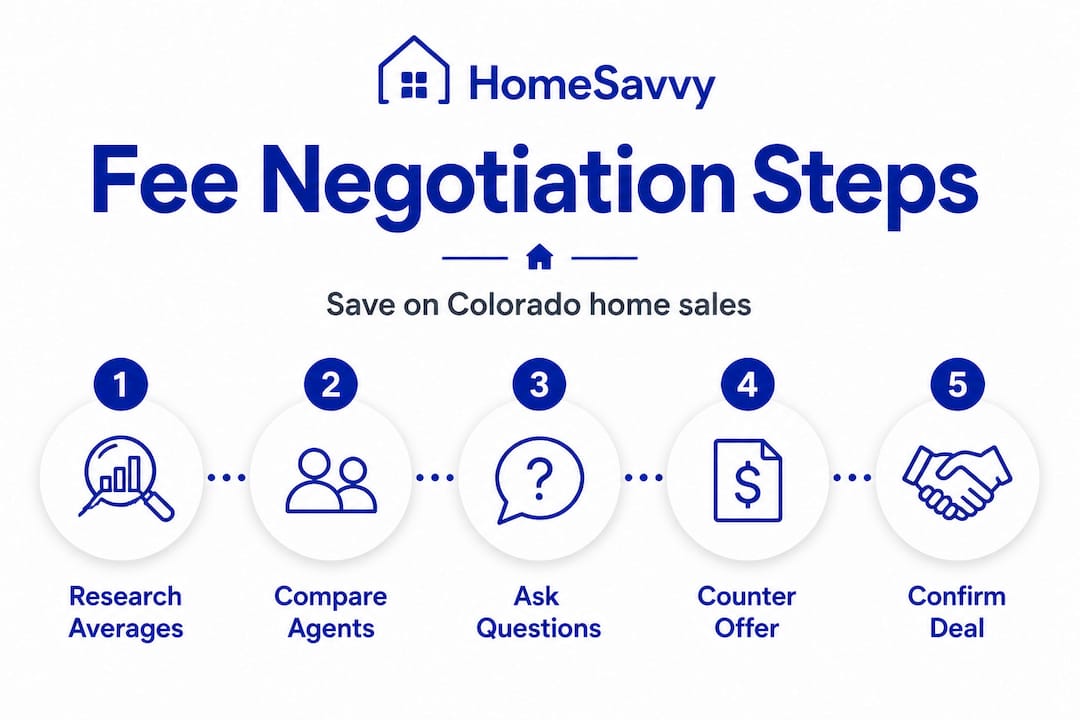
1. Open with curiosity, not confrontation. Start by asking what the agent typically charges and what that fee includes. Don't lead with "I want a lower rate." Let them explain their value first. Once you understand their pitch, you can respond with specifics.
2. Reference your market research. Say something like: "I've spoken with a few brokerages and received quotes in the 4% to 5% range with full-service support. What flexibility do you have?" This is a fact-based approach, not an attack on their value.
3. Propose specific alternatives. Don't just ask for "less." Offer a structure:
- A percentage reduction (for example, 4.5% instead of 5.5%)
- A flat listing fee
- A performance-based bonus if the home sells above a target price
- A reduced rate in exchange for an extended listing period
4. Ask about buyer's agent rebates if you're purchasing. Buyers often don't realize this is an option. Commission rebates allow buyers to receive a portion of the buyer's agent commission back at closing. Colorado allows this practice, and it can mean $3,000 to $8,000 back in your pocket on a mid-range purchase.
5. Address dual agency situations carefully. If one agent is representing both buyer and seller, they're earning both sides of the commission. That's a strong argument for asking for a lower combined rate. Don't accept a dual agency arrangement without negotiating a meaningful fee reduction.
"Some sources say commissions are steady, but the reality is that real negotiation power exists today. Buyers and sellers who ask, who compare, and who use discount alternatives consistently outperform those who accept the first number they're given."
6. Understand the duties your buyer's agent owes you. In Colorado, buyer's agents have fiduciary duties. Knowing what they're legally required to do versus what's optional helps you evaluate whether a higher fee is actually justified by the services they're providing.
Pro Tip: Ask every agent this question before signing: "If I bring you a buyer directly, what would your total commission be?" The answer tells you a lot about how flexible they're willing to be and how they think about their own fee structure.
Common pitfalls and smart verification
Even armed with tactics, it's easy to misstep. Here's how to avoid the most common negotiation traps and confirm your outcomes before and after closing.
Mistakes that cost Colorado buyers and sellers money:
- Negotiating verbally and assuming it's settled. Nothing is agreed until it's in writing. Verbal promises about fees disappear fast.
- Focusing only on the listing fee and ignoring the buyer's agent side. Even though sellers often cover the buyer's agent fee to attract competitive offers, that doesn't mean you can't negotiate what you're offering on that side as well.
- Assuming the agent won't budge. Many Colorado agents will adjust their rate for a well-prepared client, particularly in slower markets or for higher-priced transactions where the dollar amount is significant even at a lower percentage.
- Signing a listing agreement without reading the commission clause. The commission amount, who pays it, and under what circumstances it's owed are all spelled out in the listing contract. Read every line.
- Not checking your closing disclosure. Your final closing disclosure shows you exactly what fees were paid and to whom. Cross-reference it against your signed agreement before you sign off.
Verification step: At least two weeks before closing, ask your agent and your title company for a preliminary closing disclosure. If anything doesn't match your negotiated agreement, you have time to correct it. Don't wait until the day of closing to review fee line items.
Smart sellers also review strategies to sell for less during their planning phase, not after they've signed a listing agreement. Timing is everything here.
What to confirm in writing before you sign anything:
- Total commission percentage and dollar equivalent at the expected sale price
- How the fee is split between listing and buyer's agents
- Any rebates or credits being offered to the buyer
- Conditions under which commission is owed (cancellations, expired listings)
- Whether the agent is operating under dual agency and what that means for your fee
The reality of negotiating Colorado realtor fees: More options but more work
Here's the honest take on what fee negotiation actually looks like in practice. The landscape has changed significantly over the past few years, and the options available to Colorado buyers and sellers are genuinely better than they were even three years ago. But improved options don't automatically translate into savings unless you actively pursue them.
Expert views are split on whether fee compression is happening broadly or only for buyers who specifically seek out discount models. Both perspectives are correct in their own context. Sellers who list with traditional full-commission agents and never ask about alternatives are, in fact, not seeing lower fees. Sellers who interview multiple agents, reference discount alternatives, and negotiate specifically do see meaningful savings.
The uncomfortable truth is that the real estate industry doesn't automatically reward passivity. An agent who earns $15,000 in commission on a single transaction has little financial incentive to bring up the possibility of charging you $10,000 instead. That doesn't make them dishonest. It just means the responsibility of initiating that conversation falls on you.
We see this regularly in Colorado closings. The clients who save more on home sales are almost always the ones who did three specific things: they interviewed multiple agents, they understood what discount alternatives existed, and they asked specific fee questions before signing anything. The clients who don't tend to pay full commission and never think twice about it.
There's also a real trade-off worth considering. Some discount models offer less marketing support, fewer open houses, or reduced negotiation assistance. The savings are real, but so are the service differences. The ideal outcome is finding an agent or platform that delivers strong support at a reduced rate, rather than sacrificing service quality just to save a point on commission. That balance is achievable in Colorado's current market. You just have to look for it.
Next steps: Tools and partners for saving on realtor fees
Knowing the strategy is one thing. Having the right tools to execute it is another. HomeSavvy Colorado was built specifically to give buyers and sellers the information and options they need to stop paying more than necessary on real estate transactions.

Whether you're buying or selling, our platform makes it straightforward to access commission rebates explained in plain language, compare discount agents, and run real numbers on your potential savings before you commit to any agent or brokerage. If you're selling, our 1% listing option pairs full-service support with a dramatically reduced listing fee. For buyers, our rebate program puts thousands back in your pocket at closing. Use our savings calculator to see exactly what your transaction could look like with smarter fee management. The numbers might surprise you.
Frequently asked questions
What is the average realtor fee percentage in Colorado?
Most Colorado realtors charge between 5% and 6% of the sale price, typically split between the listing agent and the buyer's agent. Negotiated and discount arrangements can bring that total significantly lower.
Can you negotiate a flat fee instead of a percentage with a Colorado realtor?
Yes, some agents and brokerages offer flat-fee listing services as an alternative to traditional percentage commissions. This works especially well for sellers comfortable managing some parts of the process themselves.
Do sellers always have to pay the buyer's agent fee in Colorado?
Sellers typically do pay the buyer's agent fee because covering that cost attracts more offers, but fee responsibilities can be negotiated based on market conditions and how motivated a buyer is to make a deal work.
How can I find a discount agent in Colorado?
Research discount brokerages directly online or use platforms like HomeSavvy Colorado that offer side-by-side comparison tools and rebate programs. Discount agent options are expanding rapidly for both buyers and sellers across the state.
What documents should I get in writing when negotiating realtor fees?
Ensure all agreements on commission amounts, fee responsibilities, and any rebates are clearly spelled out in your listing contract or buyer representation agreement. Never rely on a verbal promise when it comes to how much money changes hands at closing.