

Most Colorado homebuyers assume the agent showing them houses at an open house is on their side. The reality is more complicated. Without a written buyer agreement in place, that friendly agent may legally owe more loyalty to the seller than to you. Understanding the difference between genuine buyer representation and neutral facilitation is not just a legal technicality. It directly shapes your negotiating position, your costs, and your protection throughout one of the largest financial decisions of your life.
Table of Contents
- Understanding the buyer's agent: roles and responsibilities
- The importance of written agreements and agency relationships
- Buyer's agent compensation: who pays and recent changes
- Cost-effective strategies for homebuyers in Colorado
- The unconventional truth about buyer's agents in Colorado
- Explore Colorado's cost-saving real estate options
- Frequently asked questions
Key Takeaways
| Point | Details |
|---|---|
| Buyer’s agent advocates for you | A buyer’s agent owes legal and fiduciary duties to represent your interests in Colorado. |
| Written agreements clarify roles | Formal agreements protect your rights and spell out compensation and duties. |
| Compensation is now negotiable | Recent changes mean buyer’s agent fees and payment terms must be discussed and agreed up front. |
| Negotiation saves money | Smart buyers can target listings with seller-covered fees or negotiate lower costs for agent services. |
Understanding the buyer's agent: roles and responsibilities
Not every real estate agent who works with a buyer is actually representing that buyer. Colorado recognizes several distinct agency relationships, and the differences carry serious legal weight.
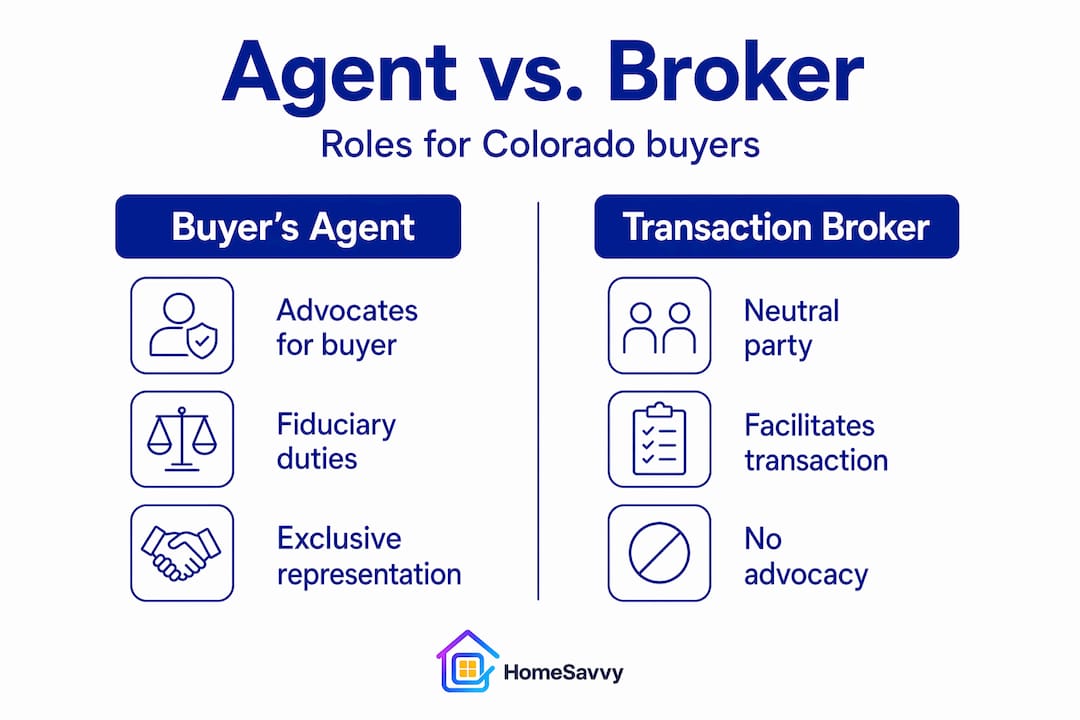
Buyer's agent: A buyer's agent is hired specifically to advocate for the buyer's interests. This agent owes you fiduciary-style duties, which means they are legally bound to act in your best interest, not the seller's. This includes searching for properties that match your needs, advising you on offer strategy, negotiating price and terms on your behalf, and disclosing any information that could affect your decision.
Transaction broker: This is a common arrangement in Colorado that surprises many buyers. A transaction broker assists both parties in completing a transaction without representing or advocating for either one. They are neutral facilitators. They can help with paperwork, coordinate inspections, and guide the process, but they are not obligated to fight for your best deal the way a dedicated buyer's agent would.
Seller's agent: This agent represents the seller exclusively. If you walk into a listing agent's open house and start chatting about your budget and timeline without a buyer's agent in place, that information may legally flow back to the seller.
Here is a quick breakdown of the core differences:
- Buyer's agent: Represents you, advocates for your interests, owes you loyalty and full disclosure
- Transaction broker: Neutral third party, assists with the transaction but does not advocate for either side
- Seller's agent: Represents the seller, has a fiduciary duty to the seller, not you
"A buyer's agent owes advocacy and fiduciary-style duties to the buyer, while a transaction broker is generally a more neutral facilitator rather than the buyer's representative." This distinction matters enormously in negotiation, inspection, and pricing conversations.
The key lesson here is that your buyer agent duties are only activated once you have a formal relationship in place. Casual conversations at showings or open houses do not create that relationship automatically. This is why written agreements are not a bureaucratic formality. They are your foundation for real protection.
If you want a complete picture of how agents operate across both buying and selling transactions in Colorado, the full-service realtor guide breaks down what full representation looks like at every stage.
The importance of written agreements and agency relationships
Once you understand the different roles, the next question becomes: how do you formally establish which type of relationship you have? The answer is a written buyer agreement, and its importance has grown significantly in recent years.
A written buyer agreement is a contract between you and your agent that spells out exactly what they will do for you, how long the relationship lasts, what geographic area it covers, how they will be compensated, and how either party can exit the arrangement. Without this document, you may assume you have dedicated advocacy when you actually have something much more limited.

The NAR's consumer guide on written buyer agreements confirms that these agreements help ensure clarity about roles and responsibilities, and they make it explicit that compensation is negotiable, not automatic. This is a significant shift from the old model where buyers rarely saw or signed anything before an agent started showing them homes.
Here is what a well-drafted written buyer agreement typically covers:
| Agreement element | What it defines |
|---|---|
| Scope of services | What properties, tasks, and timelines are included |
| Compensation structure | Whether the fee is a percentage, flat rate, or hourly |
| Duration | How long the agreement is active |
| Geographic area | Which markets or neighborhoods are covered |
| Exit provisions | How either party ends the relationship |
| Duty level | Whether this is full buyer's agency or transaction brokerage |
Compensation structures vary more than most buyers realize. Some agents charge a percentage of the purchase price (commonly 2% to 3%), others work for a flat fee per transaction, and some offer hourly arrangements for more limited advisory roles. Each structure has tradeoffs. A percentage-based fee aligns the agent's incentive with a successful close, but it also means their pay rises as your purchase price rises. A flat fee can save you money on higher-priced homes but may not cover extensive negotiation work.
Pro Tip: Before signing any buyer agreement, ask specifically whether the compensation amount is a ceiling or a floor. Some agents will accept a seller's offer of compensation and apply any excess toward your costs. Others will keep it. Getting this spelled out in writing is the difference between a vague promise and an enforceable term.
Understanding how to approach negotiating realtor fees before you sit down with an agent gives you real leverage in this conversation.
Buyer's agent compensation: who pays and recent changes
For decades, the standard assumption in American real estate was simple: the seller pays both agents. The seller's agent and the buyer's agent split a commission that came out of the sale proceeds, and buyers never saw a separate bill. That model has shifted, and Colorado buyers need to understand exactly where things stand now.
Bankrate explains that while seller-paid compensation was the historical norm, the NAR settlement has changed how these arrangements work. Buyers may now be asked to sign a contract that clearly spells out how their agent will be paid, and whether the seller is willing to cover that cost is now a negotiation point rather than a guarantee.
Here is how the landscape looks now versus before:
| Factor | Before NAR settlement | After NAR settlement |
|---|---|---|
| Who typically paid buyer's agent | Seller, through listing commission split | Negotiable, may be buyer or seller |
| Written buyer agreement required | Rarely required upfront | Increasingly standard |
| Buyer visibility into fees | Often minimal | Required to be disclosed upfront |
| Compensation negotiability | Assumed to be fixed | Explicitly negotiable |
For Colorado buyers, here is the practical sequence to follow:
- Ask about fee structure before signing anything. Know whether your agent charges a percentage, a flat fee, or an hourly rate, and what services each option includes.
- Discuss seller concessions early. When evaluating a property, ask your agent whether the seller is likely to offer buyer's agent compensation as part of the deal.
- Factor agent costs into your offer strategy. If a seller is unlikely to cover your agent's fee, you may want to account for that in your offer price or request a seller concession.
- Review the written agreement for payment caps. Some agreements cap the buyer's out-of-pocket exposure if the seller's concession falls short.
- Negotiate the fee directly. Many buyers do not realize this is possible. If an agent's standard rate feels high relative to the services offered, say so and ask what flexibility exists.
Our real estate commission guide walks through Colorado-specific commission structures in detail, and the Colorado fee overview gives you the numbers in plain language so you can benchmark any agreement you receive.
Cost-effective strategies for homebuyers in Colorado
Knowing how compensation works is one thing. Using that knowledge to reduce your costs is another. Colorado's real estate market rewards buyers who do their homework before committing to any agent arrangement.
Here are the most effective strategies for keeping your costs low while still getting strong representation:
- Request full fee transparency in writing. Ask your agent to put their compensation structure in a document before you tour a single property. This is not aggressive. It is standard practice after recent rule changes, and any good agent will accommodate it.
- Target listings where seller compensation is explicit. Some listings will clearly state that the seller is offering buyer's agent compensation. Prioritizing these listings when your options are otherwise comparable can simplify your transaction economics considerably.
- Compare service tiers before committing. Full-service representation is not always necessary for every buyer. If you are experienced, buying in a market you know well, or purchasing a straightforward property, a more limited representation arrangement may serve you just as well at lower cost.
- Look for commission rebate programs. Some Colorado real estate platforms offer buyers a portion of the commission back at closing. On a $600,000 purchase, even a 1% rebate returns $6,000 to your pocket. That is real money worth asking about.
- Ask how your agent handles dual agency scenarios. If your agent also represents the seller on a property you want to buy, the dynamic changes. Understanding that scenario in advance prevents surprises.
Pro Tip: When evaluating buyer's agents, ask them directly: "If the seller offers more compensation than your agreed fee, what happens to the difference?" The answer tells you a lot about how that agent values your interests versus their own income.
Both Bankrate and NAR confirm that compensation terms are part of the negotiated agreement, not industry mandates. That means you have more power in this conversation than most buyers realize.
For a deeper look at how to structure these conversations, our guides on fee negotiation strategies and discount real estate agents cover the specific approaches that work in Colorado's market. And if you are also selling a home, explore how to lower seller costs to reduce your total transaction expense on both sides.
The unconventional truth about buyer's agents in Colorado
Here is something most real estate articles will not tell you plainly: the written buyer agreement is not just paperwork. It is the moment the agent's legal duty to you actually switches on.
Before that agreement exists, you can tour homes, ask questions, and receive advice, and none of it may create formal buyer advocacy. NAR's consumer guidance is explicit that written agreements provide the clarity most buyers assume they already have. Yet most buyers still delay signing anything until they are emotionally invested in a property and far less willing to push back on terms.
That is the real problem. By the time you are standing in the kitchen of your dream home, your negotiating leverage over your agent's fee has largely evaporated. The time to establish clear representation terms, discuss compensation structure, and ask hard questions is before you fall in love with a listing.
We have seen buyers discover mid-transaction that the agent they trusted was technically operating as a transaction broker, not a buyer's agent. That means their agent had no obligation to disclose a known issue with the property, advise against an over-market offer, or push for repair concessions after an inspection. These are not edge cases. They happen regularly in Colorado because buyers assume representation without confirming it.
The buyers who consistently get the best outcomes are not the ones with the biggest down payments or the sharpest negotiating instincts. They are the ones who read their agreements carefully, ask what type of agency relationship applies, and engage an agent who can clearly explain the buyer duties they are committing to before the first showing.
Cost savings and strong representation are not mutually exclusive in Colorado. But they only happen together when you initiate the conversation early and put everything in writing.
Explore Colorado's cost-saving real estate options
Understanding buyer's agent roles and fee structures is a great foundation. Acting on that knowledge is what actually saves you money.

At HomeSavvy Colorado, we combine AI-powered property data with full-service agent support so you can make smarter, more cost-effective decisions at every step. Buyers who work with us receive meaningful commission rebates at closing, reducing your out-of-pocket costs without sacrificing dedicated representation. Use our savings calculator to see exactly how much you could keep based on your target purchase price. And before you make an offer, run the numbers on any Colorado property with PropertyIQ, our real-time home valuation tool that gives you the data you need to negotiate with confidence.
Frequently asked questions
Do I need a written agreement to work with a buyer's agent in Colorado?
Written agreements are strongly recommended and are becoming standard after recent changes. NAR's consumer guide confirms they clarify both roles and compensation, giving you enforceable protections throughout the process.
Who typically pays a buyer's agent in Colorado?
Historically, sellers covered buyer's agent commissions, but that is no longer guaranteed. As Bankrate notes, buyers should now expect to negotiate payment terms directly with their agent before touring homes.
What is the difference between a buyer's agent and a transaction broker?
A buyer's agent exclusively advocates for the buyer and owes fiduciary-style duties. A transaction broker acts as a neutral facilitator with no special duty to represent either party in the deal.
How can Colorado homebuyers save money when hiring a buyer's agent?
Get the fee structure in writing before you start touring properties, target listings where seller compensation is offered, and negotiate directly on rate and scope. Bankrate's guidance reinforces that every compensation term is negotiable, not fixed.