

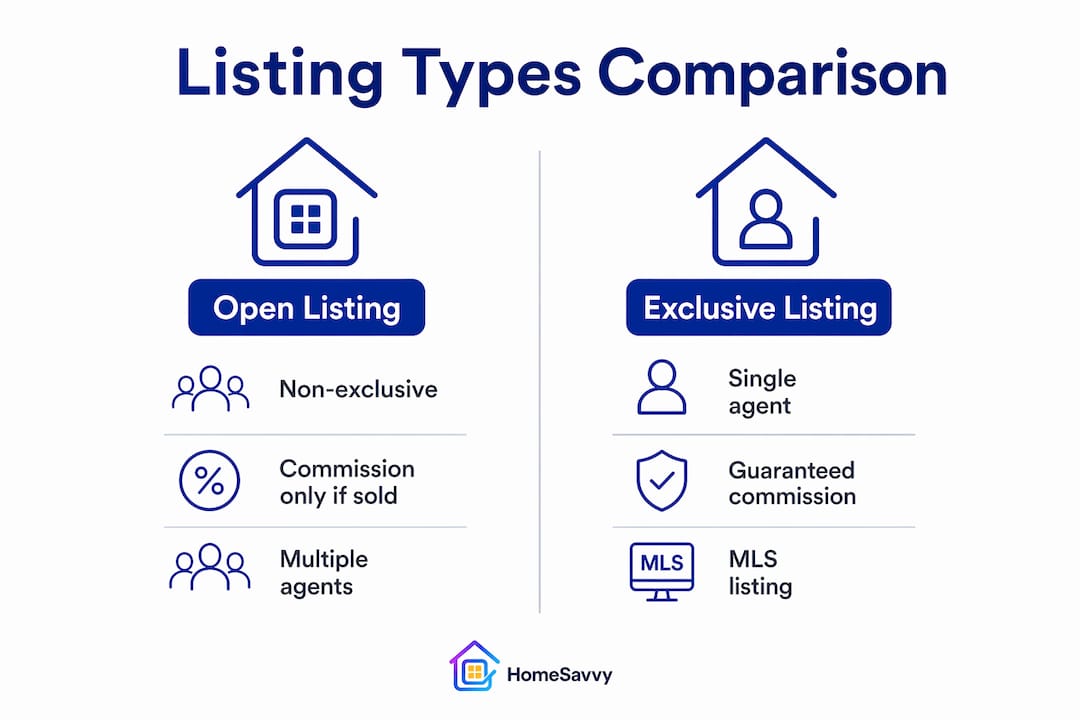
An open listing is a non-exclusive listing agreement where a seller can work with multiple agents simultaneously and retains the right to sell the property independently without paying any commission. Commission is paid only to the agent who actually produces the buyer. This structure gives sellers maximum flexibility but comes with real trade-offs that Colorado sellers need to understand before signing anything.
What is defining open listing in real estate?
An open listing, also called a non-exclusive listing agreement, is one of three main types of real estate listings used in residential and commercial transactions. The other two are the exclusive right-to-sell and the exclusive agency listing. Listing agreements differ mainly in exclusivity and commission triggers, which directly shapes how much control a seller keeps and how much effort agents invest.
Under an open listing, no single agent holds exclusive rights to the property. Any licensed broker can bring a buyer, and the one who closes the deal earns the commission. If the seller finds a buyer on their own, no commission is owed to anyone. That last point is the core appeal for sellers who are already fielding buyer interest through their own network.

The open listing definition sounds attractive on paper. In practice, it creates a competitive environment where agents know they may do significant work and earn nothing. That dynamic shapes everything about how open listings actually function in the Colorado market.
How does an open listing work in Colorado real estate?
Open listing agreements follow a clear sequence, but each step carries details that Colorado sellers must get right.
-
Contract formation. The seller signs a separate agreement with each agent they choose to work with. Each contract specifies the commission rate owed if that particular agent produces the buyer. There is no single master agreement covering all agents at once.
-
Agent competition. Multiple brokers market the property independently. Each agent has a financial incentive to find a buyer before any other agent does. This competition can generate activity, but it also means agents may withhold information from each other.
-
Seller marketing. The seller often handles their own marketing in parallel. They may list on social media, hold open houses, or contact buyers directly. The seller coordinates showings with each agent separately, which adds significant time and organizational work.
-
Commission trigger. Commission is paid only to the agent who is the procuring cause of the sale. Disputes often hinge on contract language defining the agent's connection to the buyer. A seller who does not define this term clearly in writing risks paying commission even when they believe they found the buyer themselves.
-
Seller self-sale. If the seller finds the buyer without any agent's involvement, no commission is owed. This is the scenario that makes open listings appealing to sellers who are confident in their own sales ability.
Pro Tip: Always define "procuring cause" explicitly in every open listing contract you sign. Vague language is the single biggest source of commission disputes in open listing transactions.
Colorado sellers should also know that MLS participation rules significantly influence open listing visibility. If an agent cannot submit your listing to the MLS, your property reaches far fewer buyers. Confirm MLS access before agreeing to any open listing arrangement.
What are the advantages and downsides of an open listing?
Open listings are rare in residential real estate, and the reasons cut both ways.
Benefits for Colorado sellers
- No commission if you sell yourself. A seller who finds their own buyer pays nothing. For a $600,000 Colorado home, that can mean saving tens of thousands of dollars.
- Multiple agents working the property. More agents theoretically means more buyer exposure across different networks and client pools.
- Full flexibility. The seller can cancel individual agent agreements, add new agents, or sell independently at any time without penalty clauses common in exclusive contracts.
- Useful for commercial or unique properties. Open listings appear more often in commercial real estate, where sellers want broad outreach without locking into one firm.
Downsides sellers must weigh
- Agents invest less effort. Open listings are rare because agents bear full financial risk. No buyer means no commission, so agents prioritize exclusive listings where their investment of time and money is protected.
- Limited MLS access. Most MLS systems in Colorado will not accept open listings, which cuts off the primary channel buyers and buyer's agents use to find properties.
- Heavy seller workload. The operational burden shifts heavily to sellers for showings, feedback, and coordination when multiple agents market the property independently.
- Slower sales. Less agent effort combined with limited MLS exposure typically means longer time on market.
Pro Tip: Open listings work best when you already have a strong buyer lead or a commercial property with niche demand. For standard residential sales in Colorado, an exclusive agency listing often delivers better results with less seller effort.
How does an open listing compare to exclusive listings?
The comparison between open, exclusive right-to-sell, and exclusive agency listings reveals why most Colorado sellers choose exclusive arrangements.
| Feature | Open listing | Exclusive agency | Exclusive right-to-sell |
|---|---|---|---|
| Agent exclusivity | None | One agent, seller can sell independently | One agent, full exclusivity |
| Commission if seller finds buyer | No commission owed | No commission owed | Commission still owed |
| Commission if agent finds buyer | Only to procuring agent | To listing agent | To listing agent |
| MLS inclusion | Rarely accepted | Usually included | Always included |
| Agent marketing effort | Low | Moderate to high | Highest |
| Seller workload | High | Moderate | Low |
The exclusive right-to-sell is the most common listing type in Colorado residential real estate. It gives one agent full exclusivity and guarantees their commission regardless of who finds the buyer. That guarantee motivates agents to invest in professional photography, MLS syndication, and active buyer outreach.
The exclusive agency listing sits between the two. One agent holds the listing, but the seller retains the right to sell independently without paying commission. Agents accept this arrangement more readily than open listings because they still have exclusivity against other brokers.
The open listing sits at the far end of the spectrum. Maximum seller control, minimum agent commitment. Colorado sellers considering an open listing should treat agent participation as uncertain rather than guaranteed.
What are the MLS and legal considerations for open listings in Colorado?
MLS access is the most consequential practical issue for Colorado sellers using open listings.
- NAR policy limits MLS inclusion. NAR's 2025 MLS changes specify that open listings generally lack authority for broker cooperation and compensation, which are the conditions MLS systems require for a listing to be accepted. This is not a technicality. It means most Colorado MLS systems will not publish your open listing at all.
- MLS discretion varies by market. Individual MLS organizations in Colorado retain discretion to accept or reject open listings. A seller in Denver may face different rules than one in Colorado Springs or Fort Collins. Verify the policy with your specific MLS before signing.
- Broker cooperation is absent. Because open listings carry no guaranteed commission for a buyer's agent, cooperating brokers have no financial reason to show the property. This further limits buyer exposure beyond the MLS issue itself.
- Legal disputes over procuring cause. Colorado courts and real estate boards have handled disputes where multiple agents claimed commission on the same sale. Clear written contracts defining procuring cause are the only reliable protection.
- Colorado license law still applies. All agents involved in an open listing must hold a valid Colorado real estate license. The open listing structure does not create any exemption from state licensing or disclosure requirements.
Pro Tip: Before signing an open listing in Colorado, ask each agent directly whether they can submit the listing to their MLS. If the answer is no, your property's exposure will depend entirely on that agent's personal network and direct marketing.
What practical tips should Colorado sellers consider with open listings?
Sellers who choose open listing agreements take on responsibilities that typically fall to a listing agent. Managing those responsibilities well determines whether the arrangement saves money or costs more in time and missed opportunities.
- Get every agreement in writing. Verbal open listing agreements are unenforceable in Colorado. Each agent must sign a written contract that specifies the commission rate, the commission trigger, and the definition of procuring cause.
- Create a showing log. Track every showing, every agent who brought a buyer, and every buyer contact you made independently. This record is your defense if a commission dispute arises after closing.
- Coordinate marketing carefully. Multiple agents marketing the same property can create conflicting descriptions, different asking prices, or overlapping buyer contacts. Set clear guidelines with each agent about how the property will be presented.
- Verify listing syndication. Ask each agent which platforms they will use to market the property. Without MLS access, your listing may appear only on individual agent websites or social media, which reaches a fraction of the buyer pool.
- Negotiate commission structures upfront. Some agents will accept a lower commission under an open listing because they face less competition from other listing agents. Others will not discount at all. Know your numbers before you start conversations.
Key takeaways
An open listing gives Colorado sellers maximum flexibility but transfers most of the marketing burden and risk directly to the seller, making it a practical choice only in specific circumstances.
| Point | Details |
|---|---|
| Open listing definition | A non-exclusive agreement where commission is paid only to the agent who produces the buyer. |
| MLS access is limited | Most Colorado MLS systems will not accept open listings, reducing buyer exposure significantly. |
| Agent effort is lower | Agents invest less time and money in open listings because no buyer means no commission. |
| Seller workload is high | Sellers must coordinate showings, feedback, and negotiations across multiple agents independently. |
| Written contracts are critical | Define procuring cause clearly in every agreement to avoid commission disputes at closing. |
Open listings in Colorado: what I've seen work and what hasn't
Open listings come up more often in conversations than they actually appear in practice. Sellers hear the pitch: work with multiple agents, pay no commission if you find the buyer yourself. It sounds like the best of both worlds. The reality is more complicated.
In my experience watching Colorado transactions, the sellers who succeed with open listings are the ones who already have a buyer in mind or who own a commercial or investment property with a specific buyer profile. They are not relying on agents to generate demand from scratch. They are using agents as a closing resource, not a marketing engine.
The MLS issue is the one that catches sellers off guard most often. They sign open listing agreements expecting broad market exposure and then discover their property is not on the MLS at all. At that point, they are dependent on each agent's personal network, which varies enormously in quality and reach.
My honest view is that most Colorado residential sellers are better served by an exclusive agency listing if they want to retain the right to sell independently. They get MLS access, motivated agent effort, and the same commission-free outcome if they find their own buyer. The open listing makes sense in a narrow set of circumstances. Know which situation you are actually in before you commit.
— Rishi
How Homesavvycolorado helps Colorado sellers choose the right listing strategy
Choosing between an open listing and an exclusive arrangement is a financial decision, not just a paperwork one. Homesavvycolorado gives Colorado sellers the tools and agent support to make that decision with real data behind it.

Homesavvycolorado's PropertyIQ AI home valuation tool gives sellers an accurate starting point for pricing before they decide which listing structure fits their goals. Sellers who want full-service support without full-price commissions can list for 1% with a Homesavvycolorado agent, keeping more equity at closing while still getting MLS access, professional marketing, and experienced negotiation support. For sellers weighing their options, that combination is hard to match with an open listing arrangement.
FAQ
What is an open listing in real estate?
An open listing is a non-exclusive agreement where a seller can list with multiple agents and sell independently. Commission is paid only to the agent who produces the buyer.
Are open listings common in Colorado residential sales?
Open listings are rare in Colorado residential real estate. Agents avoid them because they bear full financial risk with no guaranteed commission, which reduces their motivation to invest in marketing.
Can an open listing be submitted to the MLS in Colorado?
Most Colorado MLS systems will not accept open listings. NAR policy limits MLS inclusion for open listings because they lack the broker cooperation and compensation authority MLS participation requires.
What happens if the seller finds the buyer in an open listing?
If the seller finds the buyer without any agent's involvement, no commission is owed to any agent. This is the primary financial benefit that makes open listings attractive to sellers with existing buyer leads.
How is an open listing different from an exclusive agency listing?
An exclusive agency listing gives one agent exclusivity against other brokers but still allows the seller to sell independently without commission. An open listing has no exclusivity at all and allows any agent to compete for the commission.