

The post-NAR settlement landscape has quietly changed the rules for how Colorado homebuyers receive money back from their real estate transactions, and most buyers are still working from an outdated mental model. Where agent compensation was once baked into the MLS listing and largely invisible to buyers, agent compensation is now negotiated and disclosed deal by deal. This shift creates real opportunities for savings, but also new traps if you go in unprepared. This guide breaks down exactly how buyer rebates work under the current rules, what determines how much you can get, and how to build a smarter savings strategy from the ground up.
Table of Contents
- What is a buyer rebate and how does it work in Colorado?
- How post-2024 NAR settlement changed buyer rebates in Colorado
- Key factors that affect your buyer rebate eligibility and amount
- Strategies to maximize buyer rebates on your Colorado home purchase
- Buyer rebate rules, limits, and common pitfalls in Colorado
- Our perspective: Why buyer rebates are only one piece of the Colorado savings puzzle
- How HomeSavvy Colorado can help you secure buyer rebates and save more
- Frequently asked questions
Key Takeaways
| Point | Details |
|---|---|
| Buyer rebates redefined | After the NAR settlement, rebates are more negotiable and less standardized in Colorado. |
| Eligibility depends on details | Rebates hinge on your agent’s policies, your lender’s rules, and seller compensation structure. |
| Negotiate early and openly | Discuss rebates and agent fees before signing any agreement or touring homes. |
| Savings require strategy | Rebates are just one way to save; combine them with agent fee negotiation and seller contributions. |
| Watch for fine print | Understand lender and legal limits to avoid surprises with your rebate application. |
What is a buyer rebate and how does it work in Colorado?
A buyer rebate is money returned to you, the buyer, after closing. It comes directly from the commission your agent earns. Here is a simple example: if an agent earns a 2.5% commission on a $600,000 home, that is $15,000. If they agree to rebate you 1%, that is $6,000 back in your pocket.
Not every agent offers rebates, and the terms vary widely. Some agents rebate a flat dollar amount, others offer a percentage of the total commission, and a few structure it as a credit applied at closing. Understanding buyer agent duties helps you see what services you are paying for, which makes negotiating a rebate more grounded.
The most important change in 2026 is that you cannot assume the seller is funding your agent's compensation through the MLS listing anymore. The old system is gone.
Since sellers can no longer offer buyer-agent compensation through MLS listings, buyers and sellers must now negotiate compensation deal by deal. This means you have more control, but also more responsibility to ask the right questions early.
Before you expect a rebate, check these items:
- Does the agent have a stated rebate policy? Get it in writing before signing anything.
- What is the total commission the agent expects? The rebate comes from that pool.
- Is the seller willing to contribute to buyer-agent compensation? This affects how much room exists for a rebate.
- What does your lender allow? Some loan types cap how much credit you can receive at closing.
- When is the rebate paid? Some are issued at closing, others come days or weeks after.
Getting answers to all five questions before you fall in love with a property will save you considerable frustration later.
How post-2024 NAR settlement changed buyer rebates in Colorado
The NAR (National Association of Realtors) settlement that took effect in August 2024 fundamentally restructured how buyer agents get paid. Colorado, like every other state, had to adapt quickly. By 2026, the new process is standard, but many buyers still do not know the steps.

The biggest operational change is that buyers must sign a written agreement with their agent before touring homes and must negotiate buyer-agent compensation, since it is no longer published on MLS. That written agreement, often called a Buyer Representation Agreement, must spell out exactly what the agent will be paid and how.
Here is the step-by-step process for securing a buyer rebate under the 2026 rules:
- Interview multiple agents and ask about their rebate policy. Do this before signing any agreement. An agent who offers a rebate will typically tell you upfront.
- Review the Buyer Representation Agreement carefully. The compensation terms, including any rebate, must be written into this document.
- Negotiate the agent's fee as part of the agreement. This is the moment to discuss a rebate, not after you are under contract.
- Determine whether to request seller-paid buyer-agent compensation. Your agent can ask the seller to cover some or all of the buyer-agent fee during offer negotiations.
- Confirm rebate application with your lender before closing. Lenders must approve how any credit is applied, and some loan programs have limits.
- Receive the rebate at or after closing. The specific timing depends on what was agreed and what the lender approves.
Learning how to handle negotiating realtor fees gives you a clearer framework for steps two and three, where most buyers leave money on the table.
Pro Tip: Never assume a rebate is available after you have already toured homes or signed a buyer agreement. Once that agreement is signed without rebate terms included, you have almost no leverage to add them. Make it part of the very first conversation.
Key factors that affect your buyer rebate eligibility and amount
Even when a rebate is offered, the actual amount you receive depends on several intersecting variables. Understanding these before you start your search prevents unpleasant surprises at the closing table.
You should confirm whether the seller is contributing to buyer-agent compensation, what your agent's fee is in the buyer representation agreement, and how any credit can be applied under your lender's rules. These three checkpoints determine the size and usability of your rebate.
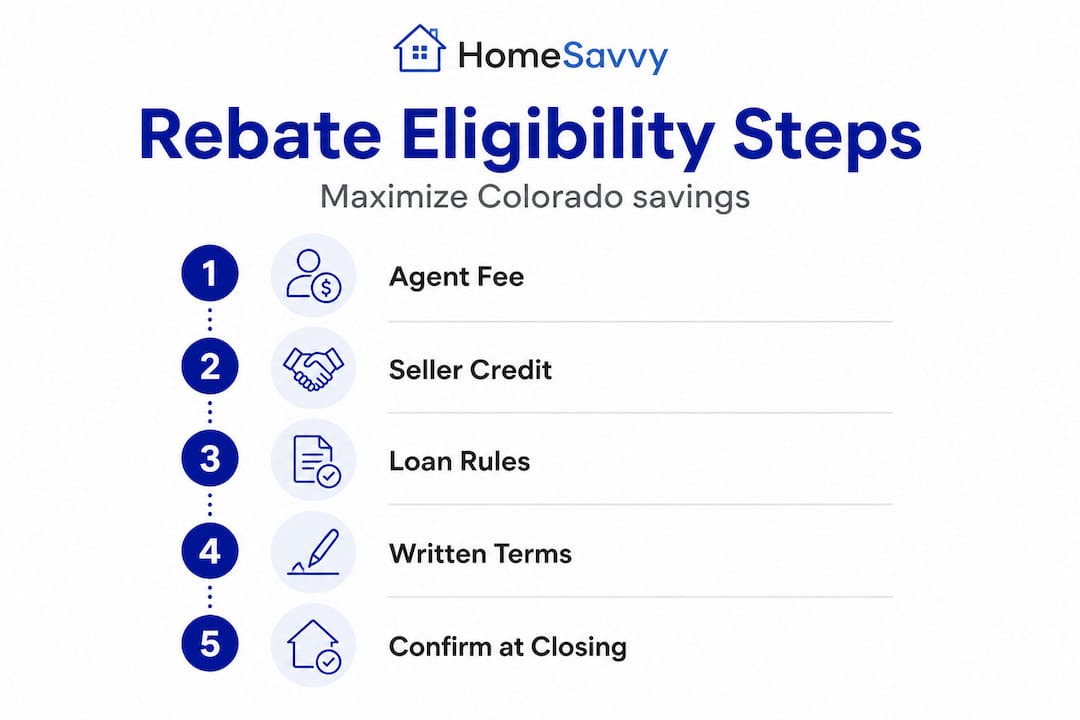
Here is a quick comparison of the main variables:
| Factor | What it means | Impact on your rebate |
|---|---|---|
| Seller pays buyer-agent fee | Seller agrees to cover agent cost in the offer | More room for agent to rebate portion back |
| Agent rebate policy | Agent's willingness to return part of commission | Directly determines if a rebate exists |
| Lender restrictions | FHA, VA, and conventional loans each have rules | May cap total credits or change how rebate is applied |
| Buyer benefit form | Cash, closing cost credit, or post-close check | Affects when and how you access the savings |
Common eligibility pitfalls that catch Colorado buyers off guard:
- Assuming the seller will cover the buyer-agent fee. In the post-settlement market, this must be negotiated as part of your offer, not assumed.
- Signing a buyer agreement without rebate language. Once signed, the terms are set.
- Choosing an agent who does not offer rebates and not asking alternatives. Finding discount real estate agents who specialize in rebate-friendly models can dramatically change your outcome.
- Ignoring lender caps on closing credits. On an FHA loan, for example, seller and agent credits combined cannot exceed your actual closing costs.
- Not having a real estate savings checklist ready before starting the process. Preparation is what separates buyers who maximize savings from those who leave money behind.
Not all rebates are cash in hand. Some take the form of closing cost credits, which means they reduce what you owe at closing rather than putting dollars in your bank account. Others arrive as a check days or weeks after the transaction closes. The form and timing matter a great deal for your overall financial planning, especially if you are stretching to cover the down payment.
Strategies to maximize buyer rebates on your Colorado home purchase
Knowing the rules is important. Acting on them strategically is what actually increases your savings. Colorado's competitive housing market in 2026 rewards buyers who approach rebate negotiation methodically rather than hoping it comes up organically.
Treat the rebate as one lever among several, including seller contributions, agent fee negotiation, and lender allowances. Buyers who focus exclusively on the rebate while ignoring the other levers often end up with a smaller total benefit than buyers who work all angles simultaneously.
Here are five concrete strategies to maximize your rebate:
- Shop agents the same way you shop lenders. Get written rebate offers from at least three agents before committing. Treat their compensation structure as a negotiable term, because it is.
- Bundle your rebate discussion with the broader agent fee negotiation. An agent who agrees to a lower overall commission has more flexibility to offer a rebate. Use the negotiate realtor fees framework to structure that conversation.
- Ask sellers to include buyer-agent compensation in the offer terms. When sellers cover the fee, your agent has a full commission to work with, making a rebate more accessible.
- Review your maximize savings checklist before writing any offer. This ensures you have not overlooked a complementary savings opportunity that works alongside your rebate.
- Coordinate with your lender early. Some loan programs are more flexible about how credits are applied. An FHA buyer may face stricter limits than a conventional buyer. Knowing this before you negotiate prevents last-minute restructuring.
Pro Tip: The strongest position you can be in is having two or three agents competing for your business, each aware that you are comparing their compensation terms. This competitive dynamic often produces better rebate offers than any single negotiation would. Agents who know you are serious and informed will work harder to earn your agreement.
Always verify the final rebate details in writing with both your agent and lender before closing. Verbal agreements about rebates are not enforceable, and last-minute surprises at the settlement table are far more stressful than a clear conversation upfront.
Buyer rebate rules, limits, and common pitfalls in Colorado
Colorado buyers also need to understand the specific rules, caps, and compliance requirements that govern rebates. This is where enthusiasm without preparation can backfire.
How any credit can be applied is subject to lender rules and must be clarified in advance. Every loan type has its own ceiling for credits, and exceeding that ceiling does not mean you get extra money. It often means the credit gets reduced or restructured at closing.
| Rule or limit | Details | What to do |
|---|---|---|
| Maximum rebate allowed | No Colorado state cap, but lender rules apply | Confirm with lender before negotiating |
| Lender approval required | All credits must be disclosed and approved | Disclose rebate to lender early in the process |
| Disclosure timing | Rebate must be disclosed before closing | Include in Buyer Representation Agreement |
| Legal compliance | Must be documented in writing | Get all terms in writing, not just verbal |
Common rebate pitfalls for Colorado homebuyers:
- Not disclosing the rebate to your lender. Undisclosed credits can cause loan denial or delay closing. Always loop in your lender.
- Expecting cash when the lender requires a credit. Some lenders will not allow post-close cash rebates and will require the benefit to be applied at closing only.
- Underestimating how loan type affects credit limits. VA loans, FHA loans, and USDA loans all have different rules. A rebate that works cleanly for a conventional buyer may need restructuring for a government-backed loan.
- Waiting until you are under contract to ask about rebates. The leverage window closes fast once you are in a transaction.
- Choosing an agent solely because of a large rebate offer. An inexperienced agent who offers a big rebate but costs you in negotiation skill can easily lose you more than the rebate is worth.
For a thorough overview of how commissions and credits interact under Colorado law, the real estate commission guide lays out the regulatory framework in plain language.
Our perspective: Why buyer rebates are only one piece of the Colorado savings puzzle
We have worked with hundreds of Colorado homebuyers, and we have noticed a consistent pattern. Buyers who fixate on getting the largest rebate possible often end up no better off, and sometimes worse, than buyers who approach the entire cost structure strategically.
Here is the reality check: a $3,000 rebate from an agent who is a weak negotiator can be wiped out by a single round of poorly managed offer negotiations. If your agent accepts a counteroffer that is $8,000 higher than it needed to be because they lacked the skill or motivation to push back, your rebate just became a net loss. The rebate number looks good on paper. The final purchase price tells the real story.
From a savings-maximization standpoint, treat the rebate as one lever among several. The other levers, specifically seller contributions, agent fee structure, lender credit optimization, and transaction timing, can each move the needle significantly on your total cost.
There are also specific scenarios in Colorado's 2026 market where skipping a rebate entirely or deprioritizing it makes financial sense. In a multiple-offer situation on a desirable Front Range property, having an agent with deep relationships and negotiation experience may matter far more than extracting a commission rebate. A strong agent can sometimes negotiate seller-paid closing costs, price reductions, or favorable repair credits that outvalue any rebate.
The smartest approach is to use the maximize overall savings framework, treating your entire transaction as a financial package rather than hunting for one silver bullet. When you look at agent fees, rebates, seller contributions, lender credits, and negotiated price together, the total savings opportunity is almost always larger than the rebate alone could ever be.
How HomeSavvy Colorado can help you secure buyer rebates and save more
Navigating the post-NAR settlement world as a Colorado buyer is genuinely complex, and trying to do it without local expertise costs buyers thousands of dollars every year. HomeSavvy Colorado was built specifically for this environment.

We combine AI-powered property valuation tools with full-service agent support, so you get the data intelligence to make confident decisions and the human expertise to execute them well. Our agents are experienced in the new buyer representation agreement process and know exactly how to structure rebates in a way that holds up with lenders. You can learn exactly how commission rebates work on our platform, step by step. Before you even start touring homes, use our rebate savings calculator to estimate what you could receive based on your target price range. Real numbers, not guesses.
Frequently asked questions
Are buyer rebates legal in Colorado in 2026?
Yes, buyer rebates are fully legal in Colorado, but how they are structured and applied must comply with both state law and your lender's specific rules. Compensation is now negotiated deal by deal rather than posted on MLS listings.
Does every agent in Colorado offer buyer rebates?
No, not every agent offers rebates, so you should ask directly and confirm rebate terms in writing before signing a buyer representation agreement.
Can I use a buyer rebate for my down payment or closing costs?
Most rebates can be applied to closing costs, but application is subject to lender rules and must be clarified with your lender well before closing.
When should I ask about buyer rebates during my Colorado home search?
Discuss rebates and agent compensation before you sign any buyer agreement or tour any homes, since buyers must sign a written agreement with their agent before touring and compensation is now negotiated upfront.
Is a buyer rebate the best way to save money when purchasing a home in Colorado?
A rebate helps, but true savings-maximization means working all available levers together, including agent fee negotiation, seller contributions, and lender credit strategies, not relying on the rebate alone.