

Hidden real estate fees are any charges beyond the listed purchase price that reduce your net proceeds or increase your total cost at closing, and knowing how to avoid hidden real estate fees in Colorado can save you thousands of dollars on a single transaction. The 2024 NAR settlement changed how buyers and sellers negotiate agent commissions, shifting more financial responsibility and transparency onto both parties. Colorado transactions carry their own local fee norms, from HOA capital contributions to title insurance customs, that catch unprepared buyers and sellers off guard. Proactive document review, strategic negotiation, and smart service shopping are the three tools that protect your budget from start to finish.
What are the common hidden fees in Colorado real estate transactions?
Hidden real estate costs fall into several categories, and most buyers encounter them for the first time on the day they receive their Closing Disclosure. Understanding each category before you sign anything is the only reliable defense.
Agent commissions represent the largest single fee in most transactions. Average commissions dropped from 5 to 6% before 2024 to roughly 4 to 5% in 2026 following the NAR settlement. That shift matters because buyer agent fees are no longer embedded in MLS listings. Buyers must now negotiate their agent's compensation directly through a formal Buyer Representation Agreement before touring homes, which means the fee is visible but also fully negotiable from day one.
Closing costs cover a wide range of lender and third-party charges. The table below breaks down the most common categories Colorado buyers encounter:
| Fee category | Typical range | Negotiable? |
|---|---|---|
| Loan origination fee | 0.5% to 1% of loan | Yes |
| Title insurance (lender) | $500 to $1,500 | Shop around |
| Title insurance (owner) | $700 to $2,000 | Shop around |
| Escrow/settlement fee | $400 to $900 | Partially |
| Prepaid interest | Varies by closing date | Yes, via timing |
| Government recording fees | $50 to $200 | No |
| Document prep/processing | $100 to $500 | Yes |
Beyond lender fees, Colorado buyers frequently encounter HOA-related charges that appear nowhere in the listing. Special assessments and upfront capital contributions are common in condo and planned community purchases, and many HOAs also charge move-in fees ranging from $200 to $1,000. These costs are often excluded from initial budgeting because buyers focus on the mortgage payment and overlook the HOA packet entirely.

Two other charges deserve attention. First, "junk fees" from lenders, including document preparation, processing, and administrative charges, can add $500 to $1,500 to your closing costs with no corresponding service value. Second, buyers purchasing before their current lease ends face an overlap period where they pay both rent and a mortgage simultaneously. That overlap is a hidden cost of timing, not a line item, but it is just as real.
How can you identify and uncover hidden fees before closing?
The documents that reveal hidden charges in real estate are already required by federal law. The challenge is knowing exactly where to look inside them.
-
Request your Loan Estimate within three business days of application. The Loan Estimate is a standardized three-page form that lists every projected fee. Read Section A (origination charges), Section B (services you cannot shop for), and Section C (services you can shop for) line by line. Section C is where most buyers leave money on the table.
-
Use the "Services You Can Shop For" section actively. The Loan Estimate's shoppable services include title insurance, surveys, and pest inspections. Many buyers accept the lender's preferred vendors without realizing they can hire independent providers at lower rates. Title insurance alone can vary by hundreds of dollars between providers in Colorado.
-
Review your listing agreement for protection periods. Sellers often overlook a clause called the protection or tail period. Listing agreements commonly include a tail period that allows the broker to collect a commission even after the contract expires, if the buyer was introduced during the listing period. This period is negotiable. Shortening it from 180 days to 60 days limits your exposure to unexpected commission fees after the listing ends.
-
Request full written fee disclosures from every agent. Verbal assurances about fees are unenforceable. Ask for a written breakdown before signing any representation agreement, whether you are buying or selling.
-
Compare your Closing Disclosure to your Loan Estimate before you wire any funds. You receive the Closing Disclosure at least three business days before closing. Use that window to verify every line item against your original estimate.
Pro Tip: Ask your lender to send you a "fee worksheet" before the official Loan Estimate arrives. This informal document gives you an early look at projected charges and lets you flag inflated fees before they become official.
What strategies help negotiate or reduce real estate fees in Colorado?
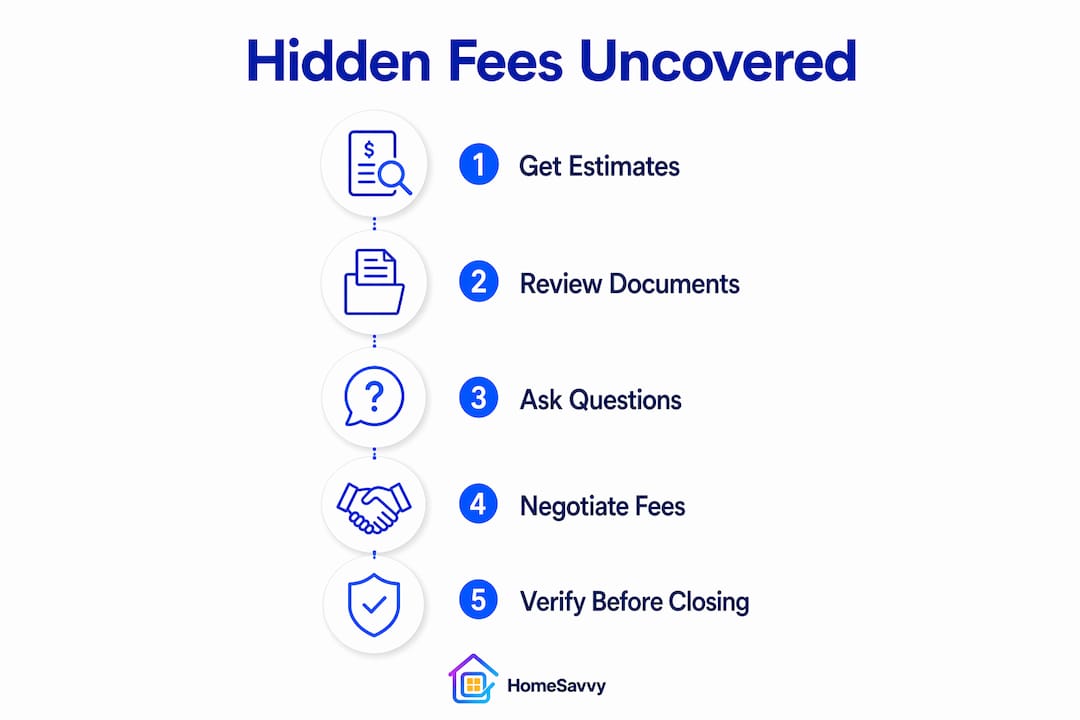
Negotiating real estate fees is not aggressive or unusual. It is expected, and the post-2024 commission environment makes it easier than ever to have direct conversations about cost.
The single most effective tactic is comparing Loan Estimates from at least three lenders. Comparing three or more Loan Estimates is the most reliable way to reduce closing costs by negotiating or eliminating inflated charges. When you show Lender A that Lender B charges $400 less in origination fees, Lender A often matches or beats that figure. The origination fee is the largest negotiable lender charge, and reducing it by 0.25% to 0.5% saves between $625 and $1,250 on a $250,000 mortgage.
Here are the most effective fee reduction strategies for Colorado buyers and sellers:
- Negotiate buyer agent commission upfront. Use the Buyer Representation Agreement to set a specific fee, not a range. If the seller offers to cover part of the buyer agent fee through a concession, confirm that arrangement in writing before you submit an offer.
- Ask for seller concessions. In a buyer-friendly market, sellers often agree to cover a portion of closing costs as part of the purchase agreement. A $5,000 concession on a $500,000 home is a 1% reduction in your out-of-pocket costs.
- Shop title insurance independently. Colorado allows buyers to choose their own title insurance provider. Call two or three companies directly and compare owner's policy premiums before accepting the lender's referral.
- Time your closing date strategically. Closing later in the month reduces prepaid interest charges. Closing on the 28th instead of the 5th can save over $1,000 in prepaid interest on a typical Colorado mortgage.
- Negotiate or eliminate junk fees. Document preparation fees, processing fees, and administrative charges have no regulatory basis. Ask your lender to waive or reduce them. Most will reduce at least one if you ask directly.
- Explore commission rebates. Colorado law permits agents to rebate a portion of their commission to buyers. This is one of the most underused savings tools available. You can learn more about negotiating realtor fees in Colorado through resources that break down the post-settlement rules in detail.
Pro Tip: When reviewing the Buyer Representation Agreement, ask your agent to specify the exact dollar amount of their fee rather than a percentage. A fixed dollar figure is easier to compare across agents and harder to inflate later.
How to verify fees and resolve discrepancies before closing
Verifying your final closing documents is not optional. It is the last line of defense against charges that were never disclosed or that increased without authorization.
-
Compare the Closing Disclosure to the Loan Estimate line by line. Federal rules place strict limits on fee increases between the two documents. Some fees carry zero tolerance for increases, including origination charges and transfer taxes. Others fall under a 10% tolerance bucket, meaning the total of that category cannot increase by more than 10% from the Loan Estimate.
-
Identify zero-tolerance fees immediately. If your origination fee, credit report fee, or transfer tax increased at all from the Loan Estimate, that is a violation. Reviewing the Closing Disclosure against the Loan Estimate can uncover errors or unauthorized fee increases that you have the legal right to dispute.
-
Do not wire funds until discrepancies are resolved. You have the right to delay closing if fees do not match. Most lenders will correct legitimate errors quickly because they want the transaction to close. Document every discrepancy in writing via email before the closing appointment.
-
Watch for escrow prepaid errors. Many buyers confuse prepaid items, such as homeowners insurance and property tax deposits, with closing costs. They are separate. Confirm the escrow deposit amount matches what your lender projected on the Loan Estimate.
"Understanding which fees are fixed, negotiable, or shoppable empowers buyers to save thousands and avoid surprise fees at closing." — Closing Costs for Buyers
If a lender refuses to correct a documented discrepancy, you can file a complaint with the Consumer Financial Protection Bureau (CFPB) or the Colorado Division of Real Estate. Both agencies take fee disclosure violations seriously, and the threat of a formal complaint often resolves disputes faster than negotiation alone.
What ongoing hidden costs should Colorado homeowners anticipate?
The hidden charges in real estate do not stop at closing. Understanding property fees that arrive after you move in is just as important as managing transaction costs.
Annual homeownership costs beyond the mortgage average $23,686, rising to nearly $28,000 when HOA fees are included. That figure covers property taxes, homeowners insurance, utilities, and routine maintenance. For Colorado buyers purchasing in HOA communities, the real number is often higher because of fees that are not disclosed upfront.
The most commonly overlooked ongoing costs include:
- HOA special assessments. These are one-time charges levied when the association needs to fund a major repair, such as a roof replacement or parking lot resurfacing. They can range from a few hundred to several thousand dollars per unit and arrive with little warning.
- Capital contributions. Many Colorado HOAs require buyers to pay an upfront capital contribution at closing, separate from monthly dues. This fee funds the HOA's reserve account and can range from one to three months of dues.
- Move-in fees. Condo associations frequently charge a separate move-in fee, typically $200 to $500, that does not appear in the purchase contract.
- Maintenance and repair reserves. Budget 1% to 2% of your home's value annually for maintenance. A $600,000 Colorado home requires $6,000 to $12,000 per year in upkeep to prevent deferred maintenance from compounding into larger costs.
The practical approach is to request the full HOA disclosure packet, including meeting minutes and reserve fund study, before you remove your inspection contingency. Colorado law requires sellers to provide this documentation, and the reserve fund balance tells you whether a special assessment is likely in the near future.
Key takeaways
Avoiding hidden real estate fees requires knowing which charges are negotiable, which you can shop for, and which documents give you the legal right to dispute unauthorized increases.
| Point | Details |
|---|---|
| Compare multiple Loan Estimates | Get quotes from at least three lenders to negotiate origination fees and eliminate junk charges. |
| Use the shoppable services section | Title insurance, surveys, and inspections can be sourced independently to reduce closing costs. |
| Negotiate agent fees in writing | Post-NAR settlement, buyer agent commissions must be set in a Buyer Representation Agreement before touring homes. |
| Verify the Closing Disclosure | Compare it line by line against the Loan Estimate and dispute any zero-tolerance fee increases before wiring funds. |
| Budget for post-closing HOA costs | Request the full HOA disclosure packet and reserve fund study to anticipate special assessments and capital contributions. |
What I've learned about fee transparency after the 2024 NAR settlement
The 2024 NAR settlement changed the conversation about agent fees in a way that I think most buyers and sellers still underestimate. Before the settlement, buyer agent commissions were effectively invisible. They were baked into the seller's proceeds and never discussed directly with the buyer. Now that buyers must sign a Buyer Representation Agreement with a specific fee before touring homes, the dynamic has shifted. Agents who were never comfortable discussing their compensation are now required to justify it upfront.
What I have seen in practice is that this transparency benefits buyers who are willing to ask direct questions. The buyers who walk in already knowing the Colorado commission structure and the difference between a negotiable and a fixed fee consistently get better outcomes than those who defer to whatever the agent presents.
The area where I see the most money left on the table is title insurance. Almost no buyer in Colorado knows they can shop for their own title provider, and almost no agent volunteers that information. The Loan Estimate makes it explicit, but only if you read it carefully. That single line item, shopped independently, can save $400 to $800 on a typical transaction with no downside.
My honest advice: treat every fee as negotiable until someone shows you in writing that it is not. Most fees that feel fixed are actually just defaults that no one challenged.
— Rishi
How Homesavvycolorado helps you cut through the fee confusion

Homesavvycolorado was built specifically for Colorado buyers and sellers who want fee transparency without sacrificing full-service support. The platform's PropertyIQ AI valuation tool gives sellers accurate, data-driven pricing so you never overprice or underprice your home and trigger costly renegotiations. For buyers, Homesavvycolorado offers significant commission rebates at closing, putting real money back in your pocket on top of the savings you negotiate directly. Every agent on the platform works with transparent, written fee structures aligned with the post-2024 commission rules. If you are buying or selling in Colorado and want to stop guessing about what you owe, Homesavvycolorado gives you the tools and representation to know exactly where every dollar goes.
FAQ
What are the most common hidden fees when buying a home in Colorado?
The most common hidden real estate costs include loan origination fees, title insurance, escrow charges, HOA capital contributions, and prepaid interest. Junk fees like document preparation and processing charges from lenders can add $500 to $1,500 to your closing costs.
How do I find hidden fees on my Loan Estimate?
Review Section A (origination charges), Section B (fixed third-party fees), and Section C (shoppable services) line by line. Any fee in Section C can be sourced from an independent provider, which is one of the most effective ways to reduce your total closing costs.
Can I negotiate my buyer agent's commission in Colorado?
Yes. Post-2024 NAR settlement, buyer agent commissions are negotiated directly through a Buyer Representation Agreement before you tour homes. You set the fee in writing, and it is fully negotiable.
What happens if my Closing Disclosure shows higher fees than my Loan Estimate?
Some fees have zero tolerance for increases, including origination charges. Others fall under a 10% tolerance cap. If a zero-tolerance fee increased at all, you can dispute it and delay closing until the lender corrects the error.
Are HOA fees considered hidden real estate costs?
Monthly HOA dues are disclosed upfront, but special assessments, capital contributions, and move-in fees often are not. Request the full HOA disclosure packet and reserve fund study before removing your inspection contingency to avoid post-closing surprises.