

Sales commissions are defined as variable pay tied directly to a salesperson's revenue output, making them the primary incentive mechanism that aligns individual effort with organizational goals. For real estate agents, brokers, and sales professionals, understanding the role of commissions in sales is not optional. It shapes every client conversation, every deal strategy, and every career decision. Platforms like Xactly and Commissionly have turned commission management into a strategic function. Typical sales commissions represent 20% to 30% of total compensation, and in high-skill roles, the base-to-variable split often targets 50/50. That ratio tells you everything about how seriously a company treats performance incentives.
What are common commission structures and how do they influence sales outcomes?
Commission structures are the architecture of sales motivation. Each model sends a different signal to the sales team about what the organization values most.
| Structure | How it works | Best use case |
|---|---|---|
| Straight commission | 100% variable, no base salary | High-volume, transactional sales |
| Salary plus commission | Fixed base with variable bonus | Balanced roles with longer sales cycles |
| Tiered commission | Rate increases as quota milestones are hit | SaaS, real estate, and high-growth teams |
| Margin-based commission | Paid on profit, not revenue | Businesses protecting margin integrity |
| Residual commission | Ongoing pay for retained accounts | Subscription and relationship-heavy models |
Tiered commission structures are especially common in SaaS and real estate because they reward overperformance with incrementally higher rates. A Colorado real estate agent earning 2.5% on a standard sale might earn 3% on deals above a quarterly threshold. That incremental difference creates predictable revenue uplifts and keeps top performers engaged.
Choosing the right structure depends on your sales cycle and client relationship model. A straight commission plan works well for high-volume, short-cycle transactions. Salary plus commission suits agents who invest months building client trust before a deal closes. Margin-based models protect brokerages from agents who discount aggressively to close volume. Residual structures reward agents who generate referrals and repeat business over time.

The structure you choose communicates priorities before a single word is spoken. If you pay purely on closed volume, agents will chase quantity. If you pay on margin, they will protect price. Real estate brokerages that want both volume and quality service need hybrid models that reward both dimensions.
Pro Tip: Review your commission structure annually against your actual sales data. If your top agents are consistently hitting the same tier ceiling, your tiers are too narrow and you are leaving motivation on the table.
How do commission plans drive sales behavior and impact client relationships?
A commission plan is not just a pay formula. The plan acts as a directive telling reps which behaviors are most rewarded, and misaligned plans result in reps optimizing the wrong activities. This is the most underappreciated truth in sales compensation design.
Here is how commission plans shape behavior in practice:
-
Accelerators motivate overperformance. Accelerators paying 1.5x the base rate between 100% and 125% of quota, and 2x above 125%, effectively drive reps to push past their targets. Accelerators below 1.1x generally fail to change behavior at all. For real estate agents, this means a brokerage offering a higher split above a quarterly GCI threshold will see agents push harder in Q4.
-
Pay mix influences risk tolerance. Higher variable components attract hunter-type reps who thrive on uncertainty, but they also raise turnover risk. Relationship-heavy real estate roles benefit from a higher base to match longer sales cycles and the emotional labor of guiding buyers through major financial decisions.
-
Clawbacks protect client quality. Clawbacks and holdbacks align rep incentives with customer retention, reducing the risk of churn caused by overselling. In real estate, a clawback provision on a deal that falls through due to misrepresentation keeps agents honest and protects the brokerage's reputation.
-
Caps create sandbagging. Capping commissions often leads to sandbagging, where top reps delay deal closings to the next period. The correct fix is better quota and territory design, not artificial ceilings.
-
Non-incentivized tasks get ignored. Sales reps will deprioritize anything not rewarded by the commission plan. If your plan does not reward follow-up calls, client reviews, or referral cultivation, those activities will fade. Real estate agents who want repeat business must either build those behaviors into their plan or accept that commission alone will not sustain a referral pipeline.
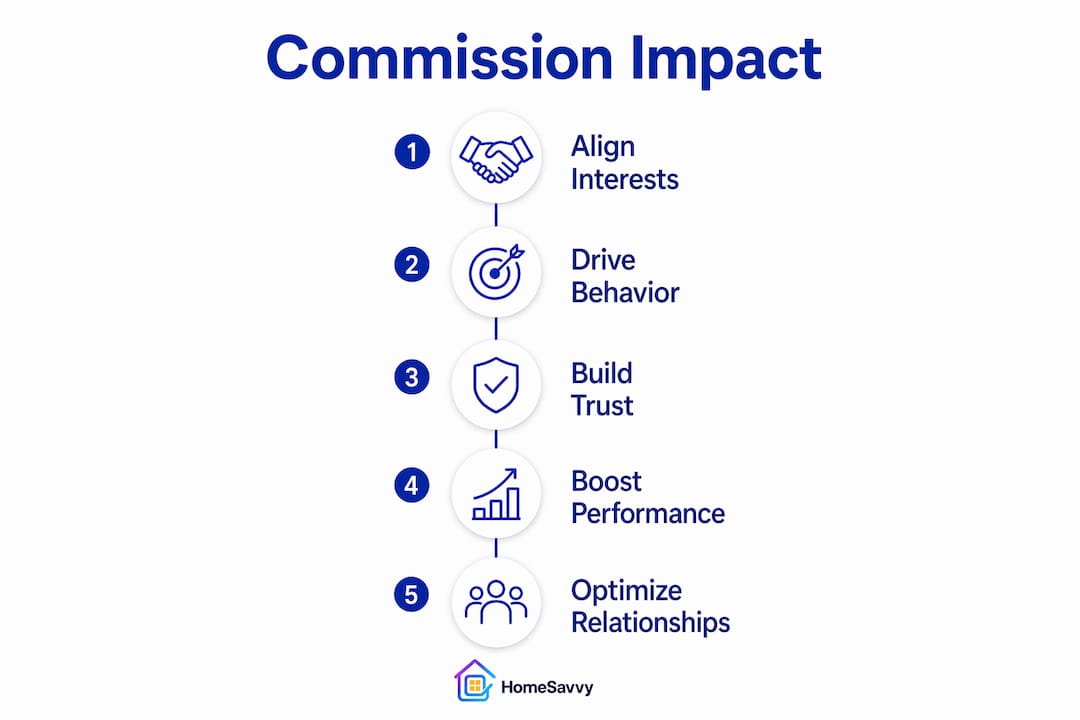
The importance of sales commissions extends beyond motivation. A well-designed plan builds client trust by aligning the agent's financial interest with the client's outcome. When an agent earns more by finding the right property at the right price rather than by closing any deal fast, the client relationship improves naturally.
Pro Tip: Test your commission plan for gaming before you roll it out. Ask yourself: "If I were a rep, what is the fastest way to earn the most money under this plan?" If the answer involves shortcuts that hurt clients or the business, redesign the plan.
What are modern best practices for commission management?
Manual spreadsheet-based commission calculations are a liability. They produce errors, erode trust, and consume RevOps time that should go toward strategy. Automated commission management reduces disputes, improves transparency, and frees teams from reconciliation work.
The business case for automation is direct. Companies using integrated platforms to manage commissions are 30% more likely to meet revenue targets than those using manual systems. That gap exists because automation removes the friction between performance and payout, keeping reps focused on selling rather than auditing their own pay stubs.
Modern commission platforms like Xactly and Commissionly offer real-time dashboards that show reps exactly where they stand against quota at any moment. This transparency matters. When agents can see their projected payout update as they close deals, the motivational effect of the commission plan is continuous rather than delayed until month-end. For brokerages managing dozens of agents across Colorado's varied markets, switching to automated payouts eliminates the reconciliation errors that damage agent trust and slow operations.
Data-driven quota and territory design is the other pillar of modern commission management. Quotas set too high demoralize agents. Quotas set too low produce sandbagging. The right quota is calibrated to market data, historical performance, and territory potential. In Colorado, where markets in Denver, Boulder, and Colorado Springs behave very differently, territory-specific quota design is not a luxury. It is a requirement for fair commission plans.
How can real estate agents optimize commissions to boost sales?
Applying general commission principles to real estate requires accounting for the industry's unique sales cycles, client relationships, and regulatory environment. The Colorado real estate commission structure has its own norms and nuances that agents must understand before designing their personal incentive strategy.
Here are the most effective ways real estate agents and brokers can use commission structures to drive better outcomes:
- Negotiate your split strategically. A 70/30 split at a high-volume brokerage may outperform an 80/20 split at a low-support firm if the brokerage's leads and tools close more deals. Evaluate total earnings, not just the percentage.
- Use rebates as a competitive differentiator. Buyer rebates, where agents return a portion of their commission to the client, build loyalty and generate referrals. Homesavvycolorado's commission rebate program is a direct application of this principle, passing savings to buyers while maintaining agent motivation.
- Consider discount listing models for sellers. Sellers in Colorado increasingly seek agents who offer reduced listing fees without sacrificing service quality. Understanding types of commission structures in Colorado helps agents position themselves competitively.
- Align your commission structure with your client mix. Agents who work primarily with first-time buyers need structures that reward patience and education. Agents focused on luxury or investment properties benefit from margin-based or tiered models that reward deal quality over volume.
- Communicate your commission structure clearly to clients. Transparency about how you are paid builds trust and reduces the friction that kills deals. Clients who understand your incentives are more likely to trust your recommendations.
The commissions impact on sales performance in real estate is most visible when agents treat their commission structure as a business tool rather than a fixed condition. Agents who understand what realtor commission covers and why it is structured as it is can explain their value proposition clearly and close more confidently.
Key takeaways
Commission plans are the single most powerful tool for aligning sales behavior with business outcomes, and their design determines whether agents close the right deals or just the fast ones.
| Point | Details |
|---|---|
| Commission structure shapes behavior | The model you choose signals what the organization rewards: volume, margin, retention, or all three. |
| Accelerators drive overperformance | Rates of 1.5x to 2x above quota thresholds motivate top agents to push past targets consistently. |
| Automation closes the trust gap | Platforms like Xactly and Commissionly reduce errors and keep agents focused on selling, not auditing pay. |
| Clawbacks protect client quality | Holdback provisions align agent incentives with long-term client satisfaction and reduce overselling risk. |
| Transparency builds client loyalty | Agents who explain their commission structure clearly earn more referrals and repeat business over time. |
Why commission design is the most underrated skill in real estate
I have spent years watching agents treat their commission structure as something that happens to them rather than something they design. That mindset is expensive. The agents I have seen build durable, high-volume practices in Colorado all share one trait: they understand their commission plan as a strategic lever, not a paycheck formula.
The most common mistake I see is accepting a brokerage split without modeling the actual dollar impact across different deal volumes and price points. A 5% difference in split sounds small until you run the numbers on 20 closings a year in a market where median home prices exceed $500,000. That is real money left on the table.
I also think the industry underestimates how much commission clarity affects client relationships. Clients are not naive. They know agents earn commissions, and they wonder whether the recommendation to make an offer or walk away is influenced by the agent's payout. Agents who address this directly, who explain their structure and why it aligns with the client's interest, close faster and generate more referrals. Commission transparency is not a liability. It is a trust-building tool.
The technology shift is real and accelerating. Brokerages still running commission calculations in spreadsheets are operating with a structural disadvantage. The time spent reconciling errors is time not spent on client relationships or market analysis. Automated platforms are not just an efficiency gain. They are a retention tool for top agents who have no patience for pay disputes.
— Rishi
How Homesavvycolorado puts commission strategy to work for you

Homesavvycolorado is built on the principle that commission structures should work for buyers and sellers, not just agents. The platform's PropertyIQ AI Home Valuation tool gives buyers and sellers real-time data to evaluate home values and market trends, removing the information asymmetry that often inflates commission-driven recommendations. For buyers, Homesavvycolorado's rebate model returns a meaningful portion of the commission at closing. For sellers, the 1% listing service delivers full-service representation at a fraction of the traditional fee. Commission strategy done right benefits everyone at the table.
FAQ
What is the role of commissions in sales?
Commissions are variable pay tied to sales output, designed to align a salesperson's financial interest with the organization's revenue goals. They motivate performance, shape sales behavior, and communicate organizational priorities directly to the sales team.
How do commissions affect sales performance?
Commission structures directly influence which deals agents pursue, how aggressively they negotiate, and how much attention they give to client retention. Well-designed plans with accelerators and clawbacks drive both volume and quality outcomes.
What is a typical commission rate for real estate agents?
Real estate commission rates in the U.S. have traditionally ranged from 5% to 6% of the sale price, split between buyer and seller agents. Colorado markets vary, and discount models now offer listing fees as low as 1% through platforms like Homesavvycolorado.
Why do commission caps hurt sales performance?
Capping commissions triggers sandbagging, where top agents delay closings to avoid losing earnings to a ceiling. Better quota and territory design is the recommended alternative to control payout costs without demotivating high performers.
What are sales commission structure best practices for real estate?
The most effective real estate commission structures combine a competitive base split with tiered accelerators above quota, clawback provisions on deals that fall through, and full transparency with clients about how agent pay aligns with their interests.