

If you've ever looked at a settlement statement and wondered where tens of thousands of dollars went, you're not alone. What is realtor commission, exactly, and why does it feel like such a black box? Most buyers and sellers know commissions exist but have no real picture of who pays them, how they're calculated, or whether the rates are set in stone. They're not. The rules changed significantly after 2024, and understanding what you're agreeing to before you sign anything can save you real money.
Table of Contents
- Key Takeaways
- What is realtor commission and how does it work
- Types of real estate agents and how commissions differ
- Who actually pays realtor commissions in 2026
- How realtor commission rates vary and what affects them
- How commission calculations work in real dollar terms
- My take on realtor commissions after years in this space
- How Homesavvycolorado helps you spend less on commissions
- FAQ
Key Takeaways
| Point | Details |
|---|---|
| Commissions are negotiable | No law fixes realtor commission rates; buyers and sellers can and should negotiate before signing. |
| Rates average around 5.5% | Total commission typically splits between listing and buyer's agents at roughly 2.5% to 3% per side. |
| Post-2024 rules shifted responsibility | Buyers must now have written agreements specifying agent fees before touring homes. |
| Agent type affects your fees | Realtors, licensed agents, and brokers have different fiduciary duties and commission structures. |
| Commissions come out at closing | Fees are paid from proceeds at closing, not upfront out of pocket during the transaction. |
What is realtor commission and how does it work
A realtor commission is the fee paid to real estate agents for their services in a home sale or purchase. It's expressed as a percentage of the final sale price and is paid at closing from the proceeds of the transaction, not upfront as a separate check you write during the process.
Here's what that looks like in practice:
- The commission percentage is agreed upon in the listing agreement (for sellers) or buyer representation agreement (for buyers) before any work begins.
- The total commission covers both agents involved in the transaction, typically the listing agent and the buyer's agent.
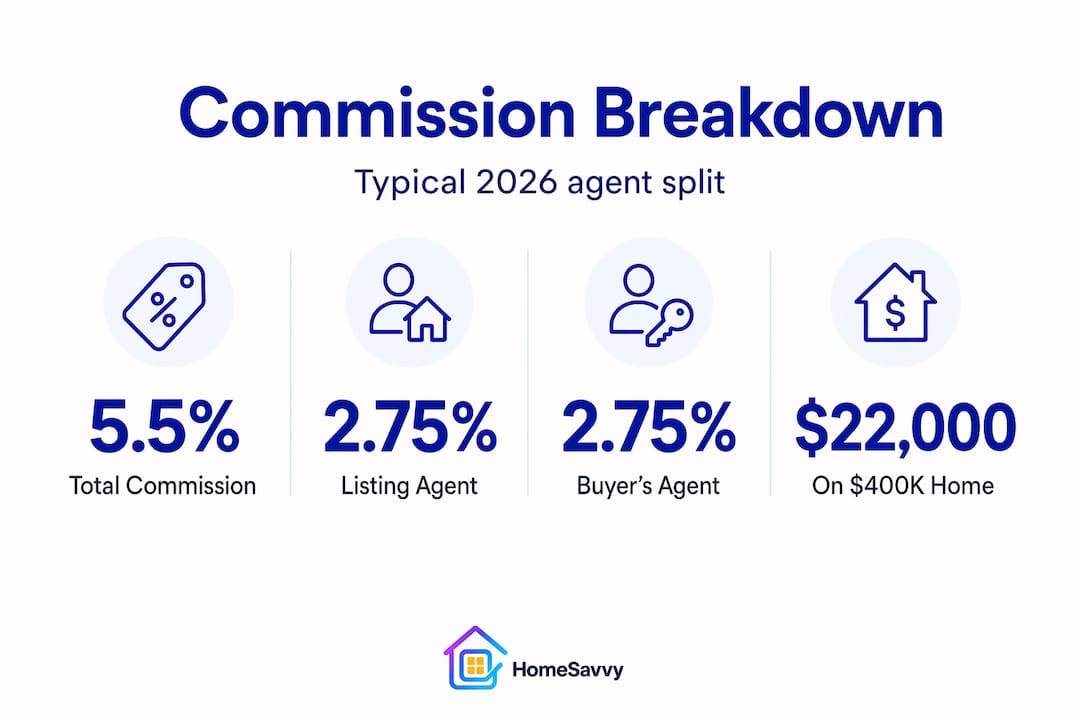
- Commissions average around 5.5% nationally in 2026, though this figure is fully negotiable and not fixed by any law or regulatory body.
- Each agent's portion is usually 2.5% to 3% of the sale price, though splits vary.
The total commission gets disbursed by the closing agent per contract terms. In a traditional transaction, the seller's proceeds cover both sides. That practice has evolved significantly since 2024, which we'll cover in detail below.
Pro Tip: Ask your agent at the very first meeting to spell out exactly what percentage they charge, what services are included, and how that fee splits between agents. This conversation should happen before you sign anything.
Types of real estate agents and how commissions differ
Understanding what is realtor commission also means knowing which type of agent you're dealing with. Not all agents are the same, and the distinction affects both your representation and your costs.
| Agent Type | Role | Commission Structure |
|---|---|---|
| Listing agent | Represents the seller; markets the property | Negotiated percentage in listing agreement |
| Buyer's agent | Represents the buyer; assists in finding and purchasing homes | Fee specified in buyer representation agreement |
| Realtor® | Licensed agent who is a NAR member bound by Code of Ethics | Same commission structure but with higher fiduciary duty |
| Broker | Licensed at a higher level; may own the agency | Receives a share of agent commissions per split agreements |
The listing agent earns a commission negotiated directly with the seller, documented in the listing agreement. This agent is responsible for pricing, marketing, showing coordination, and negotiating on the seller's behalf.
The buyer's agent handles property searches, offer preparation, inspections, and negotiations for the buyer's side. Historically, the seller paid both agents' commissions. That's no longer guaranteed.
A Realtor® is not just any licensed agent. A Realtor® has joined NAR and agreed to abide by a strict Code of Ethics, which includes prioritizing clients' interests, disclosing material facts, and maintaining confidentiality. That higher standard of fiduciary responsibility matters when you're making the largest financial decision of your life.
Brokers operate above agents in the licensing hierarchy. Agents pay a portion of their earned commissions to their brokerages based on agreed split arrangements. Some brokerages, like RE/MAX, keep as little as 5% while agents retain 95%. Others take a larger share, which can affect how motivated an agent is to negotiate aggressively on your behalf.

Pro Tip: When interviewing agents, ask what their brokerage split is and whether they work on a team. An agent who gives most of their commission to a team lead may have less flexibility to negotiate their rate with you.
Who actually pays realtor commissions in 2026
This is where most people's understanding breaks down. The historical norm was simple: the seller paid both agents' commissions from the sale proceeds. That made sense because the seller controls the funds at closing. But it also meant buyers often had no idea their agent was being compensated or at what rate.
The 2024 NAR settlement changed that. Contracts must now specify the fee type (percentage, flat rate, or hourly), the services provided, the duration of the agreement, and a clear statement that commissions are negotiable. Buyers must sign a buyer representation agreement before touring homes.
"Sellers and buyers should negotiate commission rates explicitly before services start, as commission models are no longer the standardized norm. This protects both parties and ensures transparency." — Bankrate
Here's what payment looks like across different scenarios in 2026:
- Seller pays both sides: Still happens, but now must be explicitly agreed upon in the listing contract. The seller offers a buyer's agent fee as a concession, which shows up transparently in the MLS.
- Buyer pays their agent directly: The buyer negotiates and pays their agent's fee independently. This gives buyers more control but requires upfront budget planning.
- Hybrid arrangement: Seller offers a partial concession toward the buyer's agent fee, and the buyer covers the remainder.
- Negotiated flat fee: Instead of a percentage, the buyer's agent agrees to a flat dollar amount for their services.
The shift is real. Buyers who walk into a transaction without reading their representation agreement may be surprised to find they owe their agent a fee regardless of whether the seller covers it. Read every line before you sign. For Colorado-specific guidance on navigating these new rules, the Colorado commission guide breaks down exactly how agent fees work in this market.
How realtor commission rates vary and what affects them
The national average commission sits around 5.57% in 2026, with listing fees averaging approximately 2.88% on the seller side. But that number tells only part of the story. Rates vary considerably based on several factors.
Here's what actually moves the needle on your final commission rate:
- Market conditions. In a hot seller's market where homes sell in days, agents may accept lower commissions because the work involved is minimal. In slower markets, agents often hold firm because transactions require more time and effort.
- Agent experience and reputation. A top-producing agent who consistently sells homes for above asking price may command a higher commission, and the premium is often worth it. A newer agent may offer lower rates to build their portfolio.
- Property price. On a $1.5 million home, even 2% generates a significant dollar amount. High-value properties sometimes attract lower percentage rates because the math works out for both parties.
- Service package. Full-service listings that include professional photography, staging consultation, open houses, and active marketing cost more than a basic MLS listing with minimal support.
- Flat fees and à la carte options. Some agents and platforms offer flat-fee MLS listings where sellers pay a set amount for specific services rather than a percentage of the sale.
Pro Tip: Don't anchor on the percentage alone. Calculate the actual dollar amount and then evaluate whether the services justify that number. A 2.5% commission on a $600,000 home is $15,000. Ask exactly what you get for that amount.
Negotiating realtor commissions effectively means doing your homework before the conversation. Know your local market, interview at least three agents, and get all fees in writing before signing anything. You can also explore strategies for negotiating realtor fees specific to Colorado if that's your market.
How commission calculations work in real dollar terms
Abstract percentages become real fast when you put them against actual home prices. Here's how the math plays out across three price points using the standard 5.5% total commission split equally between agents.
| Sale Price | Total Commission (5.5%) | Listing Agent (2.75%) | Buyer's Agent (2.75%) |
|---|---|---|---|
| $300,000 | $16,500 | $8,250 | $8,250 |
| $500,000 | $27,500 | $13,750 | $13,750 |
| $1,000,000 | $55,000 | $27,500 | $27,500 |
For sellers, these figures come directly out of your net proceeds. If you owe $280,000 on a $400,000 home and pay $22,000 in commissions plus $5,000 in other closing costs, your actual takeaway is around $93,000, not $120,000. Running those numbers before you list sets realistic expectations.
For buyers in markets where they're now responsible for their agent's fee, that same 2.75% on a $400,000 purchase is $11,000 coming out of your pocket in addition to your down payment and closing costs. That's a number worth factoring into your budget early.
A few things to keep in mind when reviewing your contract terms:
- Commission percentages apply to the final sale price, not the list price. If you drop your price $20,000 to get a deal done, the commission adjusts accordingly.
- Some agreements include minimum commission clauses that protect the agent if the price drops significantly. Read for that language.
- In buyer-paid commission scenarios, amounts may be eligible to be rolled into closing costs depending on lender rules. Ask your loan officer.
My take on realtor commissions after years in this space
I've watched buyers and sellers make the same mistake repeatedly: they assume the commission rate on the listing agreement is the rate, full stop. No negotiation, no questions asked. That assumption has cost people I know tens of thousands of dollars they didn't need to spend.
In my experience, the biggest issue isn't the commission itself. It's the lack of conversation before the paperwork is signed. Most agents will negotiate. Most won't bring it up unless you do. That's not dishonesty. It's just how the business has worked. The 2024 rule changes pushed more transparency into the process, and that's genuinely good for consumers.
What I've also seen is the flip side: sellers who try to avoid commissions entirely by going FSBO (for sale by owner) and run into reduced buyer interest, fewer showings, and legal exposure that often costs more than the commission would have. Saving 3% on commissions while leaving 5% on the table through a weaker negotiating position is not a win.
The value a skilled agent brings is real. Pricing strategy, negotiation, inspection response, contract navigation. These are areas where experience directly translates to money in your pocket. The goal shouldn't be to eliminate the commission. It should be to get maximum value for what you pay and to understand every dollar before you commit.
Ask questions early. Negotiate openly. And make sure whoever you're working with has a clear fiduciary duty to you, not just a professional license.
— Rishi
How Homesavvycolorado helps you spend less on commissions
Understanding commissions is one thing. Doing something about them is another. Homesavvycolorado was built specifically to give Colorado buyers and sellers tools and agents that reflect the way this market actually works in 2026.

For sellers, Homesavvycolorado offers a 1% listing option that dramatically reduces the traditional listing fee without sacrificing full-service support. For buyers, the platform offers commission rebates that put money back in your pocket at closing. Before any of that, the PropertyIQ AI valuation tool gives you a data-grounded picture of what a home is actually worth, so you go into price and commission negotiations with real numbers instead of guesses. Smarter data and lower fees in one place.
FAQ
What is a real estate commission exactly?
A real estate commission is a fee paid to agents for their services in a home sale, expressed as a percentage of the final sale price and paid at closing from transaction proceeds.
What is the average realtor commission in 2026?
The national average total commission sits around 5.5%, typically split between the listing agent and buyer's agent at roughly 2.5% to 3% per side.
Who pays the realtor commission?
Since the 2024 NAR settlement, payment responsibility is negotiable. Sellers traditionally covered both agents' fees, but buyers may now pay their agent directly or share costs depending on the agreed terms.
Can you negotiate realtor commission rates?
Yes. Commissions are fully negotiable and not set by law. Buyers and sellers should discuss and agree on rates and services before signing any representation agreement.
What's the difference between a Realtor® and a real estate agent?
A Realtor® is a licensed real estate agent who is also a member of the National Association of Realtors and is bound by a formal Code of Ethics that requires prioritizing client interests and full disclosure.