

If you've started researching home purchases in Colorado, you've likely run into the phrase "broker fee" without a clear explanation of what it actually costs you. A broker fee is the payment made to a real estate agent or brokerage for facilitating a property transaction. It sounds simple, but the structure, who pays it, and whether it's negotiable all trip up buyers and sellers alike. This guide cuts through the confusion with a broker fee explanation built specifically for Colorado residents, including what's typical, what's changed, and where you can save real money.
Table of Contents
- Key takeaways
- What is a broker fee in real estate
- How broker fees work in Colorado
- Broker fees across transaction types
- How to negotiate and minimize broker fees
- My take on broker fees after years in Colorado real estate
- Save on broker fees with Homesavvycolorado
- FAQ
Key takeaways
| Point | Details |
|---|---|
| Broker fees defined | A broker fee is a payment to a licensed intermediary for facilitating a real estate or financial transaction. |
| Colorado standard rates | Colorado sellers typically pay 5% to 6% of the sale price in broker commissions at closing. |
| Who pays matters | The seller traditionally covers both the listing and buyer's agent commissions in Colorado home sales. |
| Fees are negotiable | Commission rates are not set by law. Sellers can and should negotiate before signing a listing agreement. |
| Discount options exist | Platforms like Homesavvycolorado offer reduced listing fees and buyer rebates that cut total transaction costs. |
What is a broker fee in real estate
A broker fee is compensation paid to a licensed broker or agent for services rendered during a transaction. In real estate, that means everything from listing your home and marketing it, to scheduling showings, negotiating offers, managing paperwork, and getting you to closing. The fee is the broker's payment for acting as the intermediary between buyer and seller.
Brokerage fees are defined differently depending on the industry, but the core concept stays the same: a professional handles a complex transaction on your behalf, and you pay them for that service. In real estate, three main fee structures exist.
- Commission-based percentage. The agent earns a percentage of the final sale price. This is by far the most common model in U.S. residential real estate.
- Flat fee. A fixed dollar amount regardless of sale price. Flat fees offer transparency but may not always reflect the complexity of the transaction.
- Hourly rate. Less common in real estate, but used in advisory contexts. Rates for advisory services typically run $200 to $500 per hour.
In residential real estate, the commission model dominates. The average broker fee in U.S. home sales ranges from 5% to 6% of the total property sale price, paid by the seller at closing and split between the listing and buyer's agent brokerages. On a $400,000 home, that's up to $24,000 in total commissions.
Pro Tip: Ask every agent you interview to explain their fee structure in writing before you sign anything. Verbal agreements about commissions are not enforceable.
It's also worth knowing that commission models can create conflicts of interest by incentivizing agents to close deals faster rather than negotiate the best possible terms for you. Understanding this upfront helps you hold your agent accountable.
How broker fees work in Colorado
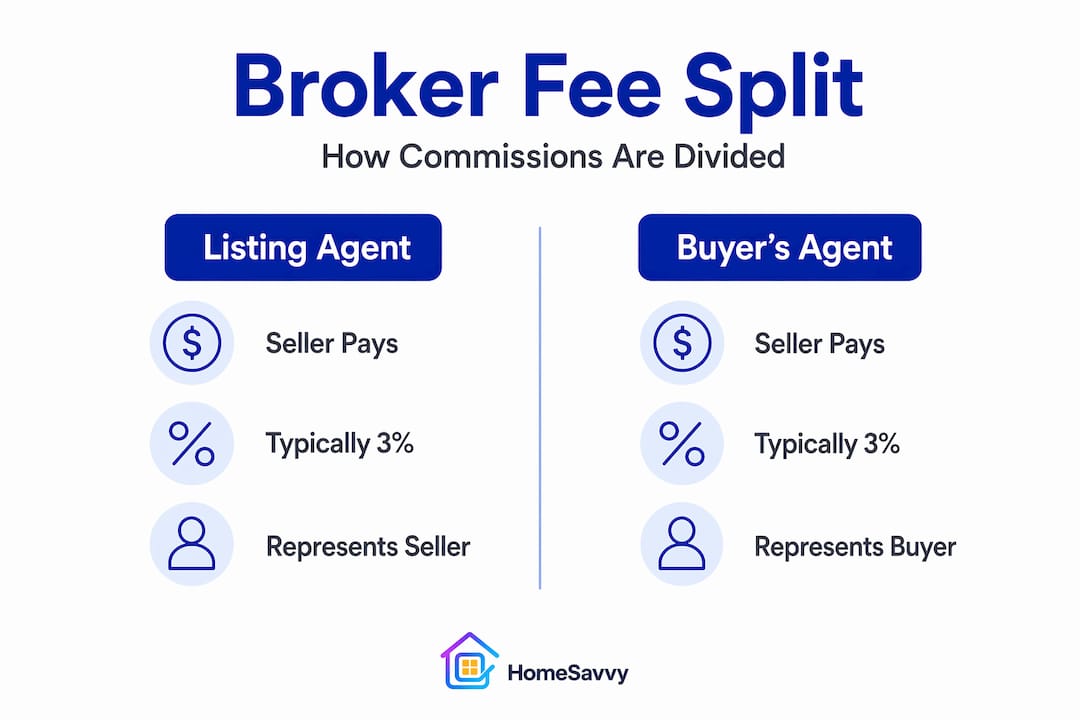
Colorado follows national norms fairly closely when it comes to broker commissions. The standard commission in Colorado is 5% to 6% of the sale price, paid by the seller and split between the listing agent's brokerage and the buyer's agent's brokerage. Understanding how agent fees work in your local market is the first step toward negotiating effectively.
Here's how a typical Colorado home sale breaks down at a 6% total commission:
| Sale price | Total commission (6%) | Listing agent share (3%) | Buyer's agent share (3%) |
|---|---|---|---|
| $400,000 | $24,000 | $12,000 | $12,000 |
| $550,000 | $33,000 | $16,500 | $16,500 |
| $700,000 | $42,000 | $21,000 | $21,000 |
| $900,000 | $54,000 | $27,000 | $27,000 |
The seller pays the total commission out of the proceeds at closing. Buyers don't write a check for their agent's fee directly, but that cost is often factored into how the deal is structured. If the seller isn't offering a buyer's agent commission, the buyer may need to negotiate that payment separately or cover it out of pocket.

One important shift in Colorado: following the National Association of Realtors settlement changes in 2024, buyers are now required to sign a written buyer agency agreement before touring homes with an agent. This agreement must clearly state the buyer's agent compensation. That written documentation matters because it spells out exactly what you're agreeing to pay before you're emotionally committed to a property.
Colorado has no law setting a fixed commission rate. Rates are always negotiable. But the local norm still hovers around 5% to 6%, and understanding local norms helps buyers and sellers save money by knowing when they're getting a fair deal and when they're not.
Broker fees across transaction types
How broker fees work varies significantly depending on whether you're buying a home, renting an apartment, or working with a financial broker. The table below covers what Colorado residents are most likely to encounter.
| Transaction type | Typical fee range | Who pays | Notes |
|---|---|---|---|
| Home purchase/sale | 5% to 6% of sale price | Seller (at closing) | Split between listing and buyer's agents |
| Rental (Colorado) | Rare or zero | Varies | Less common in CO than in markets like NYC |
| Financial brokerage | 0.5% to 1.5% of assets | Client | Varies widely by service type |
| Online stock trading | $0 to $4.95 per trade | Client | Flat fees common at online brokerages |
The rental market offers an instructive contrast. In cities like New York, rental broker fees can reach 15% of annual rent. On a $4,000 per month apartment, that's $9,600 due upfront before you've even moved in. Legislation like New York's FARE Act pushed back on that practice by prohibiting landlord-hired brokers from charging tenants those fees.
Colorado doesn't face this problem at the same scale. Rental broker fees are far less common in Colorado markets compared to dense urban coastal cities. Still, the principle matters: you should only pay a broker fee if you explicitly hired that broker. If a landlord hires the broker to find tenants, the landlord pays the fee. That rule applies across transaction types, and written disclosures protect you when the lines get blurry.
Financial brokerage fees follow a different model entirely. A financial broker managing your investment portfolio might charge an annual percentage of assets under management, a flat advisory retainer, or a per-trade commission. These fees are subject to SEC and FINRA oversight, which requires far more disclosure than real estate has traditionally demanded.
How to negotiate and minimize broker fees
Most Colorado homebuyers and sellers accept the first commission rate they're quoted. That's a mistake. Here's a practical approach to keeping broker fees in check.
-
Ask directly, upfront. Before signing any listing agreement or buyer agency agreement, ask the agent what their commission is, whether it's negotiable, and what services are included. Many agents expect this question and will negotiate without pushback.
-
Get everything in writing. Written fee disclosures protect consumers from unexpected charges and prevent the kind of after-the-fact disputes that cost people thousands. Never rely on a verbal understanding of what you'll owe.
-
Shop around. Talk to at least two or three agents before committing. Comparing offers gives you a baseline for what's fair in your price range and market. It also signals to agents that you're an informed client, which tends to produce better terms.
-
Explore discount brokerage options. Digital real estate platforms have increased transparency and reduced fees compared to traditional full-service models. Some list homes for 1% to 2% instead of 3%, without sacrificing marketing quality or agent responsiveness.
-
Understand what you're trading off. A lower commission doesn't always mean worse service, but it can. Ask discount brokers exactly what's included: professional photography, MLS listing, showings, offer review, negotiation, and closing coordination. If any of those are missing, factor in the cost of hiring them separately.
Pro Tip: On a $600,000 Colorado home, negotiating the listing commission from 3% down to 1.5% saves you $9,000. That conversation takes about five minutes. Have it.
Strategic fee negotiation can save thousands in transaction costs in Colorado, and most sellers leave that money on the table simply because they don't know it's available. Check the seller's fee breakdown guide to get a clear picture of where your money actually goes at closing.
Buyers should also know their options. A buyer's agent commission rebate returns a portion of the buyer's agent fee back to you after closing. Not every brokerage offers this, but the ones that do can put thousands of dollars back in your pocket on a standard Colorado home purchase.
My take on broker fees after years in Colorado real estate
I've watched hundreds of Colorado buyers and sellers walk into transactions without a real understanding of what they're paying or why. The most common misconception I see is the belief that broker fees are fixed. Clients treat the 6% number like it's stamped on a government form. It isn't. It's a starting point.
What I've learned is that transparency about fees matters more than the percentage itself. Agents who clearly explain what they do for their commission, and are willing to put it in writing, almost always deliver better results than agents who deflect the conversation. If an agent gets uncomfortable when you ask about fees, that tells you something.
I've also seen the other extreme. Clients who chase the cheapest possible option, sign with a 0.5% flat-fee lister, get minimal marketing support, and end up with a lower sale price than they would have achieved with a slightly higher commission. The math doesn't always favor going cheap. The goal is paying a fair fee for real service, not paying the most or the least.
The other thing most buyers miss is how broker fees being contingent on closing shapes agent behavior. Agents don't get paid unless the deal closes. That's mostly good because it aligns incentives, but it also means some agents push harder to close than to negotiate the best terms. Keep that in mind when your agent tells you to make a quick decision.
— Rishi
Save on broker fees with Homesavvycolorado
Understanding broker fees is one thing. Actually saving on them is another.
Homesavvycolorado combines AI-powered market data with full-service agent support to help Colorado buyers and sellers pay less without giving up expertise. Sellers can list for just 1% instead of the standard 3%, keeping thousands more from every sale. Buyers can earn significant commission rebates after closing. Before you negotiate anything, run your address through the PropertyIQ home valuation tool to know exactly what your home is worth in today's market. That number is your strongest negotiating asset.
FAQ
What is a broker fee in simple terms?
A broker fee is a payment to a licensed real estate agent or brokerage for helping facilitate a property transaction, typically calculated as a percentage of the sale price.
Who pays the broker fee in a Colorado home sale?
The seller pays the total broker commission in Colorado, usually 5% to 6% of the sale price, which is then split between the listing and buyer's agents at closing.
Are broker fees negotiable in Colorado?
Yes. Colorado sets no fixed commission rates, so broker fees are fully negotiable. Sellers can often reduce their listing commission by comparing agents and asking directly before signing.
What is the average broker fee for Colorado home sales?
The average broker fee in Colorado runs between 5% and 6% of the sale price, meaning a $500,000 home sale typically generates $25,000 to $30,000 in total broker commissions.
Do buyers pay a broker fee when purchasing a home in Colorado?
Buyers don't usually pay the broker fee directly. The seller covers both agents' commissions at closing, though buyers may negotiate separately after 2024 buyer agency agreement requirements took effect.