

Most agents spend hours each week searching for a contact they saved in a spreadsheet, chasing a lead they forgot to follow up on, or manually typing the same email for the tenth time. A real estate CRM solves all three. But what is a real estate CRM, exactly? It is not just a digital address book. It is the operating system behind how top-producing agents manage relationships, track deals, and build a business that runs with less chaos and more results. This guide breaks down exactly how it works and why it matters in 2026.
Table of Contents
- Key takeaways
- What is a real estate CRM and what does it do
- The real business case for using a CRM
- Real estate CRM vs generic CRM: key differences
- Putting your CRM to work across the client lifecycle
- Common mistakes and what to watch for in 2026
- My honest take on CRM adoption
- How Homesavvycolorado makes your CRM work harder
- FAQ
Key takeaways
| Point | Details |
|---|---|
| CRM is not just a contact list | A real estate CRM manages your entire client lifecycle from first inquiry to post-close referral. |
| Revenue impact is real | Agents using CRM report 41% higher revenue and close significantly more deals each year. |
| Speed wins leads | Responding within five minutes makes you 21 times more likely to convert a lead than waiting longer. |
| Generic CRMs fall short | Systems built for general sales miss MLS integrations and real estate workflows you actually need. |
| Automation frees your time | CRM saves agents 5 to 20 hours weekly by handling follow-ups, reminders, and routine outreach. |
What is a real estate CRM and what does it do
CRM stands for Customer Relationship Management. In the context of real estate, it is software built specifically to help agents and brokers manage every interaction with leads, clients, and past customers from one central place.
Think of it as replacing your sticky notes, spreadsheet tabs, and memory with a system that never forgets. A real estate CRM explained at its core is a centralized database with lifecycle tracking that gives you a single source of truth for your entire business.
Here is what a purpose-built real estate CRM actually does:
- Contact management: Stores detailed client profiles including communication history, buying preferences, price range, neighborhood interest, and personal notes like birthdays or family details.
- Lead tracking: Captures leads from your website, Zillow, social ads, open houses, or phone calls and assigns them to a stage in your pipeline.
- Automated workflows: Sends follow-up emails, drip campaigns, and text messages on a schedule without you lifting a finger. A CRM acts as a virtual assistant running outreach like market updates and check-in messages automatically.
- Pipeline visualization: Shows you every active deal at a glance, where each client is in the buying or selling process, and what needs attention today.
- Transaction management: Tracks key deadlines, document submissions, inspection dates, and closing milestones so nothing falls through the cracks.
- Reporting and analytics: Tells you which lead sources convert best, what your average deal cycle looks like, and where your marketing dollars are working.
- Multi-channel integration: Connects email, SMS, phone, and social media into one conversation thread. Communication stays unified regardless of which channel your client prefers.
The result is a system where every client touchpoint is documented, every follow-up is scheduled, and no lead ever goes cold because you were too busy closing another deal.
The real business case for using a CRM
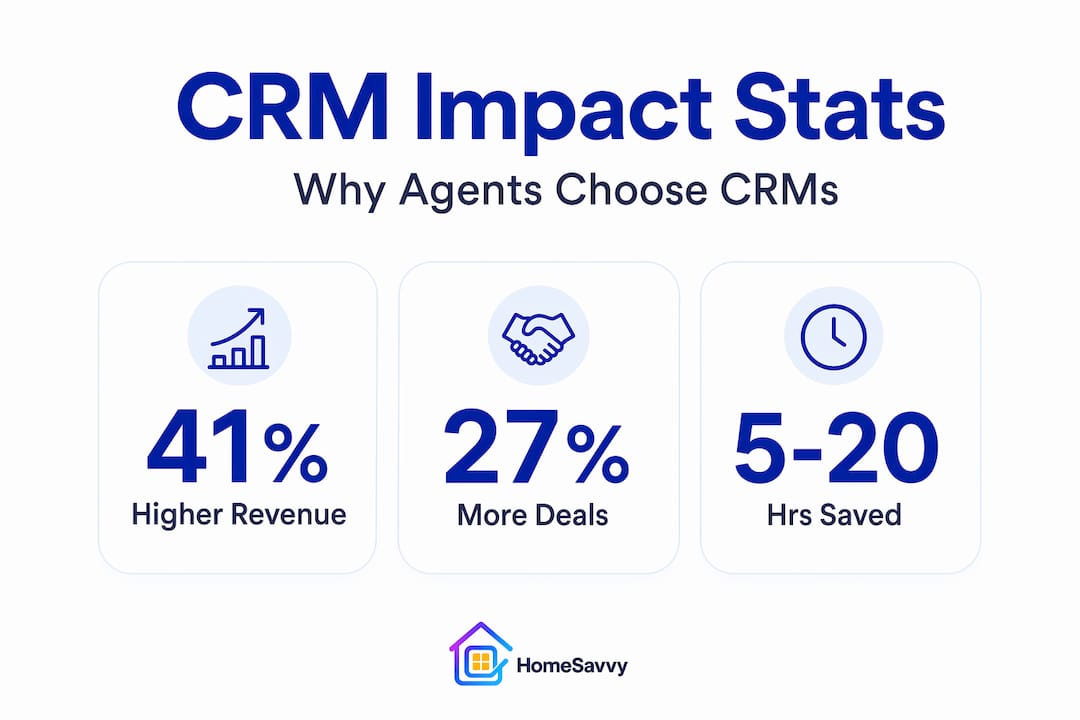
Here is the number that usually stops agents cold. Agents using professional real estate CRM software report 41% higher revenue and 27% more deals closed annually compared to those who do not use one.
That gap is not luck. It comes down to capacity and consistency. The average agent is managing 50 or more active leads simultaneously. Without a system, most of those leads go cold after the second or third touchpoint. With a CRM, follow-ups happen automatically on a schedule that matches where each lead is in their buying timeline.

The time savings alone justify adoption. CRM use frees up between 5 and 20 hours each week that agents previously spent on administrative tasks. That is time you can redirect toward showing homes, negotiating contracts, and building referral relationships.
And that referral piece is bigger than most agents realize. Repeat clients and referrals drive 70% of top agents' business. A CRM keeps you visible with past clients through automated anniversaries, market updates, and seasonal check-ins. You do not need to remember to stay in touch. The system does it for you.
Pro Tip: Set up a 90-day post-close drip sequence for every client the moment a deal closes. By the time they are ready to refer a friend or buy again, your name is still top of mind because the CRM never stopped nurturing the relationship.
The competitive advantage shows up most clearly in responsiveness. Agents using CRM report 25% higher conversion rates and 28% faster response times than those managing leads manually. In a market where buyers contact three or four agents at once, response speed is often the only differentiator.
Real estate CRM vs generic CRM: key differences
Not all CRM software is built equal, and this distinction matters more than most agents realize when they are choosing a real estate CRM.
There are four general CRM categories in the broader market: operational (workflow automation), analytical (data and forecasting), collaborative (team communication), and strategic (long-term relationship planning). Most real estate agents need a blend of all four. The problem is that general-purpose CRMs built for sales teams in other industries lack MLS integrations and real estate-specific contact fields, which means you either work around the gaps or pay for expensive customizations.
Here is a side-by-side look at where the two types diverge:
| Feature | Real Estate CRM | Generic CRM |
|---|---|---|
| MLS and IDX integration | Built-in or native | Requires custom integration |
| Contact fields | Buyer/seller specific (price range, property type, neighborhoods) | Generic company, title, industry fields |
| Pipeline stages | Pre-configured for real estate transactions | Generic sales stages needing heavy customization |
| Transaction management | Deadline alerts, document tracking, closing workflows | Not included |
| Drip campaigns | Pre-built real estate content sequences | Generic email templates |
| Reporting | Lead source ROI, pipeline by property type | Standard sales funnel metrics |
A generic CRM can track contacts and send emails. What it cannot do is tell you that your Zillow leads convert at half the rate of your referrals, or automatically alert your transaction coordinator when an inspection deadline is 48 hours away.
For agents who also want to understand the right listing strategies in Colorado, pairing CRM data with local market knowledge creates a sharper competitive picture.
Putting your CRM to work across the client lifecycle
Understanding the features is one thing. Knowing how to apply them at each stage of your business is what separates agents who get ROI from their CRM from those who abandon it after two months.
Here is how a well-configured real estate CRM works across your entire pipeline:
-
Lead capture: Connect your CRM to every source, including your website, social ads, open house sign-in sheets, and listing portals. Every new inquiry enters the system automatically with a time stamp and source tag.
-
Rapid response: Automate an immediate acknowledgment text or email the moment a lead comes in. Responding within five minutes increases conversion likelihood by 21 times. Your CRM handles this even when you are in a showing.
-
Lead scoring and routing: Use your CRM to flag high-intent leads based on behavior like multiple property views or repeated portal visits. Route them to the right agent on your team within minutes.
-
Drip campaigns: Place new leads into automated sequences based on their stage. A buyer six months from purchasing gets different content than someone actively scheduling tours.
-
Transaction oversight: Once a contract is signed, the CRM becomes your transaction timeline. Set alerts for every milestone: inspection, appraisal, title search, and closing. Nothing gets missed.
-
Post-close nurturing: After closing, the CRM keeps working. Schedule anniversary emails, neighborhood market reports, and referral requests automatically.
Pro Tip: Tag every lead by source inside your CRM from day one. After 90 days, pull a lead source report and compare conversion rates. Most agents discover one or two sources are driving the majority of closed deals, which tells you exactly where to double your marketing budget.
For agents focused on Colorado real estate marketing, a CRM that tracks which campaigns produce actual closings transforms how you allocate your time and spending.
Common mistakes and what to watch for in 2026
Even with the best CRM software, agents run into predictable problems. Knowing them in advance is how you avoid them.
- Underestimating the setup investment. A CRM does not work out of the box without configuration. Plan time to build your pipelines, import contacts, and write your initial drip sequences before going live.
- Choosing a generic system. As covered above, a standard sales CRM will cost you more in workarounds than it saves in efficiency. Start with a platform built for real estate workflows.
- Ignoring data quality. A CRM is only as useful as the data inside it. Agents who skip adding notes, property preferences, or communication history end up with a system that cannot personalize anything.
- Slow lead response. The technology exists to respond instantly. Agents who automate initial responses and later shift from reactive to proactive management consistently out-convert those who check messages in batches.
- Not using reporting. The analytics inside your CRM are where the real competitive intelligence lives. Check your pipeline, conversion rates, and lead source data at least once a week.
Looking ahead to the rest of 2026, AI-driven platforms for property management and lead scoring are becoming standard expectations rather than premium features. Chatbots, predictive lead scoring, and automated behavioral triggers are no longer optional additions. They are quickly becoming the baseline.
My honest take on CRM adoption
I have watched agents resist CRM adoption for years, and the reason is almost always the same. It feels like more work before it feels like less. You are right that setup takes time. But every agent I have seen push through that initial friction has told me the same thing six months later: they cannot imagine running their business without it.
What surprises most people is not the time savings, though those are real. It is the emotional relief. When every deadline is tracked and every follow-up is scheduled, the anxiety of "what am I forgetting?" disappears. You stop reacting and start operating with a plan.
The agents who get the most out of CRM are not the most tech-savvy ones. They are the ones who decide to treat the system like a business partner rather than a software subscription. They enter every note, trust the automated sequences, and actually read the reports.
My strongest advice when choosing a real estate CRM: do not buy based on feature count. Buy based on how well it fits the specific way you capture leads, communicate with clients, and manage your transaction workflow. A simpler system you use every day beats a complex one you avoid. And if you want to see how data-driven decisions change the way you advise clients, start with your own business data inside your CRM first.
— Rishi
How Homesavvycolorado makes your CRM work harder
If your CRM is the engine managing your client relationships, Homesavvycolorado is the fuel that powers smarter conversations with those clients.
The PropertyIQ AI home valuation tool integrates directly with lead capture workflows, giving you real-time property data to share with buyers and sellers the moment they enter your pipeline. Instead of sending a generic follow-up, you send personalized market intelligence that starts the relationship with credibility. For sellers, Homesavvycolorado's 1% listing service pairs naturally with CRM-driven transaction management, reducing friction at every stage. And for buyers, how the commission rebate works becomes a compelling conversation piece your CRM can deliver at exactly the right moment in the nurture sequence.
FAQ
What is a real estate CRM in simple terms?
A real estate CRM is software that helps agents manage leads, clients, and transactions from one place. It automates follow-ups, tracks deals, and stores client history so nothing gets missed.
How is a real estate CRM different from a regular CRM?
Real estate CRMs include MLS integrations, property-specific contact fields, and transaction management tools that generic CRMs lack. They are built around the actual workflows agents use daily.
What are the biggest benefits of a real estate CRM?
Agents using CRM report 41% higher revenue, 27% more deals closed, and time savings of 5 to 20 hours per week compared to manual management.
How does lead response speed relate to CRM use?
CRMs automate immediate responses to new leads. Research shows that responding within five minutes makes conversion 21 times more likely than slower follow-up.
How do I choose the best CRM for real estate?
Prioritize platforms with MLS integration, pre-built real estate pipelines, transaction tracking, and automated drip campaign tools. Fit to your actual workflow matters more than the total number of features.