

FSBO, or For Sale By Owner, is defined as the process where a homeowner lists and sells their property without hiring a real estate agent, handling everything from pricing and staging to negotiations and closing. The primary motivation is straightforward: skip the listing agent's commission, which typically runs 2.5–3%, and keep more of your sale proceeds. On a $700,000 home, that savings can reach $17,500–$21,000. But FSBO is not simply a matter of planting a yard sign and waiting for offers. It demands real effort, market knowledge, and legal awareness from every seller who attempts it.
What does FSBO mean for sellers and buyers?
FSBO stands for "For Sale By Owner." In practical terms, it means the seller takes on every task a listing agent would normally handle. That includes setting a competitive price, creating marketing materials, scheduling and hosting showings, fielding buyer inquiries, negotiating offers, and managing the closing paperwork.
For buyers, a FSBO transaction means dealing directly with the homeowner rather than a professional intermediary. Some buyers prefer this because it can create room for more flexible negotiations. Others find it frustrating when sellers are emotionally attached to their home's price or unfamiliar with standard contract terms.

One area that does not change in a FSBO sale is the mortgage process. Mortgage underwriting and appraisal requirements are identical whether the home is listed by an agent or the owner. What does change is the coordination. FSBO deals more frequently run into closing delays because there is no agent managing communication between the buyer's lender, the title company, and the seller.
Here is what a seller takes on in a typical FSBO transaction:
- Pricing: Researching comparable sales and setting a list price without professional guidance
- Marketing: Creating listings on platforms like Zillow, Trulia, and Forsalebyowner.com, plus yard signs and social media
- Showings: Scheduling and conducting property tours directly with buyers
- Negotiations: Reviewing offers, countering terms, and managing contingencies without agent support
- Closing: Coordinating with the buyer's lender, title company, and attorney to finalize the sale
Pro Tip: If you plan to list on Zillow as a FSBO seller, create a free Zillow owner account and upload professional-quality photos. Listings with high-resolution images consistently attract more buyer inquiries than those with smartphone snapshots.
What are the advantages and disadvantages of selling FSBO?
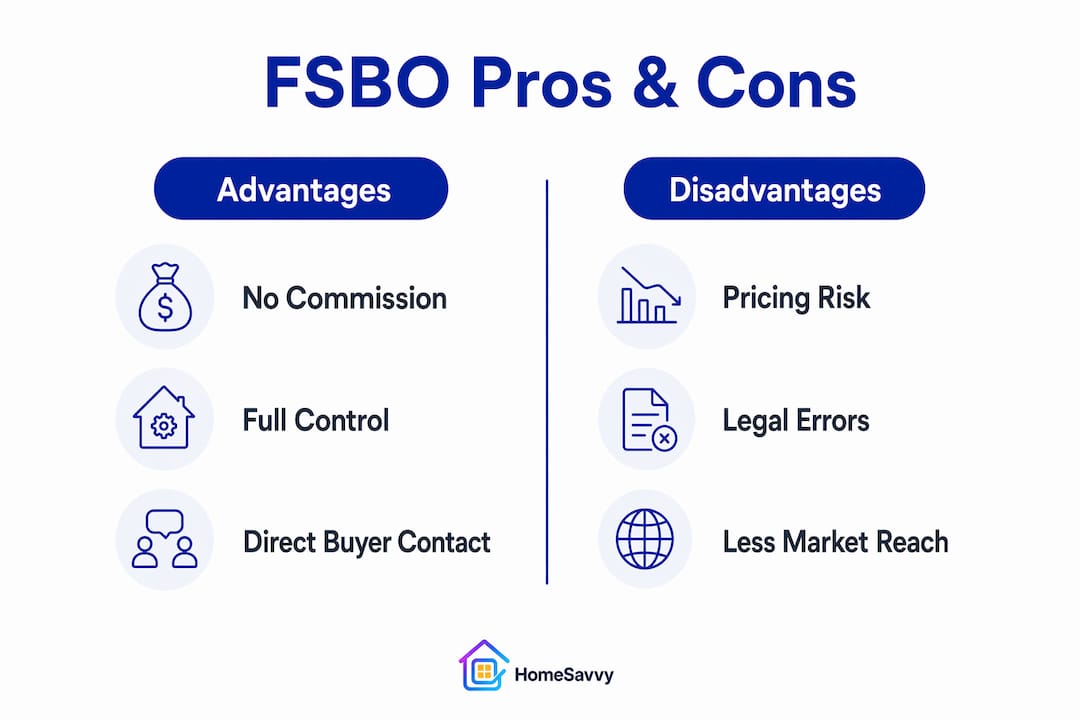
The FSBO advantages and disadvantages are real on both sides, and understanding them clearly is the only way to make a smart decision.
The case for going FSBO
The biggest draw is commission savings. Avoiding a listing agent's fee of 2.5–3% can mean tens of thousands of dollars staying in your pocket. On a $500,000 home, that is $12,500–$15,000 in savings. Beyond money, FSBO gives you complete control over how your home is presented, when showings happen, and how you communicate with buyers. Some sellers value that direct relationship and find it leads to smoother, more personal transactions.
The real risks of FSBO
The disadvantages are harder to dismiss. Without agent guidance, FSBO sellers risk errors in disclosures, contracts, and legal compliance that can derail a sale entirely. A missed disclosure requirement in Colorado, for example, can expose you to post-closing liability.
Pricing is another major risk. Agents use comparative market analysis (CMA) data and professional networks that help justify higher asking prices. Without that data, FSBO sellers frequently underprice or overprice their homes. Both outcomes cost money. Overpricing leads to a stale listing. Underpricing leaves equity on the table.
FSBO sellers may net less overall due to weaker negotiation and reduced market exposure compared to agent-assisted sales. That potential commission savings can shrink or disappear entirely when the final sale price falls short.
| Factor | FSBO | Agent-Listed |
|---|---|---|
| Commission cost | 0% listing fee | 2.5–3% listing fee |
| Market exposure | Limited to owner's channels | MLS, agent networks, portals |
| Pricing accuracy | Owner-determined | CMA-backed professional estimate |
| Legal support | Owner's responsibility | Agent and transaction coordinator |
| Negotiation support | Owner handles alone | Agent advocates on your behalf |
Pro Tip: Before committing to FSBO, get a free home valuation from a local agent or use an AI-powered tool like Homesavvycolorado's PropertyIQ. Knowing your home's accurate market value before you list is the single most important step in any sale.
How does FSBO compare to using a real estate agent?
The core difference between FSBO and agent-listed sales comes down to resources and reach. A licensed agent brings access to the Multiple Listing Service (MLS), a professional buyer network, and transaction management experience. FSBO sellers work outside that system unless they pay a flat-fee MLS service to get their listing onto the MLS.
Agents offer CMA data and professional networks that help with pricing and managing buyer offer contingencies. That expertise matters most in competitive markets where multiple offers, escalation clauses, and inspection contingencies require careful handling. A seller who has never read a real estate purchase contract before is at a disadvantage when a buyer's agent submits a complex offer.
Closing timelines also differ. FSBO deals face more closing delays due to communication gaps between the seller, the buyer's lender, and the title company. An experienced agent acts as a project manager for the transaction, chasing documents, coordinating deadlines, and solving problems before they become deal-killers.
| Comparison Point | FSBO | Agent-Listed |
|---|---|---|
| MLS access | Requires flat-fee service | Included |
| Closing delay risk | Higher | Lower |
| Offer management | Owner alone | Agent-managed |
| Buyer pool size | Smaller | Larger |
| Legal document support | None unless attorney hired | Included |
That said, agent-listed does not have to mean full commission. Services like Homesavvycolorado offer reduced listing fee options that give sellers MLS access and agent support without the traditional 2.5–3% cost. That middle ground is worth knowing about before you decide between full FSBO and a traditional listing.
How to sell a home FSBO: step-by-step
Selling a home FSBO follows a clear sequence. Skipping steps or rushing through them is where most FSBO sellers run into trouble.
-
Set a competitive price. Research recent comparable sales in your neighborhood using public records, Zillow's sold data, or Redfin's history tool. Price too high and buyers skip your listing. Price too low and you leave money behind. Consider a professional appraisal if you are unsure.
-
Prepare and stage your home. Clean, declutter, and make necessary repairs before any photos are taken. Review home staging strategies specific to your market. First impressions in listing photos drive whether buyers schedule a showing.
-
Market your listing. FSBO marketing typically includes yard signs, listing on Zillow, Trulia, and Forsalebyowner.com, social media posts, and word of mouth. For broader reach, pay a flat-fee MLS service to get your listing in front of buyer's agents. Learn more about listing your home online to maximize your exposure.
-
Manage showings. Schedule tours directly with buyers or their agents. Be available and responsive. Delayed responses to showing requests cost you serious buyers.
-
Review and negotiate offers. Read every offer carefully. Pay attention to contingencies, financing terms, and closing timelines. Counter when appropriate. Know your bottom line before negotiations start.
-
Handle disclosures and contracts. Colorado law requires specific seller disclosures. FSBO sellers must manage offer contingencies, closing coordination, and legal paperwork on their own. Hire a real estate attorney to review contracts if you are not confident in the legal language.
-
Coordinate the closing. Work directly with the title company and the buyer's lender to schedule the closing date, complete the title search, and sign final documents. Stay on top of every deadline.
Key documents you will need to prepare or review:
- Seller's Property Disclosure form
- Purchase and Sale Agreement
- Lead-based paint disclosure (for homes built before 1978)
- HOA documents (if applicable)
- Title commitment from the title company
Key takeaways
FSBO gives sellers full control and potential commission savings, but the risks of mispricing, legal errors, and limited market reach make it a demanding path that requires serious preparation.
| Point | Details |
|---|---|
| FSBO definition | A homeowner sells without an agent, managing pricing, marketing, and closing alone. |
| Commission savings potential | Skipping a listing agent saves 2.5–3%, or up to $21,000 on a $700,000 home. |
| Biggest FSBO risk | Legal and paperwork errors can derail a sale and create post-closing liability. |
| Closing delays are common | FSBO deals face more delays due to gaps in lender and title company communication. |
| Middle-ground options exist | Reduced-fee agent services offer MLS access and support without full commission costs. |
The part most FSBO articles won't tell you
Most articles on FSBO focus on the commission savings number and leave it there. After years of watching Colorado sellers navigate this decision, I can tell you the math is almost never as clean as it looks on paper.
The sellers who succeed with FSBO share one trait: they treat it like a part-time job for two to four months. They research pricing obsessively, respond to inquiries within the hour, and hire a real estate attorney before they ever accept an offer. They do not wing the legal paperwork.
The sellers who struggle are the ones who underestimate buyer's agents. When a buyer is represented by an experienced agent and the seller is not, the negotiation is rarely equal. Buyers' agents know how to use inspection reports, appraisal gaps, and financing contingencies as leverage. An unprepared FSBO seller can give back thousands in concessions without realizing it.
My honest read: FSBO makes the most sense for sellers who have sold homes before, have time to dedicate to the process, and are selling in a hot market where demand is high enough to offset limited marketing reach. For everyone else, the benefits of listing agents often outweigh the commission cost. A reduced-fee service that gives you MLS access and professional support for 1% is worth serious consideration before you go fully solo.
— Rishi
How Homesavvycolorado can help you price and sell smarter
Whether you are weighing FSBO or looking for a lower-cost alternative, accurate pricing is the foundation of every successful sale.

Homesavvycolorado's PropertyIQ AI valuation tool gives you a data-backed home value estimate in real time, so you know exactly where to price before you list. If you decide FSBO is not the right fit, Homesavvycolorado offers a 1% discount listing service that puts your home on the MLS with full agent support at a fraction of the traditional cost. Buyers can also explore commission rebate programs that return money at closing. Start with a free valuation and see what your home is actually worth today.
FAQ
What does FSBO mean in real estate?
FSBO stands for For Sale By Owner. It means the homeowner sells the property without a listing agent, managing pricing, marketing, negotiations, and closing independently.
How much can you save with a FSBO sale?
Sellers typically save 2.5–3% in listing agent commission. On a $700,000 home, that equals $17,500–$21,000 in savings, though final net proceeds depend on sale price and concessions.
Is the mortgage process different for FSBO homes?
No. Mortgage underwriting and appraisal requirements are identical for FSBO and agent-listed homes. FSBO deals do, however, face a higher rate of closing delays due to communication gaps.
What are the biggest risks of selling FSBO?
The primary risks are mispricing the home, making legal errors in disclosures or contracts, and achieving a lower final sale price due to limited market exposure and weaker negotiation leverage.
Do FSBO sellers have to pay a buyer's agent commission?
In most transactions, yes. If the buyer is represented by an agent, the FSBO seller is typically expected to offer a buyer's agent commission, usually 2.5–3%, to attract represented buyers.