

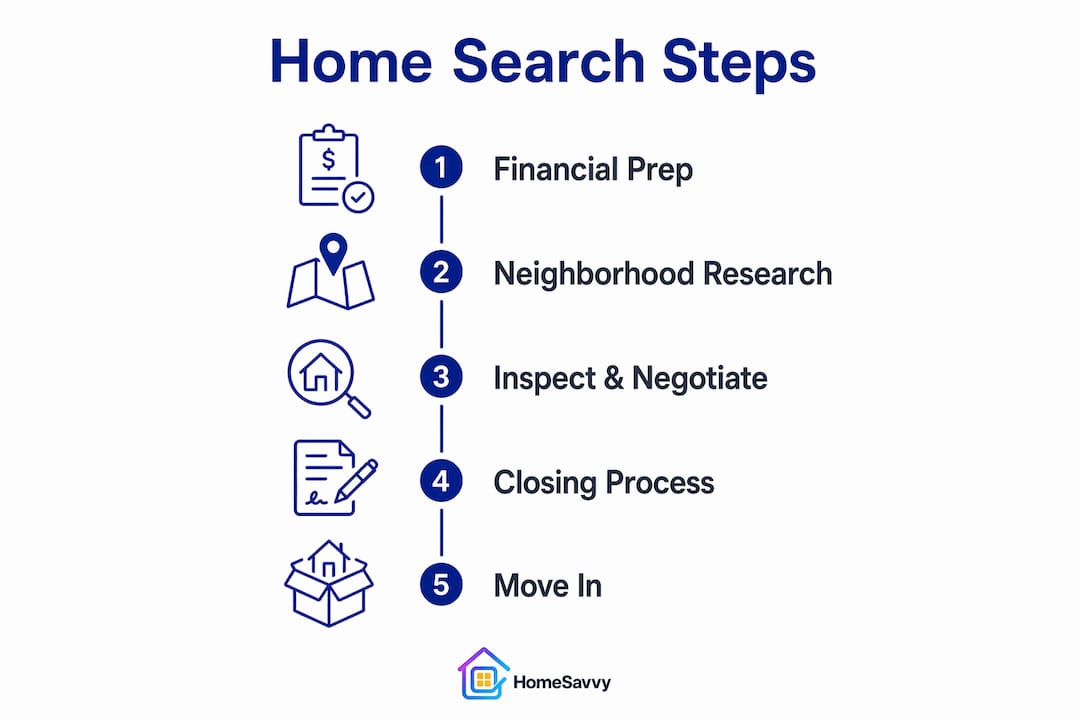
The Colorado home search process is a structured sequence of financial, legal, and logistical steps that buyers must complete to purchase a home in one of the country's most competitive real estate markets. Colorado buyers face location-specific costs beyond the home price, including average property tax rates around 0.51% and HOA fees from $50 to $500 per month. Average closing costs run approximately $13,000 for standard transactions. Well-prepared buyers typically complete the full process in 2 to 4 months, depending on market conditions and how quickly they move through each stage.
What are the essential financial preparations for the Colorado home search process?
Financial readiness is the single most important factor that separates buyers who close quickly from those who lose homes to competing offers. Colorado's market moves fast, particularly along the Front Range and in metro Denver. Getting your finances in order before you search a single listing is not optional.

Credit and mortgage pre-approval
Your credit score determines which loan products you qualify for and at what interest rate. Most conventional lenders want a score of at least 620, while FHA loans accept lower scores with a larger down payment. Pre-approval for a mortgage signals to sellers that you are a serious buyer with verified income, assets, and credit. Without a pre-approval letter, many Colorado sellers will not even consider your offer.
Pro Tip: Get pre-approved, not just pre-qualified. Pre-qualification is a rough estimate. Pre-approval involves a full credit check and document review, which carries real weight in a competitive offer situation.
Budgeting beyond the list price
The purchase price is only part of what you will pay. Colorado buyers need to account for several additional cost layers:
- Property taxes: Colorado's statewide average rate sits around 0.51%, but rates vary by county and municipality. Two homes with identical prices can carry very different annual tax bills depending on location.
- HOA fees: Fees range from $50 to $500 per month. Some communities charge more, particularly those with amenities like pools, fitness centers, or gated access.
- Closing costs: Budget roughly $13,034 for a standard financed transaction. These costs cover title insurance, escrow fees, lender origination charges, and prepaid items like homeowner's insurance.
- Home inspection: Expect to pay $300 to $500 out of pocket before closing.
- Insurance: Wildfire and hail coverage in Colorado can cost significantly more than national averages, especially in the foothills and Front Range corridors.
Property taxes and closing costs differ significantly by location within Colorado, affecting the true affordability of homes with similar list prices. Two buyers purchasing at the same price point can end up with very different monthly obligations.
How do you research and select neighborhoods and homes in Colorado?
Choosing where to buy in Colorado requires more than browsing listings. The state's geography, tax structure, and HOA landscape create meaningful differences between neighborhoods that look similar on paper.
Defining your search criteria
Start with hard limits: maximum purchase price, preferred neighborhoods, acceptable commute times, and school district requirements. Colorado's school districts vary widely in performance and funding, and district boundaries do not always align with city or neighborhood names. Research specific districts through the Colorado Department of Education before assuming a neighborhood qualifies.
- Commute: Denver metro traffic is worst on I-25 and I-70 corridors. A home in Thornton or Aurora may look affordable until you factor in a 90-minute daily commute.
- School districts: Jefferson County, Cherry Creek, and Douglas County school districts consistently rank among the state's strongest. Boulder Valley and Fort Collins are also highly rated.
- Neighborhood trajectory: Look at recent sale prices, days on market, and new development activity. A neighborhood with rising prices and new construction nearby signals demand.
Evaluating HOAs in Colorado
Colorado HOAs are governed by the Colorado Common Interest Ownership Act (CCIOA), which sets baseline rules for disclosure and governance. However, CCIOA compliance does not guarantee a financially healthy HOA. Request the HOA's reserve study and financial statements before making an offer. A reserve study shows whether the HOA has set aside enough money for future repairs to roofs, parking lots, and shared systems.
Insurance risks by location
Homes in Colorado's foothills and mountain communities face higher wildfire and hail insurance risks, with some insurers withdrawing from high-risk areas entirely. Flood insurance is also recommended in Front Range corridors near rivers and drainage channels. Get insurance quotes for any home you seriously consider before submitting an offer. A home that fits your budget at purchase may not fit your budget once you add a high-risk insurance premium.
Use a Colorado property evaluation checklist to track these variables across multiple properties so you can compare them objectively.
What steps ensure successful offers, inspections, and negotiations in Colorado?
Making an offer in Colorado is not just about price. The structure of your offer, the contingencies you include, and how you present your financial strength all affect whether a seller accepts, counters, or ignores your bid.
Structuring your offer
- Set your offer price. Base it on recent comparable sales in the same neighborhood, not the list price alone. Your agent should pull comps from the past 90 days.
- Include earnest money. Earnest money deposits in Colorado typically run 1–3% of the purchase price, held in escrow. A higher deposit signals stronger commitment.
- Add your contingencies. Financing contingencies typically last 21–30 days. Appraisal contingencies are usually included within the financing contingency period.
- Request an inspection period. Colorado contracts typically allow 10 days for inspection. Use this window to hire a licensed inspector and review the full report before deciding whether to proceed, negotiate, or walk away.
- Submit your pre-approval letter. Attach it to every offer. Sellers and their agents treat pre-approved buyers as lower-risk.
Pro Tip: In a competitive multiple-offer situation, consider an escalation clause. This automatically increases your offer by a set increment above any competing bid, up to your maximum price. It keeps you competitive without requiring a back-and-forth negotiation.
Negotiating after inspection
The inspection report is your primary negotiation tool after an accepted offer. Common negotiation outcomes include a seller credit toward closing costs, a price reduction, or specific repairs completed before closing. Seller concessions are more common when a home has been on the market for more than 30 days. In a hot market, sellers may reject repair requests entirely. Know your walk-away point before you enter negotiations.
A Colorado real estate checklist helps you track every negotiation point and avoid missing critical deadlines during this stage.
What does the Colorado closing process involve, and what should buyers expect?
Closing is the final transfer of ownership from seller to buyer. In Colorado, title companies play a central role in safely managing funds, verifying ownership, and facilitating secure wire transfers during closing.
Timeline and key steps
The typical closing timeline in Colorado runs 30–45 days for financed purchases and 14–21 days for cash buyers. During this period, several things happen simultaneously:
- Mortgage underwriting: Your lender reviews your full file, orders an appraisal, and issues a final loan approval.
- Title search: The title company verifies the seller has clear ownership and no outstanding liens.
- Final walkthrough: Typically scheduled 24 hours before closing to confirm the home's condition matches the contract.
- Closing disclosure review: Your lender sends a Closing Disclosure at least three business days before closing. Review every line item against your Loan Estimate.
Pro Tip: Verify wire transfer instructions by phone directly with your title company before sending any funds. Wire fraud targeting real estate transactions is a documented and growing problem in Colorado. Call the number on the title company's official website, not the number in an email.
Closing costs average about $13,034 in Colorado, covering title insurance, escrow fees, lender charges, and prepaid expenses. Review a detailed breakdown of Colorado closing costs before your closing date so nothing surprises you at the table.
| Closing cost item | Typical cost range |
|---|---|
| Title insurance | $500–$1,500 |
| Escrow/settlement fee | $300–$800 |
| Lender origination fee | 0.5%–1% of loan |
| Prepaid homeowner's insurance | $800–$1,500 |
| Property tax proration | Varies by closing date |
How do you evaluate HOAs and manage location-specific risks in Colorado?
HOA evaluation goes well beyond the monthly fee. The financial health of an HOA determines whether you face a surprise special assessment six months after moving in.
Buyers should prioritize reviewing HOA reserve funds and financial health over just monthly fees to avoid unexpected special assessments that are not always disclosed openly. A reserve fund below 70% of its target is a warning sign. An HOA with a depleted reserve and aging infrastructure will eventually pass the repair costs to homeowners through a special assessment, which can run into thousands of dollars per unit.
"Many HOAs have complex fee structures not always transparent to buyers. Request the last two years of meeting minutes, the current budget, and the reserve study before you commit."
Key risks to evaluate when choosing a Colorado home:
- Wildfire zones: Check the Colorado Division of Fire Prevention and Control's risk maps before buying in the foothills or mountain communities.
- Hail damage history: Ask your insurance agent about claims history in the zip code. Areas with frequent hail claims face higher premiums and policy cancellations.
- Flood zones: FEMA flood maps show whether a property requires flood insurance. Front Range properties near the South Platte River and its tributaries carry real flood risk.
- Metro districts: Some Colorado communities are governed by metro districts rather than traditional HOAs. Metro districts can levy property taxes on top of standard county taxes, significantly increasing your annual cost.
A local real estate agent is invaluable for navigating these Colorado-specific complexities, including metro district structures and HOA governance details that rarely appear in online listings.
Key Takeaways
The Colorado home search process rewards buyers who prepare financially, research local costs thoroughly, and understand the state's unique HOA and insurance landscape before making an offer.
| Point | Details |
|---|---|
| Get pre-approved first | Without a pre-approval letter, most Colorado sellers will not consider your offer. |
| Budget for total costs | Factor in property taxes (~0.51%), HOA fees ($50–$500/month), and ~$13,000 in closing costs. |
| Evaluate HOA health | Review reserve studies and financial statements, not just the monthly fee amount. |
| Assess insurance risks | Get wildfire, hail, and flood insurance quotes before committing to any Colorado property. |
| Expect a 30–45 day close | Financed buyers typically close in 30–45 days; cash buyers can close in 14–21 days. |
What I've learned from watching Colorado buyers make the same mistakes
The buyers who struggle most in Colorado are not the ones with the smallest budgets. They are the ones who underestimate how much local knowledge matters. I have seen buyers fall in love with a home in a foothills community, skip the insurance research, and then discover their annual premium would be $6,000 more than they planned. That is a budget-breaking surprise that a 20-minute conversation with an insurance agent would have prevented.
Financial preparation is the foundation, but it is not enough on its own. The buyers who close with confidence are the ones who treat every step as a research project. They pull HOA financials. They check metro district tax levies. They verify the school district boundary, not just the neighborhood name. These are not complicated tasks. They just require discipline.
The other thing I consistently see undervalued is the role of a Colorado-specific agent. A good local agent does not just open doors. They know which HOAs have pending special assessments, which neighborhoods are in active wildfire mitigation zones, and which metro districts carry hidden tax burdens. That knowledge is worth far more than the commission you pay for it.
— Rishi
Homesavvycolorado's PropertyIQ tool gives you a real edge
Knowing a home's fair market value before you make an offer is one of the most powerful advantages a buyer can have in Colorado's competitive market.

Homesavvycolorado's PropertyIQ AI valuation tool analyzes real-time Colorado market data to give you an accurate, data-backed estimate of any property's value. Use it before you write an offer to confirm you are not overpaying, or during negotiations to support a lower bid with hard numbers. Buyers working with Homesavvycolorado also qualify for significant commission rebates at closing, putting real money back in your pocket. The combination of AI-powered valuation and full-service agent support gives you both the data and the expertise to buy with confidence.
FAQ
How long does the Colorado home search process take?
The full process from financial preparation to closing typically takes 2 to 4 months for well-prepared buyers. Market conditions and buyer readiness are the biggest variables.
What is a typical earnest money deposit in Colorado?
Colorado buyers typically submit an earnest money deposit of 1–3% of the purchase price. The funds are held in escrow and applied toward closing costs or returned if a contingency is triggered.
What are Colorado closing costs?
Colorado closing costs average about $13,034 for a standard financed transaction. They cover title insurance, escrow fees, lender origination charges, and prepaid items like homeowner's insurance.
What is the CCIOA and why does it matter?
The Colorado Common Interest Ownership Act (CCIOA) governs HOA rules and disclosure requirements across the state. It sets baseline standards, but buyers still need to independently review each HOA's financial health and reserve fund status.
Do I need flood or wildfire insurance in Colorado?
It depends on your location. Homes in the foothills and mountain communities face elevated wildfire risk, while Front Range properties near rivers may require flood insurance. Get location-specific quotes before finalizing any purchase.