

Colorado's 2026 real estate market is giving investors something they haven't had in years: room to breathe. After several years of frenzied bidding wars and shrinking inventory, the market has shifted toward balance, with more homes available, longer listing times, and real negotiation leverage returning to buyers. But this window of opportunity comes with new complexity. Rent growth has cooled, short-term rental rules have tightened in key markets, and expense math has become harder to ignore. This guide walks you through exactly what you need to know to invest wisely in Colorado this year.
Table of Contents
- 2026 market overview: Inventory, leverage, and pricing
- Preparing for your Colorado investment: Expense math and due diligence
- Negotiation power: Leveraging inventory and days on market
- Navigating Colorado's short-term rental regulations
- A seasoned investor's take: Why Colorado demands deeper due diligence
- Next steps: Colorado investment tools and saving opportunities
- Frequently asked questions
Key Takeaways
| Point | Details |
|---|---|
| Buyer leverage is rising | More inventory and longer days on market give buyers greater negotiation power in Colorado’s 2026 market. |
| Expense analysis is vital | Successful investing requires careful calculation of recurring costs beyond just rent or purchase price. |
| Regulation varies by location | Short-term rental and licensing laws differ across Colorado towns and are especially strict in Denver. |
| Expert negotiation maximizes returns | Applying negotiation strategies on high-inventory properties can yield better deals for investors and buyers. |
| Leverage local tools for value | Utilize valuation, commission rebate, and selling tools to optimize savings and investment outcomes. |
2026 market overview: Inventory, leverage, and pricing
The single biggest change in Colorado's 2026 real estate landscape is inventory. After years of scarcity, supply has returned in most metro and mountain markets. More homes are sitting on the market longer, and sellers who once expected multiple offers in days are now fielding one or two offers over weeks. That's a meaningful shift for investors and buyers who know how to use it.
Colorado's 2026 housing market is shifting toward buyer leverage, with more inventory and longer days on market creating real opportunities for patient, data-driven buyers. Statewide conditions reflect this balance. According to the Colorado Association of REALTORS, markets are finding equilibrium as the full spring season begins, with days on market elevated and supply supporting buyer leverage across most of the state.
Here's what the numbers look like for Denver specifically:
| Metric | 2026 figure |
|---|---|
| Median home price | $600,000 |
| Median monthly rent | $2,695 |
| Rent change (year over year) | Down 5% |
| Average days on market | Elevated vs. 2023 and 2024 |
| Market posture | Balanced to buyer-favorable |
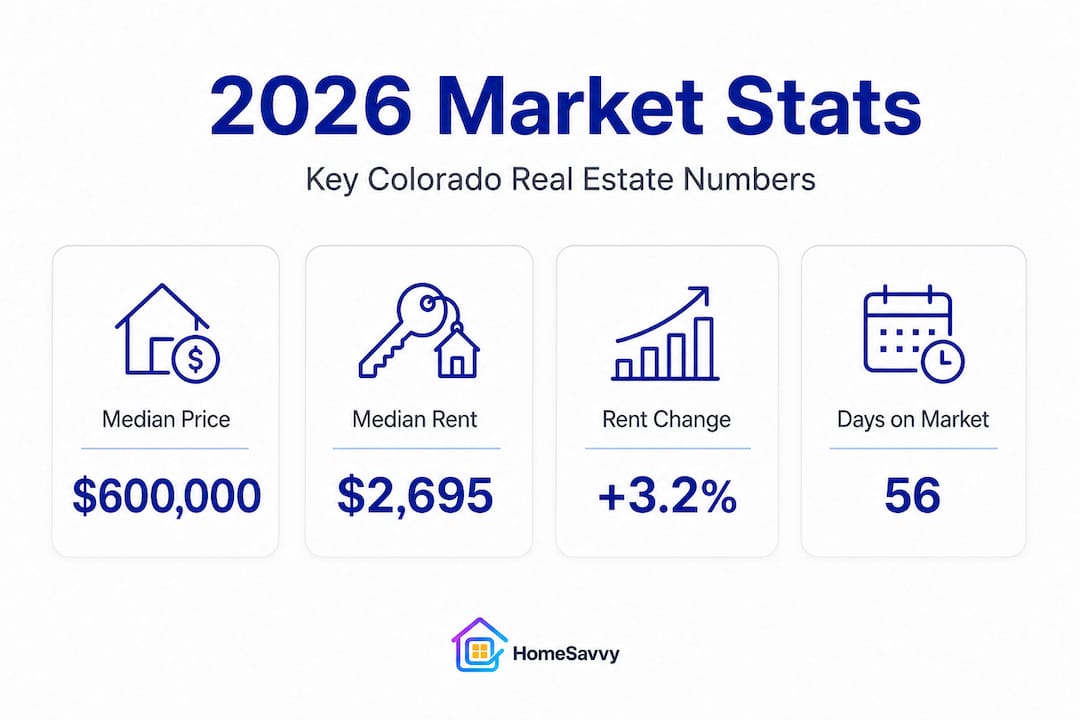
For investors, a 5% drop in median rent is significant. It means pro forma models built on 2022 or 2023 assumptions are likely overstating your income potential. If you're using making smarter buying choices as part of your approach, recalibrating rent assumptions downward before you run your numbers is a mandatory first step.
Key dynamics every investor should track in 2026:
- Active inventory is well above pandemic-era lows in most Colorado metros
- Months of supply have climbed into balanced territory (4 to 6 months in many areas)
- Price reductions are more common, creating room to negotiate below list
- Seller concessions for closing costs and repairs are back on the table
- Buyer competition has softened enough to conduct proper due diligence
This environment rewards preparation. If you go into a deal with a solid understanding of your target property's income potential, local expense structure, and exit options, you are in a far better position than you were two years ago. Understanding marketing strategies for ROI can also help you think about how you'll position a property when it's time to sell or lease.
Preparing for your Colorado investment: Expense math and due diligence

Most investors who lose money on rental properties don't lose it because they bought a bad asset. They lose it because they underestimated expenses. In Colorado, the gap between gross rent and net cash flow can be surprisingly large.
Cash flow math is heavily affected by ongoing expenses including property taxes, insurance, management fees, and maintenance. In Denver specifically, those numbers break down like this:
| Expense category | Typical range or rate |
|---|---|
| Property tax rate | ~0.49% of assessed value annually |
| Homeowner's insurance | $1,200 to $2,500 per year |
| Property management | 8% to 10% of gross rent monthly |
| Maintenance reserve | 5% to 10% of gross rent monthly |
| HOA fees (if applicable) | Varies widely, often $200 to $600/month |
| Vacancy reserve | 5% to 8% of gross rent annually |
On a $600,000 Denver property, property taxes alone run roughly $2,900 per year. Add insurance, management, maintenance, and a vacancy buffer, and you could be looking at $1,200 or more in monthly expenses before you even pay your mortgage. That fundamentally changes your cash flow picture.
Here's a step-by-step process for building an accurate expense model before you make an offer:
- Calculate your all-in monthly housing cost. Start with principal, interest, taxes, and insurance (PITI). Then add management, maintenance reserve, vacancy reserve, and HOA.
- Use current market rents, not peak rents. With Denver rents down 5% year over year, use current Zillow or rental comps, not year-old data.
- Stress-test your model. Run the numbers assuming rents drop another 5% and vacancy runs at 8%. If the deal still works, it's worth pursuing.
- Budget for capital expenditures separately. Water heaters, roofs, HVAC systems, and appliances fail. Set aside 1% of purchase price per year as a CapEx (capital expenditure) reserve.
- Account for hold time. In a balanced market, plan for a longer hold period of five to seven years minimum to allow for appreciation.
Pro Tip: Before finalizing any purchase, run two models: one optimistic and one conservative. If the conservative model generates negative cash flow, walk away or renegotiate the price down until the numbers work.
Understanding buyer rebates explained can also help reduce your upfront acquisition cost, which directly improves your long-term return on investment. Fewer dollars spent at closing means faster payback on your initial capital. Your buyer agent duties in Colorado also extend to helping you evaluate these exact cost structures before you commit.
Negotiation power: Leveraging inventory and days on market
Here's something that gets overlooked in most real estate discussions: the best time to negotiate isn't when you're desperate. It's when you're not. With more inventory on the market and sellers sitting on unsold listings for weeks, 2026 is giving buyers the patience advantage they've been missing for years.
Buyer leverage is now prominent, with more inventory and longer days on market creating tangible negotiation opportunities across Colorado's major markets. The question is how to act on it strategically.
Finding the right targets:
- Look for properties that have been listed for 30 days or more. Sellers at that point are far more open to concessions.
- Filter for price-reduced listings. A price reduction signals a motivated seller who has already demonstrated flexibility.
- Check listing history. A property that expired, was pulled off market, and relisted is almost always negotiable.
Effective tactics in 2026:
- Request seller concessions toward closing costs or a rate buydown. In a balanced market, 2% to 3% in concessions is realistic.
- Ask for a repair credit rather than asking sellers to fix items. This gives you control over the quality of work done.
- Negotiate inspection contingency terms. A longer inspection period lets you get quotes on any needed repairs before committing.
- Make offers based on data, not emotion. If a property has been sitting for 45 days in a market where average days on market is 28, that's leverage. Use it.
"In a normalized market, the buyer who comes in with data, patience, and a clear walk-away number wins more often than the buyer who comes in with urgency." This is the mindset shift that separates investors from anxious buyers.
Understanding home selling tips from the seller's perspective also helps investors think like the other side of the table, which makes your negotiation strategy sharper.
Also, use the maximize savings checklist before finalizing any offer. It covers key steps that many buyers miss when moving quickly through the process.
Navigating Colorado's short-term rental regulations
If you're considering a short-term rental (STR) property, whether in Denver, the mountains, or a college town, the regulatory environment is the most critical factor you need to understand before running any income projections.
Colorado STR regulation is not uniform statewide. Local governments set their own rules, and those rules can materially change investor returns overnight. There is no state-level preemption that protects your ability to operate an STR in any given municipality.
Here's how major Colorado markets compare on STR rules:
| Municipality | Primary residence required? | License required? | Additional restrictions |
|---|---|---|---|
| Denver | Yes | Yes | STR limited to primary home only |
| Breckenridge | No | Yes | Cap on total STR licenses |
| Steamboat Springs | No | Yes | Zoning-based restrictions apply |
| Colorado Springs | No | Yes | Neighborhood association rules vary |
| Boulder | Yes (in most zones) | Yes | Strict occupancy limits |
The steps to verify your STR viability before purchasing:
- Contact the local planning or licensing department directly. Don't rely solely on an agent or online sources.
- Check zoning for your specific parcel. Even within a city, STR rules can differ block by block.
- Review HOA documents thoroughly. Many HOAs in Colorado explicitly prohibit STRs regardless of what the municipality allows.
- Understand the tax obligations. Colorado STR operators must collect and remit sales tax, lodging tax, and sometimes county taxes. Review the Colorado STR tax guide for a detailed breakdown.
- Understand registration requirements. The STR registration process in Colorado varies by locality and often includes insurance, inspection, and fee requirements.
The safest approach: underwrite any potential STR investment as a long-term rental first. If the deal works as a traditional rental, the STR income is upside. If it only works as an STR, you're taking on significant regulatory and income risk.
A seasoned investor's take: Why Colorado demands deeper due diligence
We've seen investors get burned in Colorado not because the market turned against them, but because they used outdated mental shortcuts. The "1% rule" that worked in 2015 (where monthly rent should equal 1% of purchase price) doesn't apply in a market where a $600,000 Denver property rents for $2,695. That math produces 0.45%, and expenses still have to come out of that.
The investors who succeed in Colorado's 2026 market are doing several things differently. First, they're treating expense modeling as a discipline, not an afterthought. They're not estimating maintenance at 1% and calling it done. They're getting actual insurance quotes, calling property managers for real fee structures, and pulling tax records on specific parcels before making offers.
Second, they're taking regulatory risk seriously. Colorado's regulatory environment around STRs has tightened considerably over the past three years, and that trend is not reversing. Every STR investment now needs a Plan B: what does this property generate as a traditional long-term rental, and is that enough to service the debt and produce acceptable returns?
Third, they're building in flexibility. An exit strategy that only works if rents rise and the property sells at a premium is not a strategy. It's a hope. Experienced investors in this market build scenarios where they break even on cash flow for two to three years while equity builds, then reassess based on market conditions.
We also see smart investors using data tools to find properties where the gap between list price and intrinsic value is widest. ROI marketing insights show that properties purchased below market value with strong fundamentals consistently outperform speculative acquisitions. Patience, preparation, and conservative underwriting are not exciting strategies. They just happen to work.
Next steps: Colorado investment tools and saving opportunities
Colorado's 2026 market rewards buyers and investors who combine solid fundamentals with the right tools and professional support.

At HomeSavvy Colorado, we built our platform specifically for buyers and investors who want data clarity without overpaying for it. Our home valuation tool gives you AI-powered property insights based on real-time market data, so your purchase decisions are grounded in current comps, not stale estimates. Buyers working with our platform also benefit from commission rebates that can put thousands of dollars back in your pocket at closing, improving your overall return from day one. If you're selling a property to reposition your portfolio, our discount listing service lets you reduce transaction costs while still getting full-service support and expert market exposure.
Frequently asked questions
How is Colorado's real estate investment environment changing in 2026?
Inventory is higher and buyer leverage has increased, with pricing more stable and negotiation opportunities greater than in past years, making it a favorable environment for prepared investors.
What are the biggest ongoing expenses for Colorado rental properties?
Property taxes, insurance, management fees, and maintenance reserves significantly impact cash flow, and according to Denver expense planning data, investors who underestimate these costs consistently miss their return targets.
Do all Colorado towns have the same short-term rental rules?
No. STR regulations vary widely by municipality, and Denver is especially strict, requiring that STRs operate only out of an owner's primary residence.
What negotiation strategies work best with elevated days on market?
Targeting listings with extended time on market, requesting seller concessions, and using repair credits are the most effective tactics in today's market, with buyer leverage now prominent across most Colorado metros.