

Colorado transfer tax is defined as a two-part cost: a minimal statewide documentary fee of 0.01% on any property sale over $500, plus potential local real estate transfer taxes in select mountain resort municipalities. Most buyers and sellers in Colorado pay almost nothing at the state level. The real surprise comes from local transfer taxes in towns like Aspen, Vail, and Breckenridge, where rates climb from 1% to 3% of the sale price. Understanding both layers before closing day is the difference between a smooth transaction and a budget shortfall.
How does colorado transfer tax work?
Colorado does not impose a traditional statewide real estate transfer tax. Instead, the state charges a documentary fee of 0.01% on property sales where the consideration exceeds $500. This fee applies uniformly across all 64 Colorado counties. At that rate, the statewide cost on a $500,000 home is just $50. Compare that to states with transfer tax rates of 0.1% to 3%, and Colorado's base fee is among the lowest nationally.
The documentary fee is sometimes called a "real estate transfer fee" in casual conversation, but the correct industry term is the Colorado Documentary Fee. Both phrases refer to the same charge. Knowing the standard term helps you spot it correctly on your closing disclosure.

How the documentary fee is calculated
The math is simple. The formula is: Sale Price x 0.0001 = Documentary Fee.
- A $300,000 sale generates a $30 documentary fee.
- A $500,000 sale generates a $50 documentary fee.
- A $900,000 sale generates a $90 documentary fee.
- Any sale at or below $500 is exempt from the fee entirely.
Recording fees are separate from the documentary fee. The county charges recording fees as flat administrative costs to file your deed. Recording fees run approximately $43 per document in most Colorado counties. Budget for both charges independently.
Pro Tip: Use the Colorado All Counties Documentary Fee Calculator at clpropertysearch.com to confirm the exact fee for your specific sale price before closing day.
Which colorado cities charge local transfer taxes?
Local real estate transfer taxes are municipal ordinances, not state law. That distinction matters because local RETTs are separate from state tax law and vary by city. You must check the specific municipality where the property sits, not just the county.
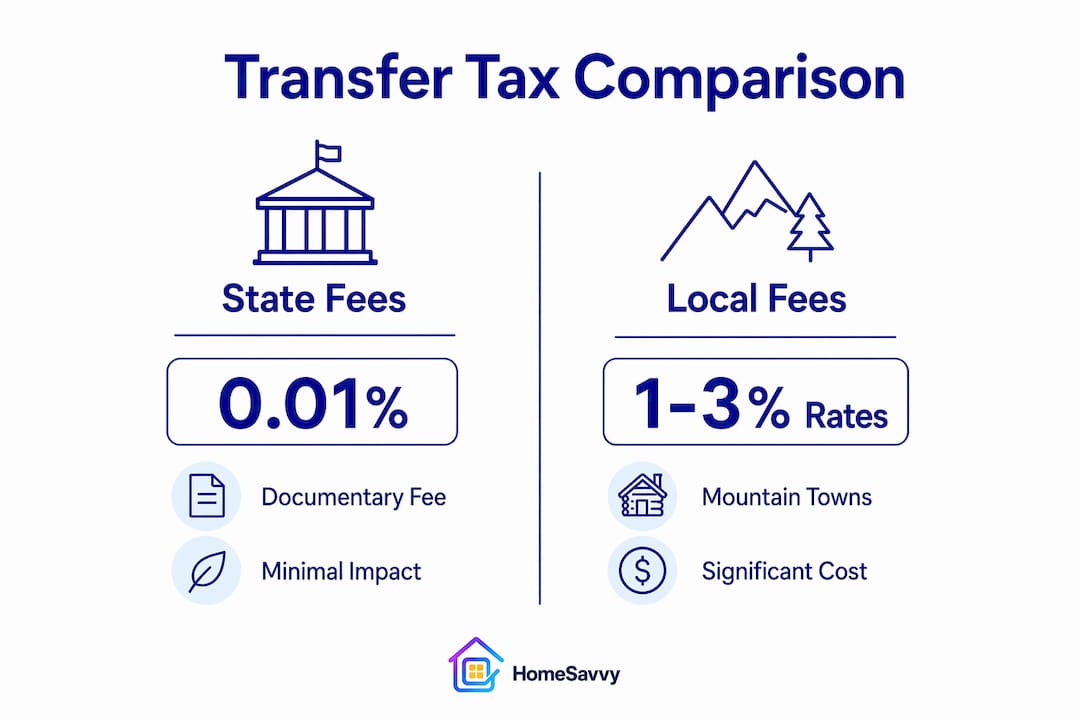
The following mountain resort towns impose local real estate transfer taxes on top of the statewide documentary fee:
| Municipality | Local Transfer Tax Rate |
|---|---|
| Aspen | 1.5% |
| Vail | 1.0% |
| Breckenridge | 1.0% |
| Telluride | 3.0% |
| Snowmass Village | 1.0% |
These local rates range from 1% to 3%, and they apply to the full sale price. On a $1,000,000 Telluride property, the local RETT alone is $30,000. That figure dwarfs the $100 statewide documentary fee on the same transaction. Buyers focused only on the state fee routinely underestimate their total closing costs in these markets.
Pro Tip: Before making an offer on any Colorado mountain property, search the city's official website or ask your agent to confirm whether a local RETT applies. This takes five minutes and can change your entire budget.
Who pays the transfer tax in colorado?
Transfer tax responsibility is negotiable in Colorado. The Colorado Residential Contract provides three options: the seller pays, the buyer pays, or the parties split the cost. No state law mandates which party must pay.
In practice, sellers most often cover the local RETT in resort markets because it has historically been treated as a seller's cost. The statewide documentary fee is typically paid by the seller as well, though this varies by county and deal terms. Here is how the negotiation usually plays out:
- Seller pays: Most common in resort towns and standard residential sales statewide.
- Buyer pays: Less common but negotiable, particularly in competitive markets where sellers hold leverage.
- Split: Used in transactions where both parties want to share closing costs to keep the deal moving.
Understanding who pays affects your net proceeds as a seller and your total cash-to-close as a buyer. A $30,000 local RETT in Telluride is a meaningful line item in any negotiation. Review your Colorado closing costs early so you know what to expect before you sit at the table.
Transfer taxes vs. recording fees: what is the difference?
Transfer taxes and recording fees are two distinct charges that appear on the same closing disclosure. Confusing them is one of the most common mistakes buyers and sellers make. Legal and escrow professionals note that this confusion creates unexpected friction at closing more often than any other fee misunderstanding.
Here is the core difference:
- Transfer tax is an ad valorem charge. It scales with the sale price. The higher the price, the higher the tax.
- Recording fees are flat administrative charges. The county collects them to officially record the deed in public records. Recording fees typically range $50–$150 per document depending on the county.
Reviewing your closing disclosure carefully ensures transfer tax and recording fees are properly itemized and avoids payment errors on closing day.
Both charges appear as separate line items. Neither one is optional. Budget for them as two distinct costs, not one combined fee. If you want a full breakdown of every charge you will see at the table, the real estate closing guide from Homesavvycolorado walks through each item in plain language.
How to budget for colorado transfer taxes: real examples
Practical planning starts with knowing your numbers before you make an offer. Here are three real-world scenarios that show how transfer costs stack up across different Colorado markets.
Scenario 1: Denver, $600,000 sale
- Statewide documentary fee: $600,000 x 0.0001 = $60
- Local RETT: None (Denver does not impose a local RETT)
- Recording fee: approximately $43
- Total transfer-related costs: approximately $103
Scenario 2: Breckenridge, $800,000 sale
- Statewide documentary fee: $800,000 x 0.0001 = $80
- Local RETT at 1%: $800,000 x 0.01 = $8,000
- Recording fee: approximately $43
- Total transfer-related costs: approximately $8,123
Scenario 3: Telluride, $1,500,000 sale
- Statewide documentary fee: $1,500,000 x 0.0001 = $150
- Local RETT at 3%: $1,500,000 x 0.03 = $45,000
- Recording fee: approximately $43
- Total transfer-related costs: approximately $45,193
The contrast is stark. A Denver buyer and a Telluride buyer pay nearly identical state fees, but the local RETT in Telluride adds tens of thousands of dollars. Local RETTs in resort towns significantly impact final transaction costs beyond what the modest state fee suggests.
| Market Type | State Documentary Fee | Local RETT | Total Impact |
|---|---|---|---|
| Front Range (Denver, Boulder) | Minimal (0.01%) | None | Very low |
| Mountain Resort Towns | Minimal (0.01%) | 1%–3% | High to very high |
Pro Tip: Always ask your agent to confirm local RETT rates for the specific city, not just the county. Summit County, for example, contains multiple municipalities with different rules.
To avoid hidden real estate fees in Colorado, request a preliminary closing disclosure from your title company at least one week before closing. This gives you time to question any line item you do not recognize.
Key takeaways
Colorado transfer tax is minimal at the state level but can reach tens of thousands of dollars in mountain resort towns due to local real estate transfer taxes ranging from 1% to 3%.
| Point | Details |
|---|---|
| Statewide documentary fee | Colorado charges 0.01% on sales over $500, applying uniformly across all 64 counties. |
| Local RETTs in resort towns | Aspen, Vail, Breckenridge, Telluride, and Snowmass Village add 1%–3% on top of the state fee. |
| Who pays is negotiable | The Colorado Residential Contract lets seller, buyer, or both parties share the transfer tax. |
| Transfer tax vs. recording fees | Transfer tax scales with sale price; recording fees are flat charges around $43 per document. |
| Budget before you offer | Calculate local RETT costs before making an offer, especially in mountain resort markets. |
What i have learned after years of colorado closings
Most buyers walk into a Colorado transaction focused on the mortgage rate and the purchase price. Transfer taxes are an afterthought. That is a mistake I have seen cost people real money, particularly in resort markets.
The statewide documentary fee is genuinely not worth worrying about. Fifty dollars on a $500,000 sale is noise. But the local RETT in Telluride at 3% is a different conversation entirely. I have watched buyers in Telluride and Aspen get blindsided by five-figure transfer tax bills they never factored into their cash-to-close. Their agents did not flag it early enough, and the title company only surfaced it on the final disclosure.
The other pattern I see constantly is buyers conflating transfer taxes with recording fees. They are not the same thing. One scales with your sale price. The other is a flat $43 administrative charge. When a buyer calls me confused about a $15,000 line item on their disclosure, it is almost always the local RETT, not the recording fee. Clear communication about these fees from the start of a transaction prevents that confusion entirely.
My honest advice: treat the local RETT as a negotiation variable, not a fixed cost. In a slower market, sellers in resort towns will often absorb it. In a hot market, you may need to split it. Either way, knowing the number before you write the offer puts you in control. Buyers who understand the tax benefits of real estate ownership also recognize that some of these costs have longer-term financial implications worth discussing with a tax advisor.
Plan ahead. Read the disclosure. Ask the question before closing day, not during it.
— Rishi
How Homesavvycolorado makes closing costs transparent
Homesavvycolorado built its platform specifically so Colorado buyers and sellers never get surprised by costs like local real estate transfer taxes. The PropertyIQ AI home valuation tool gives you an accurate picture of property value before you make an offer, so you can calculate transfer taxes and all closing costs against a reliable price estimate.

Homesavvycolorado agents know which municipalities carry local RETTs and factor them into your budget from day one. Buyers also receive significant commission rebates at closing, which can directly offset transfer tax costs in high-RETT markets. Sellers list for a reduced fee, keeping more of their net proceeds. If you are buying or selling anywhere in Colorado, Homesavvycolorado gives you the data and the support to close with confidence.
FAQ
What is colorado's statewide transfer tax rate?
Colorado charges a documentary fee of 0.01% on property sales exceeding $500. This equals $0.10 per $1,000 of sale price, making it one of the lowest transfer-related fees in the country.
Do all colorado cities charge a local real estate transfer tax?
No. Local real estate transfer taxes apply only in select mountain resort municipalities, including Aspen, Vail, Breckenridge, Telluride, and Snowmass Village. Most Colorado cities, including Denver and Colorado Springs, do not impose a local RETT.
How much is the transfer tax on a $500,000 home in colorado?
In a standard Colorado market without a local RETT, the documentary fee is $50. In a resort town like Breckenridge with a 1% local RETT, the total transfer-related cost on the same price rises to approximately $5,050.
Who pays the transfer tax when selling a home in colorado?
The Colorado Residential Contract makes transfer tax payment negotiable. Sellers most commonly pay it by default, but buyers can agree to cover it or the parties can split the cost depending on market conditions and deal terms.
Is the colorado documentary fee the same as a recording fee?
No. The documentary fee is a percentage-based transfer charge tied to the sale price. Recording fees are flat administrative charges, typically around $43 per document, paid to the county to officially record the deed.