

Comparing real estate brokers is the process of evaluating licensed professionals across criteria like credentials, communication, pricing strategy, and legal compliance to find the best representation for your transaction. In Colorado, this process carries added weight in 2026 because new regulatory changes now govern how brokers handle your confidential information internally. Whether you are buying your first home in Denver or selling a property in Fort Collins, a structured real estate broker comparison protects your interests and your money. The right broker brings local market knowledge, transparent fees, and a clear process for protecting your data.
How to compare real estate brokers: credentials and market knowledge
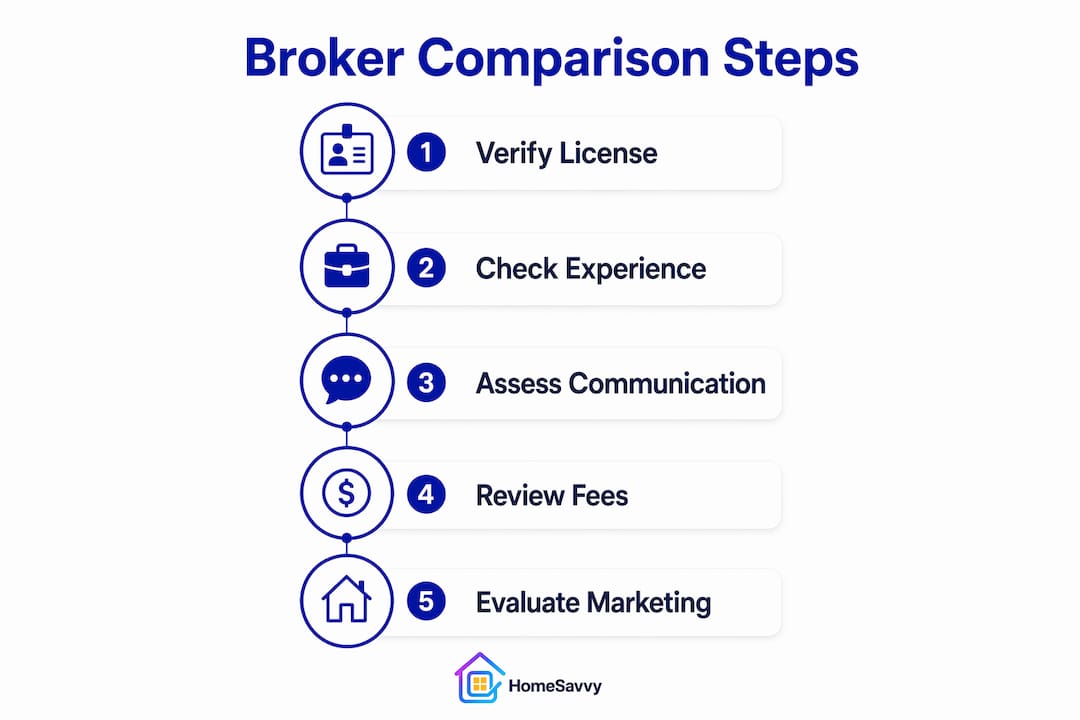
The foundation of any broker comparison is verifying that a candidate holds an active Colorado license and has a documented track record in your specific market. Years in the industry matter, but transaction volume in your target neighborhood matters more. A broker who has closed ten deals in Boulder's Hill neighborhood understands pricing nuances that a high-volume Denver broker simply does not.
Start your evaluation with these concrete steps:
- Check licensing status through the Colorado Division of Real Estate's online lookup tool to confirm the broker is active and in good standing.
- Review complaint history. Colorado's Real Estate Commission received 1,110 complaints against brokers in a single fiscal year out of 50,241 licensed professionals. That is roughly 2.2% of all licensees, which means complaint-free records are the norm, not the exception. Any complaint history warrants a direct conversation.
- Request references from recent clients who completed transactions similar to yours, whether that is a condo purchase under $400,000 or a luxury home sale above $1.5 million.
- Verify brokerage reputation. The employing brokerage's culture and training standards directly affect how individual brokers operate. Ask whether the brokerage provides ongoing education and mentorship.
Pro Tip: Ask each broker how many transactions they personally closed in your target zip code over the past 12 months. A broker who says "my team closed 50 deals" is not the same as one who personally handled 15 in your neighborhood.
Checking a broker's online profiles on platforms like Google Business and Zillow gives you a baseline, but direct reference calls reveal the details that matter. Ask references specifically about how the broker handled unexpected problems, not just whether they were satisfied overall.

What communication style and client service tell you about a broker
People skills and responsiveness are as important as technical expertise when choosing a broker. This is not a soft preference. Poor communication during a transaction causes missed deadlines, failed inspections, and lost deals. The interview stage is your only chance to assess this before you are locked into a contract.
When you sit down with a broker candidate, pay attention to how they listen. Do they ask clarifying questions about your timeline and priorities, or do they jump straight into their pitch? The best brokers ask more than they tell in a first meeting.
Here is what to probe during broker interviews:
- Response time expectations. Ask directly: "If I send you a message at 7 p.m. on a Tuesday, when should I expect a reply?" Their answer tells you their actual service standard.
- Communication channel preferences. Some brokers default to phone calls; others prefer text or email. Mismatched preferences create friction at the worst moments.
- Problem-solving examples. Ask for a specific story about a transaction that nearly fell apart and how they resolved it. Vague answers signal limited experience or poor recall of client outcomes.
- Client review patterns. Look for reviews on Google, Zillow, or the Colorado Association of Realtors directory that specifically mention communication and follow-through, not just a five-star rating.
Pro Tip: Ask each broker: "What is the most common mistake you see buyers (or sellers) make, and how do you prevent it?" Their answer reveals both their expertise and how they think about client education.
Comfort and trust are legitimate evaluation criteria. You will share financial details, personal timelines, and negotiation limits with this person. If something feels off in the interview, that instinct is data.
Understanding pricing strategies, commission fees, and value for money
Broker fees in Colorado are negotiable, and the industry has shifted significantly since the National Association of Realtors settlement changes took effect. Understanding the fee structure before you compare brokers prevents you from making decisions based on incomplete information. You can find a detailed breakdown of current structures in this Colorado broker fee guide.
The table below outlines the most common fee structures you will encounter when comparing real estate agents in Colorado:
| Fee structure | Typical range | What you get |
|---|---|---|
| Traditional full-service listing | 2.5%–3% seller-side | MLS listing, staging advice, negotiation, closing support |
| Discount listing agent | 1%–1.5% seller-side | MLS listing, basic marketing, limited negotiation support |
| Flat-fee MLS | $300–$1,500 one-time | MLS access only, no agent representation |
| Buyer agent commission | 2%–2.5% (negotiable) | Property search, offer writing, inspection coordination |
| Commission rebate model | Buyer receives 0.5%–1.5% back | Full buyer representation plus cash back at closing |
Beyond the rate itself, evaluate what each broker delivers for their fee. A broker charging 2.5% who provides professional photography, a 3D virtual tour, targeted social media advertising, and weekly market updates delivers more value than one charging 2% with a basic MLS listing and minimal follow-up.
Request a comparative market analysis from every broker you interview, based on sales from the past six months in your specific area. A broker who cannot produce a well-supported CMA or who prices your home based on wishful thinking rather than data is a liability, regardless of their commission rate. The best real estate brokers back every pricing recommendation with comparable sales, days-on-market data, and a clear rationale.
Pro Tip: When comparing commission rates, ask each broker: "What specific services are included, and what would cost extra?" Hidden fees for photography, transaction coordination, or marketing materials can erase the savings from a lower headline rate.
What role do confidentiality and the 2026 informed consent rule play?
Colorado's 2026 regulatory change is the most significant shift in broker conduct requirements in recent years, and most buyers and sellers are unaware of it. Starting January 1, 2026, Colorado brokers must obtain written informed consent before sharing any confidential client information with supervising brokers within the same brokerage. This is not a formality. It reshapes how your personal financial details, negotiation limits, and transaction strategy are handled internally.
"Colorado's designated brokerage law means your agency relationship exists only with your designated broker, not with the employing broker or other agents at the firm, unless you have explicitly consented to that information sharing."
Understanding this matters because designated brokerage in Colorado isolates your representation to a single named broker. Your confidential details should not flow freely to a managing broker or office staff without your knowledge and written approval.
When interviewing brokers, ask these specific questions about confidentiality:
- "Do you have a written informed consent process for sharing my information with supervising brokers?"
- "Who at your brokerage will have access to my financial details and negotiation strategy?"
- "How do you document client consent for internal information sharing?"
One critical compliance detail: reinserting deleted contract clauses about information sharing does not satisfy the new requirement. Brokers must implement a genuine consent workflow. Any broker who cannot clearly explain their consent procedures is either uninformed about the 2026 rule or unprepared to comply with it. You can learn more about your rights under current law in this guide to buyer agent duties in Colorado.
Comparing brokers' marketing approaches and negotiation tactics
For sellers, a broker's marketing plan is a direct predictor of sale price and time on market. For buyers, a broker's negotiation approach determines whether you win competitive offers without overpaying. Both deserve structured evaluation, not just a gut check.
Effective broker marketing includes MLS listing, Zillow and Realtor.com exposure, professional photography, video tours, and targeted social media advertising. Ask each broker candidate to walk you through a sample marketing plan for a property like yours. A broker who hands you a generic one-page overview is not the same as one who presents a property-specific strategy with a timeline and budget.
Key factors to evaluate in a broker's marketing and negotiation approach:
- MLS listing quality. Ask to see examples of their past listings. Poor photos, thin descriptions, and missing data signal low effort.
- Days on market for past listings. A broker whose listings consistently sit longer than the neighborhood average is either overpricing or under-marketing.
- Negotiation examples. Ask for a specific deal where they negotiated a favorable outcome for a client. Details matter: what was the ask, what was the result, and what tactic produced it?
- Buyer representation tactics. For buyers, ask how the broker handles multiple-offer situations. Escalation clauses, appraisal gap coverage, and inspection contingency strategy are all negotiable tools a skilled broker deploys proactively.
- Vendor relationships. Strong brokers maintain relationships with inspectors, lenders, and title companies that keep transactions on track. Ask who they recommend and why.
Comparing brokers on marketing and negotiation requires you to ask for evidence, not promises. Past performance in your specific price range and property type is the most reliable predictor of future results.
Key takeaways
Choosing the right Colorado broker requires evaluating credentials, communication, fees, confidentiality compliance, and marketing strategy together, not any single factor in isolation.
| Point | Details |
|---|---|
| Verify credentials and complaints | Check Colorado Division of Real Estate records and ask for neighborhood-specific transaction history. |
| Prioritize communication fit | Test responsiveness and problem-solving approach during the interview before signing any agreement. |
| Compare fees with deliverables | Request itemized service lists alongside commission rates to identify true value, not just the lowest price. |
| Confirm 2026 consent compliance | Ask every broker how they handle written informed consent for internal information sharing under Colorado's new rule. |
| Demand evidence-based marketing | Request sample marketing plans and past negotiation outcomes specific to your property type and price range. |
What most Colorado buyers and sellers miss when comparing brokers
Most people I talk to focus almost entirely on commission rates and brand name recognition when comparing brokers. Both are the wrong starting point. A well-known brokerage name does not guarantee the individual broker assigned to your file has the local knowledge or communication discipline your transaction requires.
The 2026 informed consent rule is a perfect example of where process matters more than prestige. I have seen buyers hand over their full financial picture and negotiation ceiling to a broker who then discussed it openly with a supervising broker, with no consent obtained. Under the new Colorado rules, that is a compliance failure. Asking a broker directly how they handle this is not paranoia. It is due diligence.
The best agent balances market knowledge with accurate pricing recommendations rather than just telling you what you want to hear. I have watched sellers choose brokers who promised the highest list price, only to sit on the market for 90 days and eventually sell below what a data-backed CMA would have suggested from the start. Overemphasis on broker prestige over process is the single most common and costly mistake Colorado buyers and sellers make.
Ask outcome-focused questions. Request specific numbers. Verify compliance with current law. That framework will serve you far better than any ranking list.
— Rishi
Find the right broker and save more with Homesavvycolorado
Homesavvycolorado combines AI-powered property data with full-service agent support to help Colorado buyers and sellers make smarter decisions without overpaying for representation.
Use the PropertyIQ valuation tool to generate an accurate, data-backed home value before you even sit down with a broker. That number gives you a benchmark to evaluate every CMA a broker presents. For sellers, Homesavvycolorado's 1% discount listing service delivers full-service representation at a fraction of traditional costs. Buyers can access Colorado's commission rebate program and receive cash back at closing. Start your broker comparison with real data behind you.
FAQ
How do I start comparing real estate brokers in Colorado?
Begin by verifying each broker's active license through the Colorado Division of Real Estate, then interview at least three candidates using specific questions about their local transaction history, communication standards, and fee structures.
What questions should I ask real estate brokers during an interview?
Ask for neighborhood-specific transaction data from the past 12 months, a sample CMA based on recent sales, examples of past negotiation outcomes, and a clear explanation of their written informed consent process for internal information sharing.
What is the 2026 informed consent rule for Colorado brokers?
Starting January 1, 2026, Colorado brokers must obtain written informed consent before sharing any confidential client information with supervising brokers within the same brokerage. Brokers who cannot explain this process clearly may not be in compliance.
Are real estate broker commissions negotiable in Colorado?
Yes. Commission rates in Colorado are fully negotiable, and options range from traditional full-service rates near 2.5%–3% to discount listing agents at 1% and buyer rebate models that return cash to the buyer at closing.
How do I evaluate a broker's marketing plan for selling my home?
Ask each broker for a property-specific marketing plan that includes MLS listing details, photography standards, online platform distribution, and a timeline. Then compare their past listings' days-on-market data against the neighborhood average to assess real-world performance.