

Colorado real estate deals live and die at the negotiation table. Whether you're a buyer trying to secure a fair price in a competitive Denver suburb or a seller weighing multiple offers in Colorado Springs, knowing how to handle real estate negotiations is the difference between a deal that works for you and one that just happens to you. Most negotiations fall apart not because of price gaps, but because one party let emotion take the wheel. This guide gives you the preparation, contract knowledge, and tactics to negotiate with confidence from first offer to closing day.
Table of Contents
- Key takeaways
- How to handle real estate negotiations: start with the contract
- Preparing to negotiate: data, timing, and psychology
- Tactics and techniques for executing negotiations
- Common negotiation pitfalls to avoid
- Finalizing your deal with confidence
- My take on what actually moves the needle
- How Homesavvycolorado gives you a negotiation edge
- FAQ
Key takeaways
| Point | Details |
|---|---|
| Colorado contracts are deadline-driven | Missing inspection or contingency deadlines strips your negotiation leverage, sometimes permanently. |
| Preparation beats instinct | Data-backed offers using comparable sales and market trends give you credibility and protect against overpaying. |
| Concessions beat price cuts | Credits, rate buydowns, and closing cost help often close deals faster than dropping the list price. |
| Written objections are legally required | Informal verbal complaints during inspection have no legal effect under Colorado contract law. |
| Emotion is your biggest opponent | Staying calm and business-focused throughout the process protects you from costly reactive decisions. |
How to handle real estate negotiations: start with the contract
Before you craft a single offer or counteroffer, you need to understand the legal framework underneath it. In Colorado, the standard residential purchase contract is tightly structured, and inspection termination deadlines require written notice to preserve your right to walk away if conditions are unsatisfactory. This is not a formality. Missing that deadline by even one day can cost you your ability to terminate without penalty.
Explaining real estate contracts to first-time buyers and sellers in Colorado means covering these core contingencies:
- Inspection contingency: Gives buyers the right to review the property's physical condition. Any objections must be documented formally and submitted before the inspection objection deadline.
- Appraisal contingency: Protects buyers if the home appraises below the agreed purchase price, creating space to renegotiate or exit.
- Financing contingency: Allows buyers to back out if their mortgage falls through within the specified window.
Each of these contingencies defines a negotiation window. Contingencies must be signed and agreed upon to be legally binding, and unmet contingencies within their timelines allow cancellation without penalty. That's leverage. But only if you use it on time.
Pro Tip: During inspection, document every defect with photos and written contractor estimates before submitting your formal objection packet. Vague objections are easy to dismiss. Specific, priced-out repair requests are much harder to ignore.
The most misunderstood part of negotiating real estate contracts in Colorado is the inspection resolution window. Leverage here is strictly time- and notice-based, which means your negotiation strategy needs to begin the moment you schedule the inspection, not after you get the report back and start making phone calls.
Preparing to negotiate: data, timing, and psychology
Preparation accounts for roughly 80% of what makes any real estate deal negotiation successful. Walking into a negotiation without data is like arguing a point without evidence. You might feel confident, but you won't be persuasive.
Start by pulling comparable sales in the immediate area, ideally within the same neighborhood and sold within the last 90 days. In Colorado's uneven market, values can shift dramatically between zip codes. A home in Arvada and a similar home in Westminster may carry very different negotiation realities even though they're minutes apart.

Data and preparation build client trust, particularly in markets where leverage and concessions shift with conditions. Tools like Homesavvycolorado's PropertyIQ let you see real-time valuation estimates and local trend data before you write a single number on an offer form. That kind of preparation stops you from overbidding in a softening market or underpricing in a hot one.
Beyond price, understand the seller's situation:
- A seller relocating for a job may prioritize a fast close over a higher number.
- A seller who has already purchased their next home may desperately need a specific closing date.
- A seller who has been on the market for 60+ days is far more negotiable than someone who listed last week.
These are the real estate negotiation tips most buyers overlook. On the buyer side, escalation clauses, earnest money, and mortgage preapproval are the three tools that signal seriousness without exposing your ceiling. An escalation clause automatically raises your bid up to a defined maximum in response to competing offers, which protects you from being beaten by a few thousand dollars in a bidding war while keeping you from voluntarily overpaying.
Pro Tip: Before submitting an offer, ask your agent what the seller's preferred closing timeline is. Aligning your proposed closing date with their needs costs you nothing and often means more than a slightly higher price.
Tactics and techniques for executing negotiations
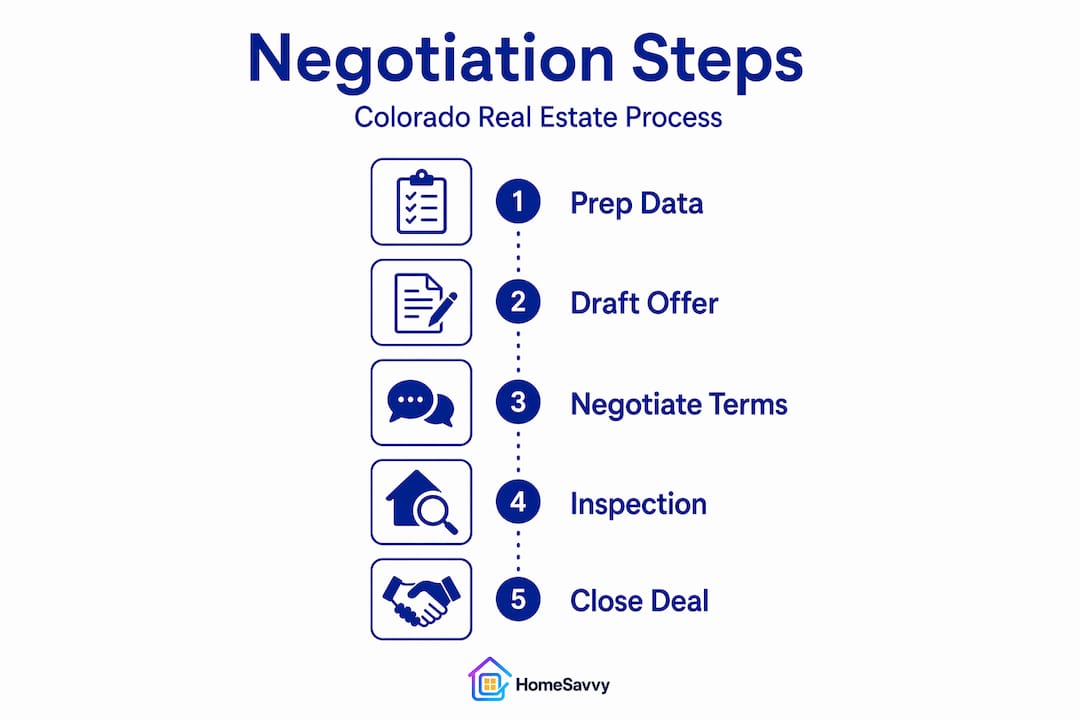
Once you're at the table, how you execute matters as much as what you know. Here's a practical framework for effective real estate strategies during active deal negotiations:
- Separate emotion from the transaction. A home is an asset. React to data, not attachment. If a counteroffer frustrates you, sleep on it before responding.
- Ask open-ended questions. "What matters most to you in this transaction?" often surfaces priorities that price alone can't address, like a leaseback period or a specific inclusion.
- Structure creative solutions. A 60-day option with a breakup fee can resolve disputes where buyer and seller disagree on value, giving the seller time to find a better offer while protecting the buyer with a defined exit.
- Use concessions strategically. Instead of lowering your ask, offer an inspection credit, a rate buydown contribution, or prepaid HOA dues. These often have the same financial impact but feel less like losing to the other party.
- Know your walk-away point. Before any negotiation, decide the maximum price or minimum concession you'll accept. Write it down. When pressure builds, that number protects you.
- Handle competing offers with discipline. In bidding wars, the temptation to win emotionally is strong. Winning in bidding wars requires a ceiling and a strategy, not just enthusiasm.
- Use your agent as a buffer. A good agent keeps direct emotional exchanges out of the negotiation and maintains a professional tone that keeps both sides at the table.
"Most real estate negotiation is less about price and more about converting inspection issues into contract remedies." This is where Colorado buyers and sellers consistently leave money on the table.
Inspection negotiations often come down to choosing remedies: repair, credit, or accepting the condition as-is within the resolution window. Buyers who understand this distinction and ask for credits rather than repairs almost always get better outcomes. Sellers retain control over contractors, and buyers get cash flexibility. It's a structure that works for both sides.
For buyers working through Colorado transactions, understanding your rights as a represented buyer can significantly sharpen how you use these tactics.
Common negotiation pitfalls to avoid
Even experienced buyers and sellers make costly mistakes in Colorado real estate deals. Recognizing these patterns before they happen is what separates successful negotiators from frustrated ones.
- Letting desperation show. If a seller knows you've lost three other offers and love this house, your leverage disappears. Keep your enthusiasm private.
- Missing written objection deadlines. Informal communication has no legal effect under Colorado contract terms. A verbal conversation with the listing agent about inspection concerns does not protect you.
- Waiving contingencies carelessly. In hot markets, waiving inspection or appraisal contingencies feels necessary. Sometimes it is. But understand exactly what you're giving up before you do it.
- Focusing only on price. Contract terms, timelines, and included items carry real financial value. A buyer who wins on price but accepts unfavorable terms may still lose the negotiation.
- Skipping scenario practice. Scenario-based training sharpens negotiation skills more than any theory. Walk through likely counteroffers with your agent before submitting an offer.
- Ignoring market data until it's too late. Preparation needs to happen before the offer, not during a counteroffer standoff.
Statistic to know: NAR research consistently shows that facts and evidence form the credibility backbone of effective negotiation. Showing up with market data in hand is not optional. It's what separates offers that get taken seriously from ones that get ignored.
Colorado buyers can get a useful head start by reviewing the Colorado real estate checklist to understand exactly what to verify before and during the negotiation phase.
Finalizing your deal with confidence
Getting to an accepted offer is only the beginning. The steps between contract execution and closing are where deals quietly fall apart if you're not paying attention.
- Confirm all contingency deadlines in writing. As soon as your contract is executed, map every deadline onto a calendar. Inspection objection, appraisal, and financing contingency dates are non-negotiable.
- Formalize every negotiated term. If a seller agrees to credit $5,000 for repairs, that number needs to appear in a signed contract amendment. Verbal agreements are legally meaningless in Colorado.
- Clear contingencies on time. Don't wait until the last day. Submit your written contingency removal or objection with buffer time so your agent can confirm receipt.
- Coordinate closing details early. Title, lender, and inspection schedules should all be aligned by the midpoint of your contract period.
- Handle last-minute issues calmly. Appraisal shortfalls or surprise inspection findings close to closing are stressful, but they're rarely deal-enders if both parties approach them with practical solutions rather than reactions.
Pro Tip: Ask your agent to do a final compliance review three to five days before closing to catch any unsigned amendments or missing documentation before it becomes an emergency.
My take on what actually moves the needle
I've watched a lot of Colorado real estate transactions, and the pattern I keep seeing is this: buyers and sellers who prepare obsessively and stay emotionally neutral almost always walk away satisfied. The ones who struggle are rarely under-prepared on price. They're under-prepared on contract mechanics.
Here's what surprises most people. The Colorado inspection process is where the most money is actually negotiated, and yet it's the part where emotion runs highest. A buyer who feels wronged by a cracked foundation gets angry. An angry buyer writes a sloppy objection, misses a deadline, or demands a repair instead of a credit and then watches the deal collapse. I've seen it happen more than once.
What I've learned is that the most effective negotiators treat inspection findings as business data. They convert every finding into a dollar figure, stack those figures into a formal objection packet, and submit it cleanly before the deadline. That's it. No drama, no ultimatums.
I'm also a strong believer that most people focus too much on the offer price and too little on the contract language around it. A seller who grants a 15-day leaseback has arguably given more than one who dropped the price $3,000. Context matters. Terms matter. Price is just the headline.
Creative deal structures, like the timed option approach described by Harvard's Program on Negotiation, rarely come up in standard Colorado deals. But they should. When buyer and seller are $20,000 apart on value and both are dug in, a structured option period with a defined breakup fee is often the move that gets everyone to the closing table.
— Rishi
How Homesavvycolorado gives you a negotiation edge
Negotiating with confidence starts with knowing your numbers. Homesavvycolorado's PropertyIQ home valuation tool gives buyers and sellers real-time AI-powered pricing data so you never walk into a negotiation guessing. You'll know what comparable homes sold for, how long they sat on the market, and where the true leverage lies.

For buyers, Homesavvycolorado's commission rebate program puts real money back in your pocket at closing, money you can use to cover inspection credits, buydown contributions, or closing costs. For sellers, the 1% listing service means you keep more of what you negotiate. Every dollar saved on fees is a dollar that strengthens your position. Pair these tools with full-service agent support and you get the research, guidance, and advocacy to negotiate like a professional from day one.
FAQ
What is the most important thing in a real estate negotiation?
Preparation and data. Facts and evidence form the credibility backbone of any negotiation, and buyers or sellers who arrive with market data consistently achieve better outcomes than those who rely on instinct alone.
How do Colorado inspection deadlines affect negotiations?
Buyers must submit written inspection objections before the inspection termination deadline to preserve their right to negotiate or terminate. Verbal conversations have no legal effect and missing this deadline removes your leverage entirely.
Should buyers ask for repairs or credits during inspection negotiations?
Asking for credits almost always produces better outcomes than requesting repairs. Inspection remedies in Colorado include repair, credit, or acceptance as-is, and credits give buyers cash flexibility while letting sellers avoid contractor coordination.
When should you walk away from a real estate negotiation?
Walk away when the deal no longer meets the financial or practical criteria you defined before the negotiation started. Decide your walk-away point before submitting any offer, write it down, and honor it regardless of emotional pressure to close.
What are effective tactics in a competitive Colorado bidding war?
Use an escalation clause with a defined ceiling, strengthen your offer with significant earnest money, and secure mortgage preapproval before submitting. Escalation clauses and preapproval signal seriousness to sellers without forcing you to voluntarily overpay.