

Fiduciary duty in real estate is defined as the highest legal standard of care that binds an agent to act in a client's best interests above all else, including the agent's own financial gain. For Colorado homebuyers and sellers, defining real estate fiduciary duty is not an abstract legal exercise. It determines whether your agent is legally obligated to protect you or simply required to be polite. The National Association of Realtors (NAR), Colorado state licensing laws, and common-law agency principles all recognize this duty as the foundation of the agent-client relationship. Understanding it before you sign anything is the smartest move you can make.
What is real estate fiduciary duty?
Fiduciary duty is the highest standard of care legally requiring agents to put clients' interests above their own and any third party. That word "highest" matters. It is not a general professional courtesy. It is a legal obligation with real consequences for agents who ignore it.
The standard term you will see in Colorado licensing law and legal documents is "fiduciary duty," not "agent loyalty" or "client care." Both the industry and courts use this term precisely, so knowing it helps you read contracts and representation agreements with confidence.
Fiduciary duty transforms an agent into a legally bound advocate that shields clients from complex transaction risks and information asymmetry. Think of it this way: when you hire a fiduciary agent, you are not just hiring someone to open doors and write offers. You are hiring someone who is legally required to fight for your outcome, not theirs.
What are the six fiduciary duties agents owe clients?
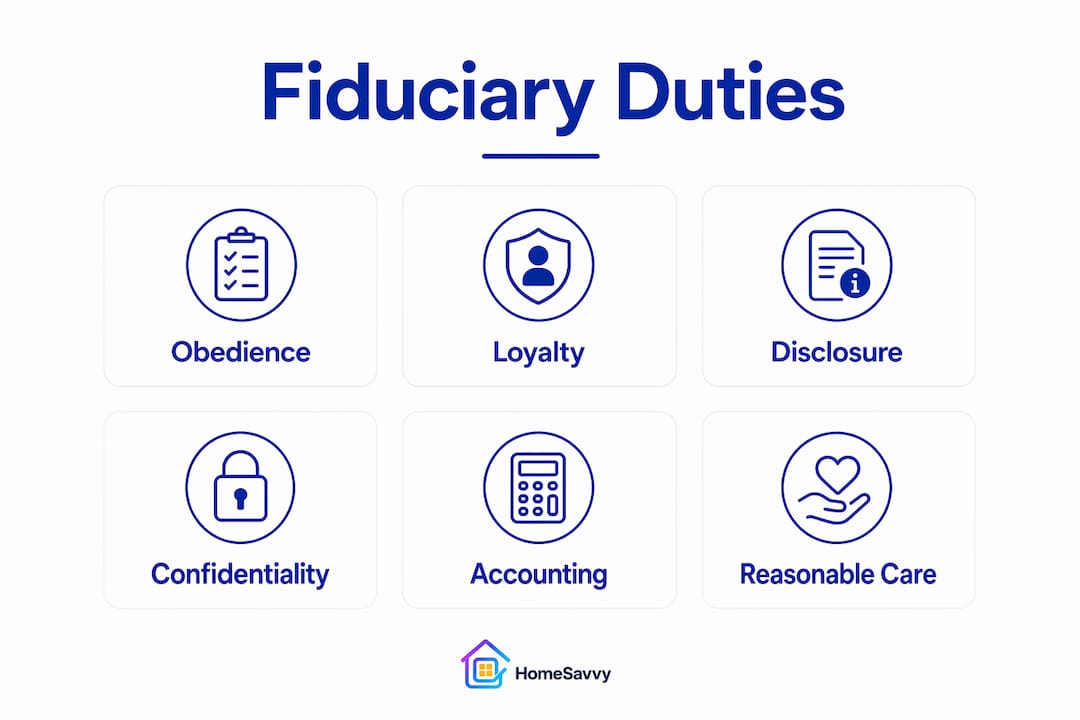
Real estate fiduciary duties legally bind agents to six core obligations summarized by the acronym OLD CAR. These duties are codified in most state license laws, and a breach can trigger legal liability and professional discipline. Here is what each one means in practice for Colorado transactions.
- Obedience: Your agent must follow your lawful instructions, even if they personally disagree. If you tell your agent not to disclose your move-out timeline to the seller, that instruction stands.
- Loyalty: Your agent must place your interests first. An agent who steers you toward a property because they earn a higher commission on it violates this duty directly.
- Disclosure: Your agent must share all material facts that could affect your decision. In Colorado, this includes known property defects, neighborhood zoning changes, and any relationship the agent has with the other party.
- Confidentiality: Your agent cannot share your sensitive information, such as your maximum budget or motivation to sell quickly, with the opposing party. This duty does not end when the transaction closes.
- Accounting: Your agent must account for all money and documents entrusted to them. Earnest money, escrow funds, and transaction documents must be handled with full transparency.
- Reasonable Care: Your agent must apply professional skill and diligence throughout the transaction. Missing a contract deadline or failing to recommend an inspection violates this duty.
Pro Tip: Print the OLD CAR acronym and keep it with your transaction documents. When something feels off, run it against this list. If your agent's action violates any of these six duties, you have grounds to raise a formal concern.
Confidentiality and accounting duties typically survive after the agency relationship ends, requiring ongoing protection of client information and funds. Many clients assume these duties expire at closing. They do not.

| Duty | What It Requires | Survives Termination? |
|---|---|---|
| Obedience | Follow lawful client instructions | No |
| Loyalty | Prioritize client interests above all | No |
| Disclosure | Share all material facts | No |
| Confidentiality | Protect sensitive client information | Yes |
| Accounting | Manage funds and documents transparently | Yes |
| Reasonable Care | Apply professional skill throughout | No |
How does fiduciary duty protect colorado buyers and sellers?
Fiduciary duty is the legal mechanism that prevents your agent from using your own information against you. Without it, the agent-client relationship would be no different from a sales transaction where the agent's goal is simply to close a deal.
Here is how each protection plays out in real Colorado scenarios:
- Loyalty prevents self-dealing. Undisclosed conflicts of interest, such as an agent purchasing a client's property without consent, are direct violations of loyalty. In Colorado, an agent who makes an offer on your listing without full written disclosure is committing a breach with serious legal consequences.
- Confidentiality protects your negotiating position. If you tell your agent you will accept $20,000 below asking price, that information stays with your agent. Sharing it with the buyer's agent is a textbook breach.
- Disclosure protects your financial decisions. Your agent must tell you about known material defects, even if the seller has not volunteered them. Colorado's disclosure laws reinforce this duty at the state level.
- Breach carries real penalties. Breach of fiduciary duties leads to consequences including forced profit restitution, personal financial liability, loss of license, and professional penalties. These are not theoretical risks. Colorado real estate license holders face discipline from the Colorado Division of Real Estate for verified breaches.
"Good faith is not optional legal fluff. Bad faith actions by an agent, including willful ignorance or intentional neglect, violate the duty of loyalty and are legally actionable."
The importance of fiduciary duty in real estate becomes clearest when a deal gets complicated. Multiple offers, inspection disputes, and title issues all create pressure points where an agent without a legal obligation to you might make choices that serve their commission rather than your outcome.
What are common misconceptions about fiduciary duty?
The most damaging misconception is that hiring an agent means handing over your decision-making authority. It does not. An agent legally cannot make decisions for the client but acts as a dedicated advocate. Clients retain control over major transactional decisions including pricing, offer amounts, and whether to proceed with an inspection.
Your agent advises. You decide. That distinction matters enormously.
Here are the other misconceptions that cost Colorado buyers and sellers the most:
- "My agent owes me fiduciary duties from our first conversation." Wrong. Without a formal buyer or seller representation agreement, agents owe only limited duties such as honesty and fair dealing, not full fiduciary obligations. The duties activate when you sign a representation agreement.
- "All agents at an open house owe me fiduciary duties." The listing agent at an open house represents the seller. They owe you honesty, but not loyalty. You are a customer, not a client, until you sign a buyer representation agreement.
- "Dual agency gives me full protection." Dual agents owe limited duties and must disclose their dual role in writing. When one agent represents both buyer and seller, neither party receives full fiduciary protection. Colorado permits dual agency only with written informed consent from both parties.
- "Fiduciary duty means I don't have to stay involved." Fiduciary duty acts as a legal safety net but requires informed client participation. Your agent cannot force you to read the inspection report or attend the final walkthrough. That responsibility stays with you.
Pro Tip: Before your first property tour in Colorado, ask the agent directly: "Are you representing me as a buyer's agent, or are you a transaction broker?" The answer changes your legal protections significantly.
How do you secure proper fiduciary representation in colorado?
Knowing your fiduciary rights means nothing if you do not take steps to activate and protect them. These are the moves that actually matter before and during a Colorado transaction.
- Sign a written representation agreement before touring homes. Formal representation agreements increasingly become mandatory before property tours to activate fiduciary duties. Colorado's updated buyer agreement requirements align with this national trend. Do not tour homes with an agent who has not committed to representing you in writing.
- Ask direct questions before hiring an agent. Ask: "Will you represent me as a fiduciary?" and "Have you ever represented both buyer and seller in the same transaction?" Their answers reveal their understanding of fiduciary obligations in real estate.
- Know the signs of a breach. Watch for agents who pressure you to skip inspections, discourage you from making lower offers, or seem unusually close to the other party. These are red flags that loyalty may be compromised.
- Use Colorado realtor boards when problems arise. The Colorado realtor boards enforce professional standards and provide a formal complaint process. Filing a complaint with the Colorado Division of Real Estate is the correct channel for documented breaches.
- Understand agency type before signing anything. Review whether your agent is a buyer's agent, seller's agent, transaction broker, or dual agent. Each carries a different scope of fiduciary obligations. Learning about buyer agent duties in Colorado before you commit to representation is time well spent.
Only clients with formal agency agreements receive full fiduciary duties. Customers receive lesser duties like honesty and fair dealing only. That single fact should motivate every Colorado buyer and seller to get their representation agreement signed before the process begins.
Key takeaways
Fiduciary duty is the legal foundation of every Colorado real estate transaction, and activating it requires a signed representation agreement before any property tours begin.
| Point | Details |
|---|---|
| OLD CAR defines the six duties | Obedience, Loyalty, Disclosure, Confidentiality, Accounting, and Reasonable Care are the six legally binding fiduciary obligations. |
| Duties activate with a signed agreement | Without a formal representation agreement, agents owe only basic honesty, not full fiduciary protection. |
| Confidentiality survives closing | Your agent must protect your sensitive information even after the transaction ends. |
| Dual agency limits your protection | Dual agents owe reduced duties to both parties and must disclose their role in writing under Colorado law. |
| Clients remain the decision-makers | Fiduciary duty does not transfer decision authority to your agent. You approve every major transaction choice. |
Why fiduciary duty is the most underused protection in colorado real estate
By Rishi
After working through hundreds of Colorado real estate transactions, the pattern I see most often is not agents acting in bad faith. It is clients who never understood what they were entitled to in the first place.
Most buyers and sellers walk into a transaction thinking their agent is "on their side" because they seem friendly and responsive. That is not fiduciary duty. That is customer service. The legal obligation only kicks in when you have a signed representation agreement, and most people sign that document without reading a single line of it.
The part that surprises people most is the confidentiality duty surviving termination. I have seen situations where a deal fell apart and the agent, no longer under contract, casually shared the client's original offer price with the new listing agent. That is a breach. The client had no idea they were still protected.
My honest observation is that fiduciary duty is only as powerful as the client's willingness to invoke it. The law gives you real leverage. But you have to know it exists, ask the right questions upfront, and stay engaged throughout the process. Passive clients get passive representation, fiduciary duty or not.
The role of full-service agents in Colorado has never been more scrutinized than it is right now. Use that scrutiny to your advantage. Ask harder questions. Demand written agreements. And treat fiduciary duty not as legal fine print but as the most valuable clause in your entire transaction.
— Rishi
How Homesavvycolorado puts fiduciary duty to work for you
Homesavvycolorado was built on the belief that Colorado buyers and sellers deserve full fiduciary representation without paying inflated commissions for it. Every agent in the Homesavvycolorado network operates under a signed representation agreement and a clear commitment to the OLD CAR standard.

Sellers can list for just 1% with a full-service agent who is legally bound to your best outcome, not a quick close. Buyers can access significant commission rebates at closing while working with an agent who owes them complete loyalty, disclosure, and confidentiality. Homesavvycolorado also provides AI-powered property valuation tools so you walk into every negotiation with real data behind you. Fiduciary protection and financial savings are not a trade-off here. You get both.
FAQ
What does fiduciary duty mean in real estate?
Fiduciary duty in real estate is the highest legal standard of care, requiring an agent to prioritize a client's interests above their own. It includes six specific obligations: Obedience, Loyalty, Disclosure, Confidentiality, Accounting, and Reasonable Care.
When does fiduciary duty begin in colorado?
Fiduciary duty begins when you sign a formal buyer or seller representation agreement with an agent. Before that agreement is signed, agents owe only basic duties like honesty and fair dealing.
What happens if an agent breaches fiduciary duty?
A breach can result in forced profit restitution, personal financial liability, loss of the agent's real estate license, and professional discipline from the Colorado Division of Real Estate.
Does fiduciary duty apply to dual agents in colorado?
Dual agents owe limited fiduciary duties to both parties and must disclose their dual role in writing. Neither the buyer nor the seller receives the full protection they would get from an exclusive representative.
Do fiduciary duties end when the transaction closes?
Most duties end at closing, but confidentiality and accounting obligations survive termination of the agency relationship. Your agent cannot legally share your sensitive transaction information after the deal is done.