

Real estate agents are defined as authorized representatives who negotiate property transactions on behalf of their clients, balancing client interests against legal obligations, market realities, and their own professional incentives. In Colorado, the role of agents in negotiations has grown more complex in 2026, with new informed consent rules reshaping how agents handle confidential information during deal-making. Whether you are buying or selling a home along the Front Range or in mountain communities, understanding what your agent can and cannot do at the negotiating table directly affects your outcome.
How does the principal-agent relationship shape real estate negotiations?
The principal-agent relationship is the foundational dynamic in every real estate negotiation. You are the principal. Your agent is the agent. You delegate authority to negotiate on your behalf, and your agent exercises that authority within agreed limits. The problem is that your goals and your agent's goals are not always identical.

Agents face a conflict of interest risk because their financial incentives can diverge from yours. A listing agent who earns a percentage commission has a financial reason to close quickly, even if holding out longer would net you a higher sale price. A buyer's agent might push you toward a deal that meets their timeline rather than your ideal terms. These conflicts are not always intentional. Even ethical, experienced agents can unconsciously prioritize their own interests when the pressure is on.
Here is where the incentive misalignment shows up most clearly in Colorado real estate:
- Price pressure on sellers. An agent earning 1% of a $50,000 price difference earns $500 more. You lose $49,500. The math rarely motivates agents to fight hard for the last dollar.
- Concession timing. Agents may recommend accepting repair credits or closing cost concessions faster than necessary to keep a deal alive.
- Multiple offers. In competitive markets like Denver or Boulder, agents sometimes steer clients toward the "cleanest" offer rather than the highest one, because it is easier to close.
The solution is not to distrust your agent. Clients should pre-define negotiation decision thresholds that agents must follow, including walkaway prices, acceptable concession ranges, and timeline priorities. When your agent knows your hard limits upfront, there is far less room for misaligned judgment calls.
Pro Tip: Before your agent submits or responds to any offer, write down your minimum acceptable price or maximum offer ceiling and share it in writing. This creates accountability and removes ambiguity during fast-moving negotiations.
What impact do Colorado's 2026 informed consent rules have on agent negotiations?
Colorado made a significant regulatory change on January 1, 2026. Colorado brokers must now obtain informed consent before sharing confidential client information with supervising brokers. The Colorado Real Estate Commission removed prior contract language that allowed this sharing without client permission. This is not a minor procedural update. It changes how negotiation information flows inside brokerages.
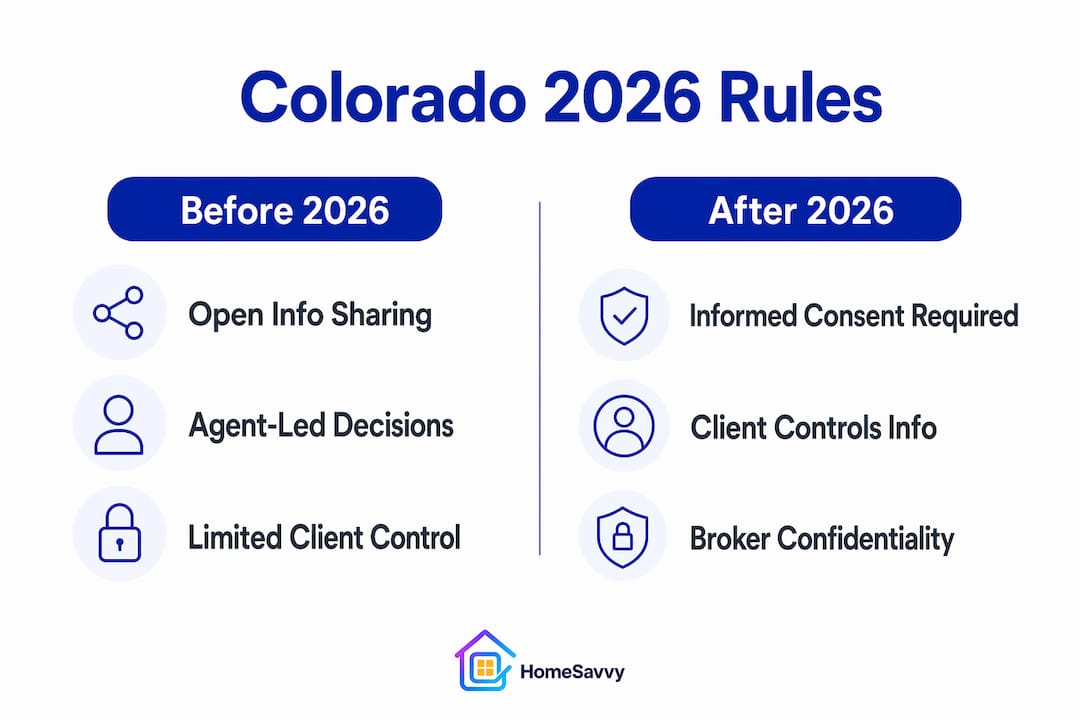
Confidential client information includes your motivation for buying or selling, your price limits, your timeline urgency, and any personal circumstances driving the transaction. Previously, a buyer's agent could freely discuss these details with their managing broker to get guidance on negotiation strategy. Now, that conversation requires your explicit permission first.
The practical effect on negotiation is real. Colorado's broker-to-broker confidentiality rules limit how agents can leverage client information internally, which means agents must be more deliberate about what they share and with whom. This protects you from accidental disclosure but also means your agent may have less internal support when crafting a negotiation strategy.
Here is a direct comparison of how the rules changed:
| Scenario | Before January 1, 2026 | After January 1, 2026 |
|---|---|---|
| Agent shares your price ceiling with managing broker | Permitted without your consent | Requires your written informed consent |
| Supervising broker advises on negotiation using your motivations | Standard practice | Only allowed after client permission |
| Internal brokerage communication about your timeline urgency | Unrestricted | Restricted to need-to-know with consent |
| Agent discusses your walkaway point with team members | Common in team environments | Requires explicit client authorization |
This table shows that the 2026 rules shift more control to you as the client. Your agent now needs to ask before sharing sensitive details, even internally. Colorado's evolving confidentiality requirements mean agents must ask permission before sharing client motivations or price limits beyond the immediate need-to-know chain.
Pro Tip: When your agent asks for consent to share your information with their supervising broker, ask specifically what information will be shared and why. Informed consent is your right. Use it to stay in control of your negotiation position.
How do agents influence negotiation outcomes for homebuyers and sellers?
The practical influence of a skilled negotiation agent goes well beyond writing offers. Agents in real estate negotiate through communication, authority management, and ethical constraints, not just verbal back-and-forth. Understanding the specific ways agents shape outcomes helps you evaluate whether your agent is performing at the level you need.
Here are the core ways agents directly influence your negotiation results:
- Offer framing and timing. A skilled agent knows when to submit an offer immediately and when to wait. In Colorado's competitive markets, submitting within hours of a listing can signal serious intent. Waiting 48 hours in a slow market can signal leverage.
- Concession sequencing. Experienced agents do not give concessions all at once. They release them strategically, trading smaller items first to preserve larger ones for critical moments in the negotiation.
- Inspection negotiation. After a home inspection, the negotiation restarts. Agents who understand Colorado's AS IS addendum and repair request norms can recover thousands of dollars for buyers or protect sellers from inflated repair demands.
- Confidentiality management. A good agent reveals only what strengthens your position. Disclosing that you are relocating by a fixed date, for example, hands the other party leverage they will use.
- Counter-offer strategy. Agents who understand the psychology of anchoring know that the first number in a negotiation sets the reference point. Skilled agents anchor high for sellers and low for buyers, then move deliberately.
Hiring an experienced agent improves negotiation quality but requires careful alignment of incentives to avoid conflicts. The agent's value is highest when your priorities are clearly communicated and your agent has the market knowledge to execute. For Colorado buyers, this means working with someone who tracks active inventory, days on market, and price reduction patterns in your specific target area. For sellers, it means an agent who knows comparable sales at the neighborhood level, not just the zip code.
You can also find detailed guidance on Colorado real estate negotiations to understand what to expect at each stage of the process.
How do the 5 C's and the 70/30 rule apply to Colorado real estate agents?
Negotiation theory gives agents a practical framework for representing clients effectively. Two of the most applicable frameworks in real estate are the 5 C's of negotiation and the 70/30 listening rule. Both are directly relevant to how your agent should behave at the table.
The 5 C's of negotiation are Clarity, Communication, Collaboration, Compromise, and Commitment. Each one maps directly to a real estate negotiation scenario:
- Clarity. Your agent must communicate your offer terms without ambiguity. Vague language in a purchase contract creates disputes at closing. Colorado contracts are detailed for this reason, and your agent's job is to make sure every term reflects your actual intent.
- Communication. Agents who respond slowly or communicate poorly lose deals. In Colorado's active markets, a listing agent who does not return calls within hours can cost a buyer the property. Communication speed is a negotiation tool.
- Collaboration. The best deals are not won by crushing the other side. Agents who find creative solutions, such as flexible closing dates, rent-back agreements, or seller concessions structured as closing credits, create outcomes both parties accept.
- Compromise. Every negotiation involves give and take. Your agent's job is to identify which items you can concede without material loss and which ones you must protect. Giving up a home warranty to preserve the price is a calculated compromise.
- Commitment. Once terms are agreed, your agent must follow through on every contractual obligation and deadline. In Colorado, missed deadlines can trigger contract termination rights for the other party.
The 70/30 rule advises listening 70% of the time and talking 30%, using open-ended questions to gather information. For real estate agents, this means asking the listing agent what the seller's priorities are rather than immediately stating your client's position. An agent who learns that the seller needs a 60-day closing can offer that flexibility in exchange for a price reduction. Information gathered through listening becomes negotiation leverage.
You can review how buyer representation in Colorado works in practice to see how these principles translate into real transaction savings.
Key takeaways
Effective agent representation in Colorado requires aligning incentives, respecting 2026 confidentiality rules, and applying structured negotiation principles to protect your price and terms.
| Point | Details |
|---|---|
| Define your limits upfront | Give your agent written walkaway prices and concession ranges before negotiations begin. |
| Understand the 2026 consent rules | Your agent now needs your permission before sharing confidential information with their supervising broker. |
| Incentive misalignment is real | Even ethical agents may favor a faster close over your best financial outcome. |
| Listening is a negotiation tool | Agents using the 70/30 rule gather leverage by asking questions before revealing your position. |
| Confidentiality protects your leverage | Never disclose your timeline urgency or price ceiling to the other party through your agent. |
What I've learned about trusting your agent at the negotiating table
By Rishi
After working with Colorado buyers and sellers across dozens of transactions, the single biggest mistake I see is clients who treat their agent as a passive messenger rather than a strategic partner. You hired your agent to represent you, but representation only works when you give them the right information and the right authority.
The 2026 informed consent rules are actually a gift to clients who pay attention. When your agent asks for permission to share your details internally, that is your moment to ask what they plan to share and why. Most clients sign without thinking. The ones who ask questions end up with agents who are more careful, more deliberate, and more accountable.
I also think the principal-agent conflict is underestimated in Colorado's market. Agents are not villains, but the commission structure creates real pressure to close. The fix is simple: define your priorities in writing before the first offer goes out. Tell your agent your price floor, your timeline, and your non-negotiables. When those are on paper, your agent has a clear mandate and you have a basis for accountability.
The clients who get the best outcomes are not the ones who negotiate the hardest themselves. They are the ones who brief their agents thoroughly, stay informed about what is being shared and with whom, and treat negotiation as a team effort with clear rules of engagement.
— Rishi
How Homesavvycolorado helps you negotiate smarter

Homesavvycolorado combines AI-powered market data with full-service agent support specifically designed to align agent incentives with your goals. For sellers, the 1% listing service means your agent earns a fair fee without the pressure to close fast at a lower price. For buyers, the commission rebate program puts money back in your pocket at closing. Every Homesavvycolorado agent operates with transparent negotiation practices and real-time property data, so you know exactly where you stand before, during, and after every offer. Contact Homesavvycolorado to discuss your negotiation strategy before your next transaction.
FAQ
What is the role of agents in negotiations?
Agents act as authorized representatives who negotiate property terms on behalf of their clients, managing communication, concessions, and confidentiality while operating within legal and ethical limits. Their effectiveness depends on how clearly clients define their priorities and how well agent incentives align with client goals.
How do Colorado's 2026 rules affect agent negotiations?
Starting January 1, 2026, Colorado brokers must obtain informed consent before sharing confidential client information with supervising brokers. This limits how freely agents can discuss your price limits or motivations internally, which protects your negotiation leverage.
How can I tell if my agent is negotiating effectively?
Look for agents who ask questions before revealing your position, sequence concessions strategically, and communicate your terms with precision. Agents applying the 5 C's framework and the 70/30 listening rule consistently produce better outcomes for clients.
What confidential information should I protect during negotiations?
Your timeline urgency, maximum purchase price or minimum sale price, and personal circumstances driving the transaction are the details that give the other party leverage. Share these only with your agent and only after confirming they will not be disclosed without your consent.
How do I reduce principal-agent conflicts with my real estate agent?
Define your walkaway price, acceptable concession ranges, and timeline priorities in writing before negotiations begin. Pre-defined decision thresholds reduce the risk of your agent making judgment calls that favor their interests over yours.