

If you've accepted an offer or are under contract on a Colorado home, you've probably heard the word "closing" thrown around constantly. But what is a real estate closing, exactly? It's the final step in a real estate transaction where legal ownership of the property transfers from seller to buyer. Money changes hands, documents get signed, and the deed gets recorded with the county. For many buyers and sellers, this moment is exciting but also confusing. This guide breaks down every stage of the real estate closing process in Colorado so you know exactly what to expect.
Table of Contents
- Key takeaways
- The real estate closing process and timeline in Colorado
- What happens at closing: signing, funds, and ownership transfer
- Closing costs in Colorado: who pays what
- The final walkthrough before closing
- Roles and responsibilities at closing
- My honest take on Colorado closings
- How Homesavvycolorado helps you close with confidence
- FAQ
Key takeaways
| Point | Details |
|---|---|
| Closing transfers ownership | The deed is signed, recorded with the county, and ownership officially changes hands at closing. |
| Timeline runs 30 to 45 days | From offer acceptance to closing day, most Colorado transactions take between 30 and 45 days. |
| Buyer closing costs run 2% to 5% | For a $400,000 home, buyers can expect to pay between $8,000 and $20,000 in closing costs. |
| Closing Disclosure arrives 3 days early | Buyers must receive this document at least 3 business days before closing to review final loan terms. |
| Final walkthrough happens last | Buyers should inspect the home 24 to 48 hours before closing to confirm condition and any agreed repairs. |
The real estate closing process and timeline in Colorado
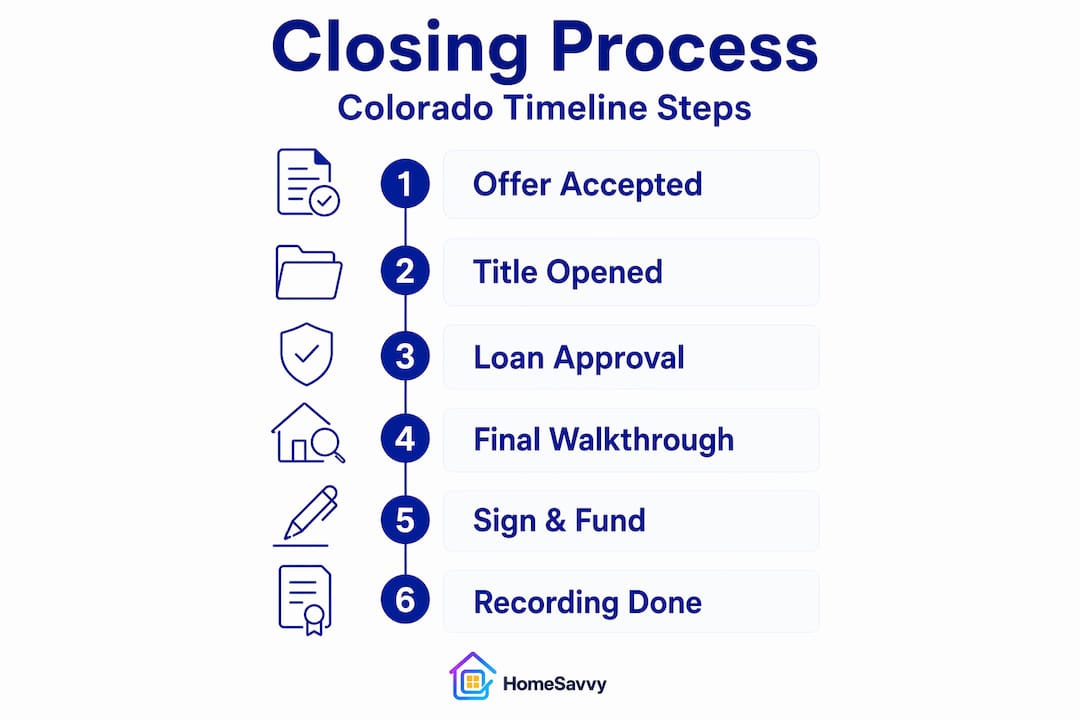
Understanding what a real estate closing involves starts with knowing the timeline. In Colorado, most transactions close within 30 to 45 days after an offer is accepted. That window covers a lot of ground, and knowing the milestones helps you stay ahead of problems rather than react to them.
Here's the general sequence of steps in closing a home in Colorado:
- Loan application and approval. Your lender verifies income, assets, and credit. This often takes the longest.
- Home inspection. Completed within the first few days after contract. Buyers review the inspection report and negotiate repairs.
- Appraisal. The lender orders an appraisal to confirm the home's value supports the loan amount. Common appraisal mistakes can slow this step if the property is unusual or the comps are thin.
- Title search and title insurance. A title company examines public records to confirm the seller has clear legal ownership and no outstanding liens.
- Closing Disclosure review. Under federal TRID rules, the Closing Disclosure must arrive at least 3 business days before closing so you can compare final costs to your original Loan Estimate.
- Final walkthrough. Done 24 to 48 hours before closing to verify property condition.
- Closing day. Documents are signed, funds are transferred, and the deed is recorded with the Colorado county clerk.
In Colorado, the title company plays a central role. It coordinates document collection, holds escrow funds, and handles deed recording after signing. Your agent and lender are also active throughout, but the title company is typically running the clock.
Pro Tip: Ask your title company for a preliminary closing disclosure at least a week before closing. Reviewing numbers early gives you time to question any fees that look wrong before you're sitting at the signing table.
What happens at closing: signing, funds, and ownership transfer
Closing day itself typically runs one to two hours. You'll sit down with a closing agent (usually from the title company), and the signing process finalizes the entire transaction. Here's what each party actually handles.
What buyers sign and bring:
- Government-issued photo ID (bring two forms to be safe)
- Certified or cashier's check, or confirmation of a wire transfer for down payment and closing costs
- Signed loan documents, including the promissory note and deed of trust
- Acknowledgment of the Closing Disclosure
- Any additional lender-required documentation
What sellers sign and bring:
- The deed transferring ownership to the buyer
- Seller's settlement statement showing proceeds and deductions
- Any required repair completion documentation
- HOA transfer documents if applicable
- Keys, garage openers, and access codes
Once both parties sign, the title company coordinates fund disbursement. The buyer's down payment and loan proceeds go to the seller, after all fees and payoffs are deducted. Then comes the step that makes everything legally official: deed recording with the county. Until the deed is recorded, ownership has not technically transferred. In Colorado, recording typically happens the same day or the next business day after signing.
At or near recording, the title company issues two title insurance policies. The lender's policy protects the mortgage company. The owner's policy protects the buyer against any future claims on the title going back before the purchase date.

Pro Tip: Don't wire funds based on email instructions unless you've called the title company directly to verify. Wire fraud targeting real estate closings is a real threat in Colorado and across the country.
Closing costs in Colorado: who pays what
Closing costs catch many buyers and sellers off guard because no one line item feels that large, but they add up fast. Buyer closing costs typically run 2% to 5% of the home's purchase price. On a $400,000 Colorado home, that's $8,000 to $20,000.
Here's a breakdown of typical cost categories and who normally pays each:
| Cost item | Typically paid by | Typical range |
|---|---|---|
| Loan origination fees | Buyer | 0.5% to 1% of loan |
| Appraisal fee | Buyer | $500 to $700 |
| Title insurance (owner's policy) | Negotiable, often seller in Colorado | $800 to $1,500 |
| Title insurance (lender's policy) | Buyer | $500 to $1,000 |
| County recording fees | Buyer | $13 to $25 per document |
| Real estate commissions | Seller | 2% to 5% of sale price |
| Property tax prorations | Split based on closing date | Varies |
| Transfer taxes | Varies by county | 0.01% to 0.02% |
Colorado does not have a high state transfer tax, which keeps seller costs lower than in many other states. That said, buyer and seller cost splits can shift based on mortgage type, local custom, and what was negotiated in the contract.
One way sellers can reduce what they lose at closing is by looking at discount listing options that cut commission without cutting service quality. Commission is often the single largest seller cost at closing, so even a one-point reduction makes a real difference.
The final walkthrough before closing
The final walkthrough is not a second inspection. It's a verification step. You're not looking for new problems; you're confirming the home is in the condition you agreed to buy it in. Buyers typically complete this 24 to 48 hours before closing.
What to check during your final walkthrough:
- All agreed repairs have been completed (request receipts or documentation)
- Appliances included in the sale are working
- No new visible damage since your inspection
- The home has been cleaned and is free of the seller's belongings
- Utilities are still on so you can test HVAC, plumbing, and electrical
- Garage doors, window locks, and exterior access points work properly
If you find a problem during the walkthrough, you have options. You can delay closing, negotiate a credit, or have the seller address the issue before you sign. Walking away is also possible but rarely necessary for minor items.
For a thorough preparation checklist, the Colorado real estate checklist from Homesavvycolorado covers both walkthrough prep and the broader purchase process in detail.
Roles and responsibilities at closing
One of the most common points of confusion is who is actually doing what during the closing process. Here's a clear breakdown.
The buyer's responsibilities include securing final loan approval, reviewing and signing all documents, providing certified funds, and completing the final walkthrough. Buyers should come to closing with a clear understanding of every number on their settlement statement.
The seller's responsibilities include delivering the deed and clearing any outstanding liens or judgments, providing required disclosures, and vacating the property per the agreed terms. Sellers also work with their agent to confirm that the title company has everything needed to close on time.
Buyer and seller agents coordinate between all parties, keep the transaction on schedule, and handle last-minute issues. A good buyer's agent in Colorado will review the Closing Disclosure with you, flag any discrepancies, and make sure you understand what you're signing. The listing agent does the same for the seller.
The title company is arguably the most important party at the closing table. According to Colorado closing practice guidance, the title company coordinates document signing, holds and disburses funds, and handles deed recording to finalize the transaction. Nothing closes without them.
The lender sends final loan documents to the title company, confirms the loan is cleared to close, and funds the loan on closing day. If the lender has a last-minute condition, it can delay closing by hours or even days, which is why getting all lender requirements in early is worth the effort.
My honest take on Colorado closings
I've watched a lot of buyers and sellers walk into closing thinking it's just a formality. It is not. The documents you sign on closing day are legally binding, and the costs you pay are often final. Getting there informed makes an enormous difference in how smoothly the day goes.
The single most common mistake I've seen is skipping a real review of the Closing Disclosure. Reviewing the disclosure early is what separates buyers who close confidently from those who feel pressured to sign things they don't understand. TRID rules give you three full business days before closing. Use every hour of that time.
I also think the final walkthrough is dramatically underused. Buyers treat it like a quick formality, spend 15 minutes in the house, and miss things they would have caught with a thorough check. That's the last moment you have leverage before ownership transfers. Treat it seriously.
The other thing I've come to believe strongly: who you work with at closing matters more than most people think. A title company that has handled hundreds of Colorado closings will navigate a title defect or last-minute lender delay without breaking a sweat. A less experienced one might let that same problem blow up the deal. Ask your agent who they trust, and take that recommendation seriously.
— Rishi
How Homesavvycolorado helps you close with confidence
Understanding the closing process is one thing. Having the right team and tools behind you is another. Homesavvycolorado combines AI-powered property insights with experienced local agent support so you go into closing with clear numbers and zero surprises.

Use the PropertyIQ home valuation tool to understand exactly what a property is worth before you get to the closing table. For sellers, Homesavvycolorado's 1% listing service reduces the commission you pay at closing, which is often your largest single expense. Whether you're buying or selling, having agents who know Colorado's closing requirements means fewer delays, fewer surprises, and more money staying in your pocket.
FAQ
What is a real estate closing in simple terms?
A real estate closing is the final step in a property sale where ownership legally transfers from seller to buyer. Documents are signed, funds are exchanged, and the deed is recorded with the county to complete the transaction.
How long does closing take in Colorado?
Most Colorado real estate closings take 30 to 45 days from accepted offer to closing day. The actual signing appointment typically lasts one to two hours.
What documents do buyers need at closing?
Buyers need a government-issued photo ID, certified funds or wire transfer confirmation, signed loan documents, and acknowledgment of the Closing Disclosure. Bringing two forms of ID is a safe practice.
Who pays closing costs in Colorado?
Buyers typically cover loan fees, the lender's title insurance policy, appraisal costs, and recording fees, totaling 2% to 5% of the purchase price. Sellers typically cover real estate commissions and may contribute to the owner's title insurance policy depending on what was negotiated.
What happens if a problem is found during the final walkthrough?
If a problem is found during the final walkthrough, buyers can negotiate a credit, require the seller to fix the issue before closing, or in serious cases request a delay. Most minor issues are resolved quickly through a credit at the closing table.