

A commission split is the method used to divide real estate commissions between agents and their brokerages, determining who earns what from a property sale. For Colorado homebuyers and sellers, understanding how this division works clarifies why agents behave the way they do and what your total transaction costs actually cover. The real estate commission structure shapes every deal, yet most buyers and sellers never see the internal math. This guide breaks it down clearly, with Colorado home prices in mind.
What is commission split in real estate?
A commission split is the agreed percentage of a transaction's total commission that each party receives after a home sale closes. The industry term for the governing document is the Independent Contractor Agreement, or ICA, which outlines exactly how commissions are divided between an agent and their brokerage. The split is not set by Colorado state law. It is a private contract between the agent and the brokerage they hang their license with.
Standard residential commissions run 5–6% of the sale price, split roughly 50/50 between the listing brokerage and the buyer's brokerage. Each brokerage then splits its share again with the individual agent who did the work. On a $600,000 Colorado home at 6% commission, the total commission is $36,000. Each brokerage receives $18,000 before the internal agent split is applied.

The commission split explained this way reveals two distinct layers. The first layer is the brokerage-to-brokerage division. The second layer is the agent-to-broker division inside each firm. Buyers and sellers pay the total commission at closing. The internal split is invisible to them, but it directly shapes the service they receive.
How are real estate commission splits structured between agents and brokerages?
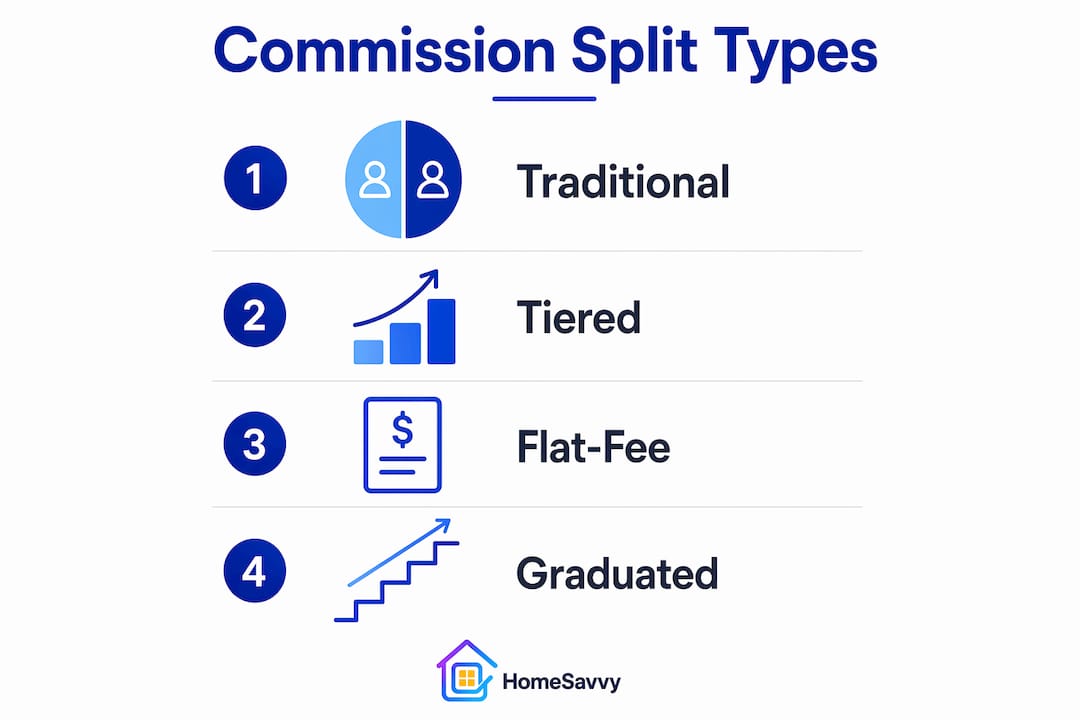
Commission split structures fall into three main categories: traditional percentage splits, tiered or graduated splits, and flat-fee models. Each one affects how much an agent takes home per transaction and how motivated they are to close deals efficiently.
Traditional percentage splits
Traditional splits divide the agent's side of the commission by a fixed ratio. New agents typically keep 50–60% of their side, mid-level agents keep 65–75%, and top producers keep 80–90% or more. A new agent earning 50% on an $18,000 brokerage share takes home $9,000. A top producer at 90% takes home $16,200 from the same transaction. Experience pays, literally.
Tiered and graduated splits
Tiered splits reward production volume. An agent starts the year at a lower split, say 60%, and moves to 70% or 80% after hitting a sales milestone. Graduated splits increase retention rates because agents have a financial reason to stay with the brokerage and close more deals. This model is common at larger regional brokerages across Colorado's Front Range markets.
Flat-fee models
Flat-fee brokerages charge agents a fixed amount per transaction, often $500–$1,500, regardless of the sale price. This model benefits high-volume agents significantly. An agent closing 30 transactions a year at a $1,000 flat fee pays $30,000 to the brokerage. At a 30% traditional split on average Colorado commissions, that same agent could pay far more. The math favors flat fees at high production levels.
| Split model | How it works | Best for |
|---|---|---|
| 50/50 traditional | Agent keeps 50% of brokerage share | New agents needing support |
| 70/30 traditional | Agent keeps 70% of brokerage share | Mid-level agents |
| 80/20 or 90/10 | Agent keeps 80–90% | Top producers |
| Tiered/graduated | Split increases with sales milestones | Growth-focused agents |
| Flat fee per deal | Fixed dollar amount per transaction | High-volume agents |
Pro Tip: Commission splits are negotiable after onboarding. If you are an agent with a track record of closed deals, bring your production numbers to the conversation. Brokerages routinely improve splits for agents who demonstrate consistent volume.
How is the total commission typically divided in a Colorado real estate transaction?
Colorado home prices vary widely, from starter condos in Pueblo to luxury properties in Aspen and Vail. The commission math scales with the price, which makes understanding the full division especially relevant for buyers and sellers in this state.
The table below shows how commission distribution works at two common Colorado price points, using a 6% total commission and a 50/50 brokerage split.
| Sale price | Total commission (6%) | Each brokerage receives | Agent at 70% split | Broker keeps 30% |
|---|---|---|---|---|
| $500,000 | $30,000 | $15,000 | $10,500 | $4,500 |
| $750,000 | $45,000 | $22,500 | $15,750 | $6,750 |
The listing brokerage and the buyer's brokerage each receive their half at closing. Each brokerage then pays its agent according to the ICA. The agent who listed the home and the agent who brought the buyer each walk away with their negotiated share. The commission distribution process is handled through escrow and title companies, so the money flows correctly without the client needing to manage it.
One detail Colorado buyers often miss: the buyer's agent commission is typically built into the seller's total commission obligation. The seller funds both sides. Buyers do not write a separate check for their agent's compensation in most standard transactions.
What variations exist in commission splits based on brokerage types and agent experience?
Not all brokerages operate the same way, and the type of brokerage an agent works with shapes the split structure significantly. Colorado has a mix of traditional full-service brokerages, virtual brokerages, and flat-fee firms, each with a different value proposition for agents.
Traditional brokerages like those affiliated with national brands offer office space, training, marketing tools, and administrative support. They take a larger share of the commission in exchange. Virtual brokerages operate with lower overhead and pass more of the commission to agents, often at 80–90% splits from day one. The tradeoff is less hands-on mentorship and fewer in-person resources.
Higher splits are not always better for less experienced agents. A brokerage with strong training, lead generation, and transaction support can produce higher net income for a new agent even at a 50/50 split. The support infrastructure closes more deals, which matters more than the percentage when you are starting out.
Commission caps add another layer to this calculation. A commission cap is the annual maximum an agent pays to their brokerage. Once an agent hits the cap, they keep 100% of commissions for the rest of the year. Caps reset annually and are a major financial advantage for high-producing Colorado agents who close consistently through the spring and summer selling seasons.
Team-based splits complicate the picture further. Team structures divide commissions among the brokerage, the team leader, and the individual agent. A buyer's agent on a team might keep only 40–50% of their side after the team leader and brokerage take their shares. The tradeoff is a steady flow of leads and operational support that solo agents must generate themselves.
Key factors to evaluate when comparing brokerage split offers:
- Split percentage and cap structure: What is the starting split, and at what dollar amount does the cap kick in?
- Lead generation support: Does the brokerage provide buyer and seller leads, or does the agent source their own?
- Training and mentorship: Is there structured onboarding for new agents or continuing education for experienced ones?
- Transaction coordination: Does the brokerage handle paperwork and compliance, or does the agent manage it alone?
- Marketing resources: Are listing tools, photography, and advertising included or billed separately?
How do commission splits impact homebuyers and sellers in Colorado?
The commission split does not change the total amount a seller pays or a buyer indirectly funds. Total commission cost to clients stays fixed at the agreed rate in the listing contract. The internal split is an arrangement between agents and their brokerages, not a variable that inflates the client's bill.
What the split does affect is agent incentive and service quality. Clients benefit most when agents have clear commission arrangements that align their financial interests with delivering results. An agent on a generous split with strong brokerage support has every reason to close your deal efficiently and at the best price.
Transparency in commission agreements matters at closing. Undocumented or unclear splits cause disputes that delay or derail closings. Colorado buyers and sellers should ask for written confirmation of how commissions are distributed before signing any listing or buyer representation agreement.
Discount models and rebate programs change the equation for clients directly. A seller listing with a 1% listing agent instead of a traditional 3% listing agent saves a meaningful amount on a Colorado home sale. A buyer working with a Colorado rebate agent receives a portion of the buyer's agent commission back at closing, reducing net purchase costs.
Key questions Colorado buyers and sellers should ask their agent:
- What is your commission rate, and how is it split with your brokerage?
- Does your brokerage offer any rebate or discount programs?
- Is your commission arrangement documented in writing before we proceed?
- Are there any team members who will share in the commission, and what do they provide?
Pro Tip: Ask your agent directly what percentage of the commission they personally keep. An agent keeping 90% of a 3% buyer's commission has a very different financial profile than one keeping 50%. That context helps you evaluate the service level you can expect and whether a buyer's agent arrangement is structured in your favor.
Key takeaways
Commission splits are the internal mechanism that determines agent pay, and understanding them helps Colorado buyers and sellers evaluate agent incentives, service quality, and total transaction costs accurately.
| Point | Details |
|---|---|
| Total commission rate | Colorado transactions typically carry a 5–6% total commission funded by the seller at closing. |
| Two-layer split structure | Commission divides first between brokerages, then again between each brokerage and its agent. |
| Split varies by experience | New agents keep 50–60%; top producers keep 80–90% or more, based on their ICA. |
| Caps benefit high producers | Annual commission caps let high-volume agents keep 100% of commissions after hitting the threshold. |
| Clients pay a fixed total | The internal split does not increase client costs; it only determines how agents and brokers share the pie. |
What I've learned about commission splits after years in Colorado real estate
Most buyers and sellers I talk to assume the commission split is someone else's problem. They sign the listing agreement, see the total percentage, and move on. That mindset costs them clarity they deserve.
Here is what I have seen repeatedly: agents with lower splits at well-resourced brokerages often outperform agents with high splits at bare-bones firms. The support infrastructure, the lead pipeline, and the transaction coordination matter more than the percentage on paper. A new agent keeping 90% of nothing closes fewer deals than a supported agent keeping 60% of a full pipeline.
The bigger issue for Colorado buyers and sellers is transparency. I have watched closings get complicated because nobody documented the commission arrangement clearly upfront. Written commission agreements before any work begins are not optional. They protect everyone at the table.
My honest advice: ask your agent how their split works. Not to judge them, but to understand their incentives. An agent who explains it clearly and confidently is an agent who operates with integrity. One who deflects or gets defensive is worth a second look. Colorado's market moves fast. You want someone whose financial interests align with yours from day one.
— Rishi
How Homesavvycolorado puts commission transparency to work for you
Colorado buyers and sellers deserve to know exactly where their commission dollars go. Homesavvycolorado was built on that principle.
Sellers can list for 1% with Homesavvycolorado, keeping more equity instead of paying traditional listing fees. Buyers can access the commission rebate program and get a meaningful portion of the buyer's agent commission back at closing. The PropertyIQ AI Home Valuation tool gives you real-time data on Colorado home values so you negotiate from a position of knowledge, not guesswork. Every tool and service Homesavvycolorado offers is designed to make commission structures work in your favor, not against you.
FAQ
What is a commission split in real estate?
A commission split is the agreed division of a real estate commission between an agent and their brokerage, governed by an Independent Contractor Agreement. It determines how much of the total commission each party keeps after a transaction closes.
How much of the commission does a real estate agent actually keep?
Agent retention varies by experience: new agents typically keep 50–60%, mid-level agents keep 65–75%, and top producers keep 80–90% or more of their brokerage's share.
Does the commission split affect what I pay as a buyer or seller in Colorado?
No. The total commission paid by the seller is fixed in the listing contract. The internal split between agent and brokerage does not change that amount.
What is a commission cap?
A commission cap is the annual maximum dollar amount an agent pays to their brokerage. After hitting the cap, the agent keeps 100% of commissions for the remainder of the year, making it a significant advantage for high-volume producers.
Can I negotiate a lower commission as a Colorado seller?
Yes. Sellers can negotiate listing commission rates directly, and discount models like 1% listing services are available in Colorado through firms like Homesavvycolorado, offering full service at a reduced fee.