

Real estate comps, formally known as comparable sales, are recently sold properties with similar features that serve as the primary benchmark for estimating a home's market value. Buyers, sellers, agents, and appraisers all rely on comps to anchor pricing decisions in objective market data rather than guesswork. Explaining real estate comps clearly matters because a misread comp can cost a seller thousands in lost equity or push a buyer into an overpriced offer. This guide covers what makes a valid comp, how to analyze them, and how Colorado homeowners can use them to negotiate with confidence.
What criteria determine a reliable real estate comparable in Colorado?
A reliable comp shares six core characteristics with the subject property: location, size, condition, property type, sale date, and bedroom and bathroom count. Miss any one of these, and the comparison loses credibility fast.
Location is the most critical factor. A home two blocks away on a cul-de-sac and a home on a busy arterial road are not the same comp, even if they share an identical floor plan. Colorado neighborhoods like Washington Park in Denver or Old Town Fort Collins carry micro-location premiums that a zip code search alone will never capture.

Size comes next. A valid comp falls within 10–15% of the subject property's square footage. A 2,000 square foot home should only be compared to homes between roughly 1,700 and 2,300 square feet. Wider gaps distort price-per-square-foot calculations and weaken the valuation.
Sale date sets the time boundary. Comps sold within 90 days are the gold standard, with a six-month window as the standard upper limit. In slower Colorado mountain markets or low-inventory periods, appraisers may stretch to 12 months, but they note that adjustment explicitly.
Additional criteria include:
- Property type: Single-family homes, condos, and townhomes each require their own comp pool. Mixing types distorts value.
- Condition and age: A fully renovated 1980s ranch and an unrenovated one are not equivalent comps without significant adjustments.
- Bedroom and bathroom count: A three-bedroom, two-bath home should not be compared to a four-bedroom, three-bath without accounting for the difference.
- Data source: About 90% of appraisers use the MLS as their primary source, then cross-check with public records to catch listing errors.
Pro Tip: When pulling comps in Colorado, always check whether a sale was an arm's-length transaction. Foreclosures, estate sales, and family transfers often sell below market and will skew your analysis downward if included without adjustment.
How do you find and analyze real estate comps effectively?
Finding comps starts with the MLS, the most complete database of sold properties. Public platforms like Zillow and Redfin offer sold data too, but their records can lag or omit off-market transactions. For the most accurate picture, pair MLS searches with county assessor records.
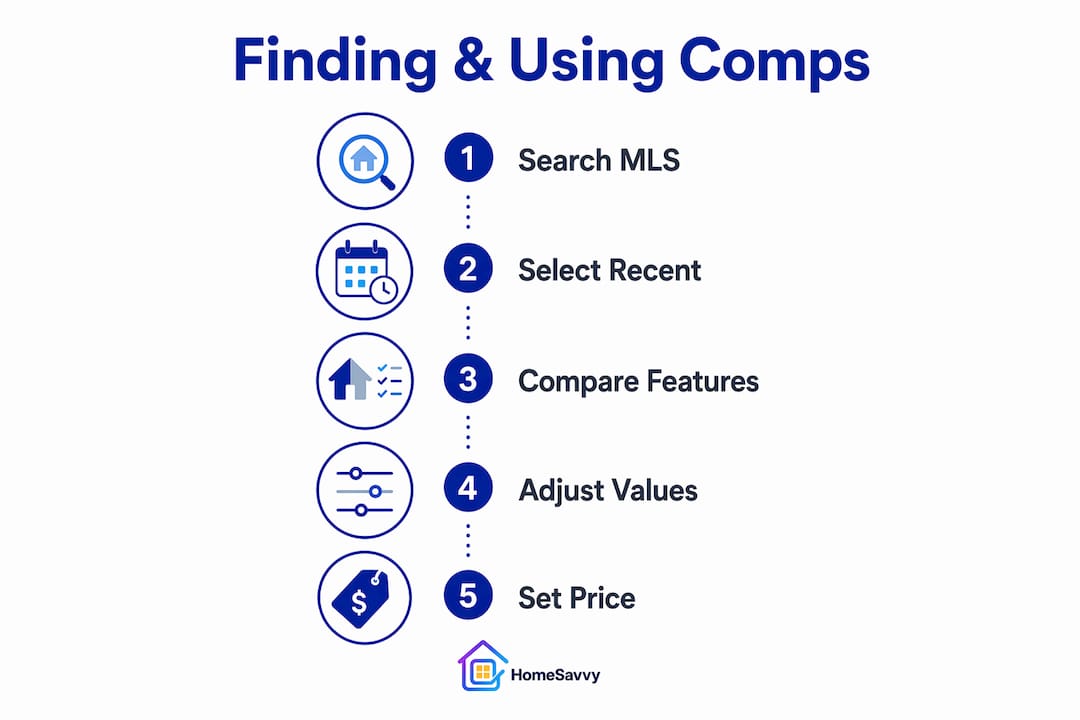
The number of comps you review matters as much as which ones you choose. Agents and appraisers analyze 6–10 comps rather than the minimum three. More comps reduce the influence of outliers and reveal pricing patterns that a small sample hides. This is especially true in Colorado's varied markets, where a single distressed sale can drag an average down significantly.
A solid analysis process looks like this:
- Set your search filters. Start with a half-mile radius, the same property type, and a 90-day sale window. Expand only if you cannot find at least six valid comps.
- Calculate price per square foot for each comp. Divide the sale price by the finished square footage. This creates a normalized unit for comparison.
- Note the range, not just the average. A range of $280–$340 per square foot tells you more than an average of $310. It shows market spread and where your property might land.
- Check market timing. A comp from six months ago in a rising market understates current value. Apply a monthly appreciation rate if the local market has moved noticeably.
- Cross-check with public records. MLS data cross-checked with public records prevents errors from listing inaccuracies or outdated information.
- Separate active listings from sold data. Active listings show current competition but should not anchor your valuation. Only closed sales confirm what buyers actually paid.
Pro Tip: Do not rely on price per square foot alone. Relying solely on price per square foot without adjustments for differences leads to flawed valuations. A finished basement, a three-car garage, or a mountain view all add value that the raw number ignores.
How do adjustments work when comps are not identical?
No two properties are identical. Adjustments are the mechanism appraisers and agents use to account for differences between a comp and the subject property. The goal is always to move the comp's sale price toward what it would have sold for if it were identical to the subject.
The adjustment direction is straightforward. If a comp has a superior feature, subtract that feature's value from the comp's price. If the comp lacks something the subject property has, add that value back. The result is an adjusted sale price that reflects an apples-to-apples comparison.
Common features that require adjustment include:
| Feature | Comp is superior | Comp is inferior |
|---|---|---|
| Garage (extra bay) | Subtract value | Add value |
| Pool | Subtract value | Add value |
| Lot size | Subtract value | Add value |
| Kitchen renovation | Subtract value | Add value |
| Bedroom count | Subtract value | Add value |
Fannie Mae sets hard limits on how far adjustments can go. Net adjustments must stay within 15% and gross adjustments within 25% of the comp's sale price. A comp that requires adjustments beyond those thresholds is disqualified, regardless of how similar it looks on paper. This rule protects the integrity of the valuation and prevents appraisers from forcing a weak comp to fit.
When you review a Comparative Market Analysis (CMA) from an agent or a formal appraisal report, look at the adjustment column for each comp. Large adjustments signal a weak comp. A well-supported valuation uses comps that need only modest adjustments, which means the properties were genuinely similar to begin with. For a deeper look at how Colorado appraisers apply these standards, the Colorado appraisal guide covers the full methodology.
How do Colorado buyers and sellers use comps for pricing and negotiation?
Comps translate directly into dollars at the negotiating table. Sellers who price based on comps list closer to true market value, which means fewer price reductions and faster closings. Buyers who study comps before making an offer know exactly how much room they have to negotiate.
For sellers, the comp analysis should drive the list price, not justify it after the fact. A common mistake is cherry-picking the highest comps to support an aspirational price. Buyers and their agents will run the same analysis. If your list price sits above what comps support, expect low offers or no offers.
For buyers, comps serve as a reality check on both the asking price and the offer amount. If a home is listed at $650,000 but every comp in the neighborhood sold between $590,000 and $620,000, the data gives you a concrete basis for a lower offer. That conversation is far more productive than negotiating on emotion.
Micro-location factors like a cul-de-sac versus a busy street explain price differences that averages never capture. Identical floor plans in the same Colorado subdivision can differ by $100,000 or more based on these nuanced factors. Understanding the "why" behind a comp's price is as important as knowing the number itself.
Practical applications for Colorado buyers and sellers include:
- Sellers: Use comps to set a list price within the range the market will support, then position your home's upgrades to justify the upper end of that range.
- Buyers: Pull comps before touring a home, not after. Knowing the comp range before you fall in love with a property keeps your offer grounded.
- Both parties: Watch for outdated comps. Colorado's Front Range markets can shift quickly. A comp from eight months ago in a cooling market overstates current value.
- Investors: Multifamily properties are valued per door, not per square foot. Using the wrong unit of comparison produces a distorted valuation for income properties.
For buyers who want to understand how accurate data shapes decisions, the difference between a well-supported comp analysis and a rough estimate can mean tens of thousands of dollars at closing.
Key takeaways
Comps are only as reliable as the criteria used to select them. Proximity, size, condition, sale date, and property type all determine whether a comparable is genuinely useful or misleading.
| Point | Details |
|---|---|
| Sale date matters most | Use comps sold within 90 days; extend to six months only when inventory is low. |
| Analyze 6–10 comps minimum | More comps reduce outlier bias and reveal true market pricing patterns. |
| Adjustments have hard limits | Fannie Mae caps net adjustments at 15% and gross at 25%; comps beyond these limits are discarded. |
| Micro-location drives price gaps | Identical floor plans can differ by $100,000 or more based on street type, views, and neighborhood desirability. |
| Active listings are not comps | Only closed sales confirm what buyers actually paid; active listings show competition, not value. |
What Colorado's market taught me about reading comps
The most expensive mistake I see Colorado buyers and sellers make is trusting an automated valuation model as a substitute for a real comp analysis. Tools like Zillow's Zestimate are useful for a quick ballpark, but they cannot account for the fact that a home backing to a greenbelt in Highlands Ranch commands a premium that the algorithm assigns to every home on the block equally.
Colorado's market adds another layer of complexity. The Front Range, mountain resort towns, and rural Eastern Plains each behave like separate markets. A comp methodology that works in Denver's Congress Park neighborhood fails completely in Breckenridge, where seasonal demand, short-term rental income potential, and altitude all affect buyer behavior in ways that square footage and bedroom count do not capture.
I also caution against the "rule of three" mentality. Three comps can tell a story, but they can also be cherry-picked to tell any story you want. Analyzing a larger number of comps builds a more defensible valuation and helps identify market trends that reduce bias from outliers. When I see a CMA with exactly three comps, all chosen to support a high list price, I know the analysis was built backward.
The best comp work I have seen combines hard data with qualitative judgment. Experienced agents synthesize hard data with qualitative factors like neighborhood desirability and seasonal market timing to produce balanced pricing advice. That combination is what separates a defensible valuation from a number pulled from an algorithm.
— Rishi
Put your comp knowledge to work with Homesavvycolorado
Understanding comps is one thing. Having the right tools to run them accurately is another.

Homesavvycolorado's PropertyIQ AI valuation tool pulls real-time comparable sales data and applies local Colorado market context so you get a valuation grounded in what buyers are actually paying right now. Sellers can pair that analysis with Homesavvycolorado's 1% listing service to price competitively without overpaying in agent fees. Buyers working with Homesavvycolorado get access to the same comp data their agent uses, plus a commission rebate at closing. Smarter comp analysis and lower transaction costs belong in the same deal.
FAQ
What are real estate comps?
Real estate comps, short for comparable sales, are recently sold properties with similar features used to estimate a subject property's market value. Appraisers, agents, buyers, and sellers all use comps as the primary pricing benchmark.
How recent should comps be for a Colorado home valuation?
Comps sold within the last 90 days are the most reliable. In low-inventory Colorado markets, appraisers may extend the window to six or twelve months, but older comps require additional adjustments for market movement.
How many comps do I need for an accurate analysis?
Six to ten comps produce a more defensible valuation than the minimum three. Analyzing more comps reduces the influence of outliers and reveals pricing patterns across the local market.
What happens if a comp needs large adjustments?
Fannie Mae guidelines cap net adjustments at 15% and gross adjustments at 25% of the comp's sale price. A comp that exceeds these limits is disqualified and should be replaced with a more similar property.
Can I use Zillow or Redfin to find comps?
Public platforms provide a useful starting point, but MLS data cross-checked with county public records gives the most complete and accurate picture. Automated valuations on these platforms do not account for micro-location factors or property-specific adjustments.